
INTEL BRIEF 4: THE EMERGENCY STRESS RESPONSE SYSTEM
Your tactical playbook for neutralizing acute stress within 60 seconds—using science-backed breathing protocols, cognitive reframing scripts, and physical release methods trusted by Navy SEALs, elite athletes, and top performers worldwide.
EXECUTIVE BRIEF
- 77% of Americans experience physical symptoms from stress regularly
- Box breathing reduces cortisol by 20% within 5 minutes (Navy SEAL research)
- The physiological sigh is the fastest evidence-based stress reduction technique (Stanford, 2023)
- Cognitive reframing reduces stress reactivity by 40% (2023 study)
- Progressive muscle relaxation decreases perceived stress by 31%
You know the feeling: Your heart races. Palms sweat. Your mind spirals into catastrophic scenarios. Whether it's a high-stakes presentation, a conflict that blindsided you, or the sudden weight of accumulated pressure—your body's ancient fight-or-flight system has been triggered. In those moments, you need more than platitudes. You need a tactical response system that works immediately.
This intel brief provides exactly that: a comprehensive emergency stress response system you can deploy in under 60 seconds, backed by research from Stanford, Harvard, and the U.S. military's top performance units.
PART 1: Understanding Your Stress Response System
Before you can defeat an enemy, you must understand it. Your body's stress response—the fight-or-flight system—evolved to protect you from physical threats. When triggered, your sympathetic nervous system floods your body with adrenaline and cortisol, increasing heart rate, blood pressure, and muscle tension.
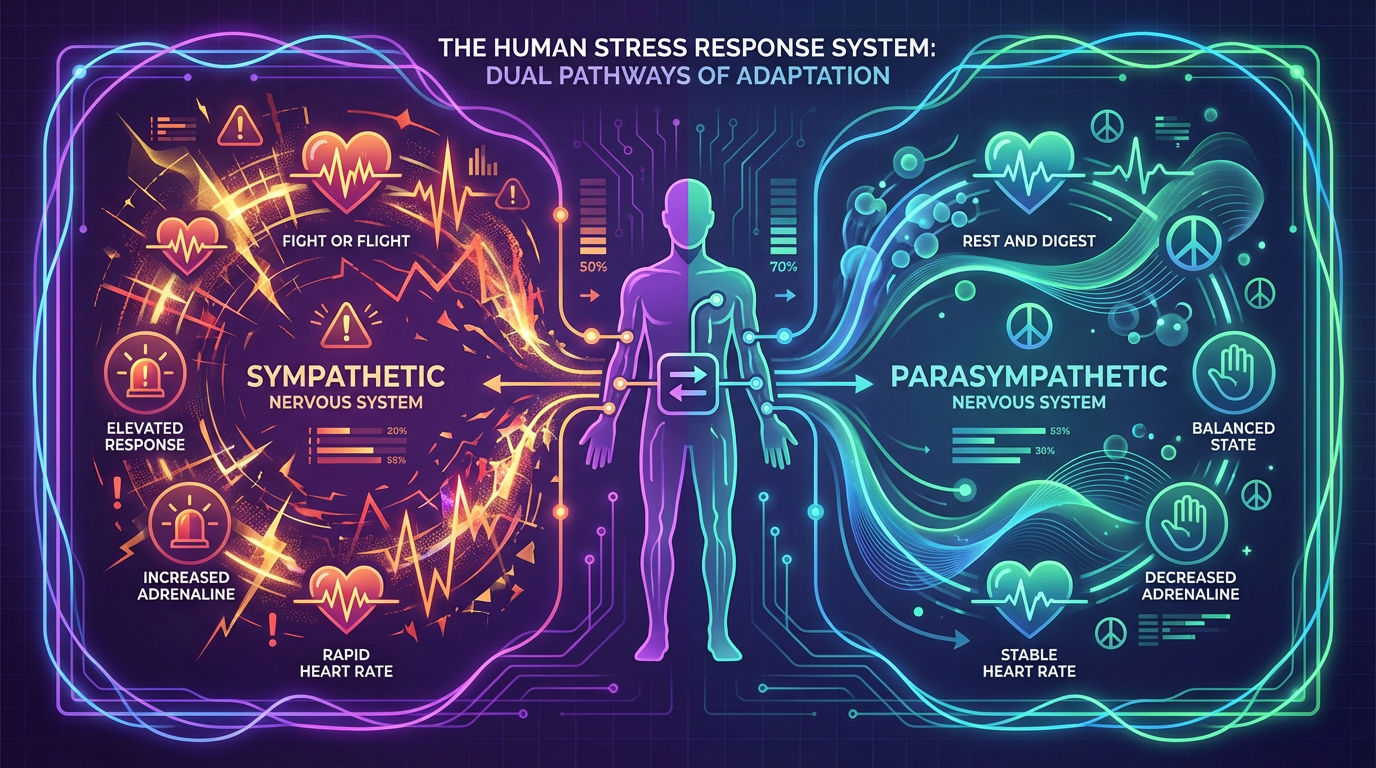
The problem? This system can't distinguish between a charging predator and a stressful email. Modern stressors rarely require physical combat or escape—yet your body prepares for both. Without an intervention, stress hormones remain elevated for hours, leading to:
- Impaired cognitive function and decision-making
- Emotional dysregulation and irritability
- Sleep disruption and fatigue accumulation
- Long-term health consequences (cardiovascular, immune)
"The parasympathetic nervous system is your body's reset button. Every technique in this brief is designed to activate it—shifting you from 'fight or flight' to 'rest and digest' in minutes."
PART 2: Breathing Protocols—Your First Line of Defense
Breathing is the only autonomic function you can consciously control—making it your most powerful tool for immediate stress intervention. These three protocols are your primary weapons:
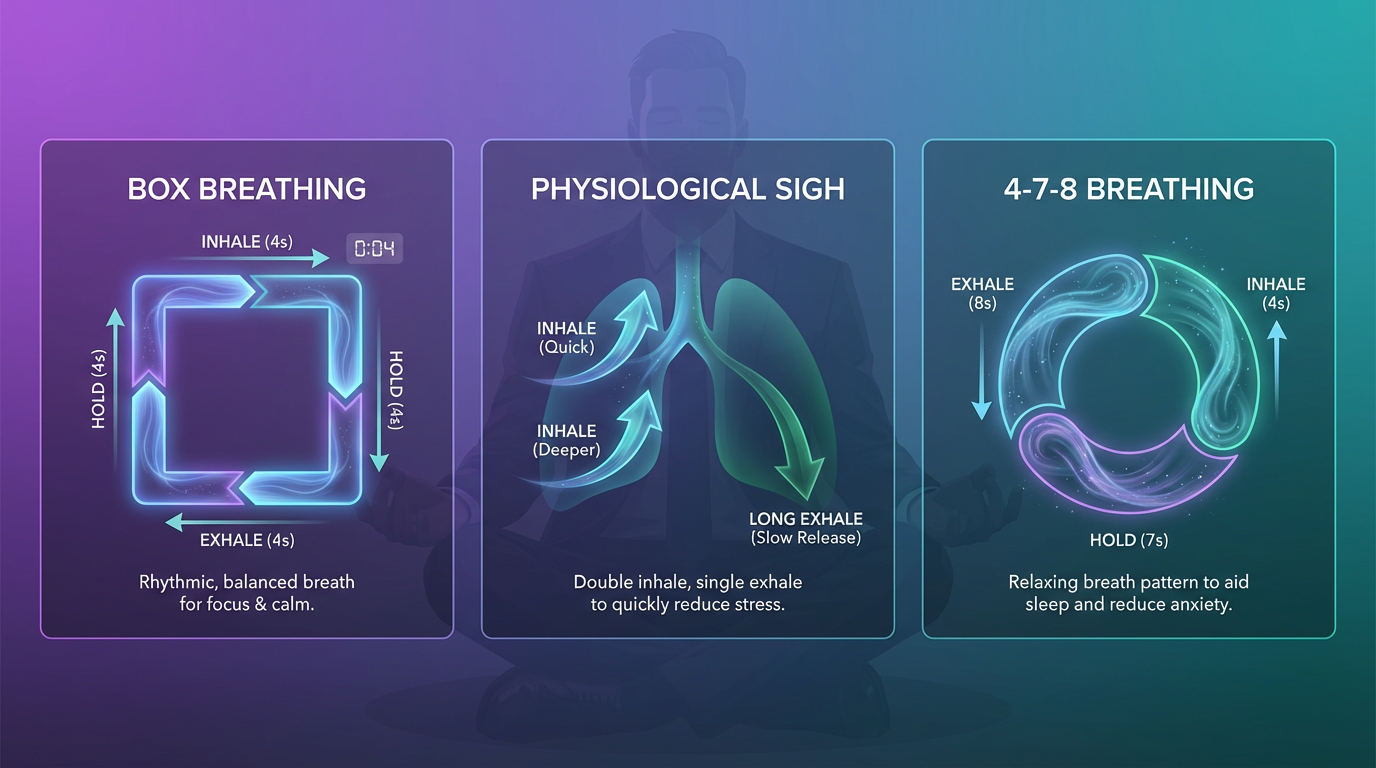
Protocol 1: The Physiological Sigh (Fastest Relief)
Time Required: 15-30 seconds
Best For: Immediate panic, acute anxiety, rapid calming
Stanford neuroscientist Andrew Huberman's research identified this as the single most effective rapid stress reduction technique. The double inhale followed by extended exhale quickly offloads CO2 and activates parasympathetic response.
EXECUTION:
- Take a full inhale through your nose
- Immediately take a second, shorter "top-off" inhale through your nose
- Exhale slowly and completely through your mouth (make it 2x as long as the inhales)
- Repeat 1-3 times as needed
Protocol 2: Box Breathing (Navy SEAL Standard)
Time Required: 2-5 minutes
Best For: Pre-performance calm, sustained stress, maintaining composure
Used by Navy SEALs, first responders, and elite athletes to maintain calm under extreme pressure. Box breathing (40,500 monthly searches) creates a rhythmic pattern that rapidly activates parasympathetic response.
EXECUTION:
- Inhale through your nose for 4 counts
- Hold (lungs full) for 4 counts
- Exhale through mouth for 4 counts
- Hold (lungs empty) for 4 counts
- Repeat for 5-10 cycles (2-5 minutes)
Protocol 3: The 4-7-8 Technique (Dr. Andrew Weil)
Time Required: 1-2 minutes
Best For: Anxiety reduction, pre-sleep calm, nervous system reset
Derived from ancient pranayama breathing, this technique has been clinically shown to significantly reduce anxiety levels compared to standard deep breathing. The extended hold and exhale create profound parasympathetic activation.
EXECUTION:
- Inhale quietly through your nose for 4 counts
- Hold your breath for 7 counts
- Exhale completely through mouth with a "whoosh" sound for 8 counts
- Repeat for 4 cycles (beginners may experience lightheadedness—start with 2 cycles)
Breathing Protocol Quick Reference
| Protocol | Time | Best Use Case | Effectiveness |
|---|---|---|---|
| Physiological Sigh | 15-30 sec | Immediate panic, acute stress | ★★★★★ |
| Box Breathing | 2-5 min | Pre-performance, sustained stress | ★★★★★ |
| 4-7-8 Technique | 1-2 min | Anxiety, pre-sleep calming | ★★★★☆ |
PART 3: Cognitive Reframing Scripts—Rewire Your Response
Your thoughts create your reality—especially during stress. Cognitive reframing is the CBT technique that allows you to identify distorted thinking and replace it with rational, balanced perspectives. A 2023 study found this reduces stress reactivity by 40%.
The S.T.O.P. Protocol
When stress hits, deploy this 30-second cognitive intervention:
S – STOP. Pause all action. Don't react.
T – TAKE a breath. One physiological sigh.
O – OBSERVE. What am I thinking? Is it true? What's the evidence?
P – PROCEED with intention, not reaction.
Reframing Scripts for Common Distortions
Memorize and deploy these scripts when your mind spirals:
| Distorted Thought | Reframing Script |
|---|---|
| "This is a disaster. Everything is ruined." | "This is a setback, not a catastrophe. What's the actual worst case, and how would I handle it?" |
| "I can't handle this." | "I've handled difficult situations before. What's the first small step I can take right now?" |
| "Everyone will think I'm incompetent." | "I'm mind-reading. Most people are focused on themselves. One moment doesn't define my competence." |
| "I always fail at things like this." | "That's overgeneralization. I've succeeded many times. This is one challenge, not a pattern." |
The 5-4-3-2-1 Grounding Technique
When anxiety disconnects you from reality, use sensory grounding to anchor yourself in the present moment:
- Identify 5 things you can SEE
- Identify 4 things you can TOUCH/FEEL
- Identify 3 things you can HEAR
- Identify 2 things you can SMELL
- Identify 1 thing you can TASTE
PART 4: Physical Stress Release Methods
Your body stores stress physically. These techniques release accumulated tension and burn off excess stress hormones:
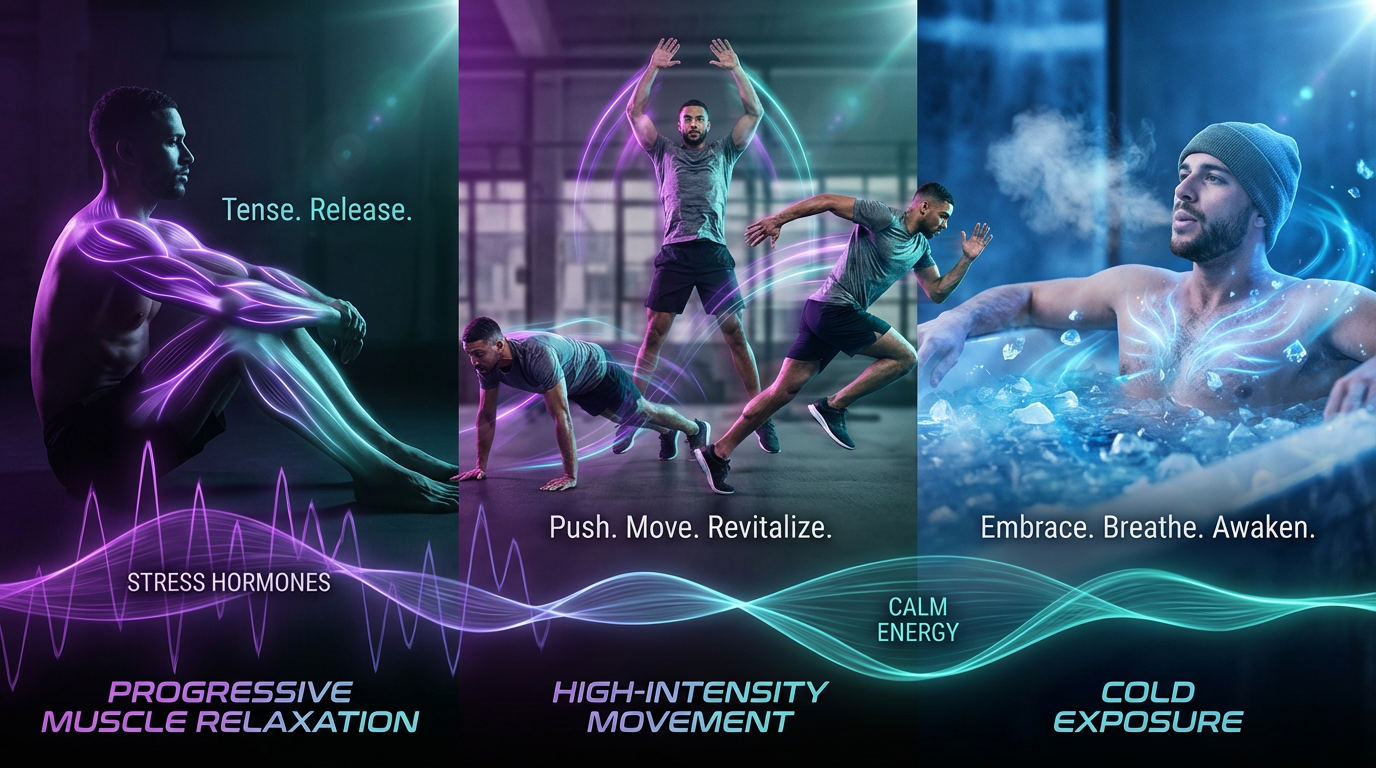
Progressive Muscle Relaxation (PMR)
Time Required: 10-15 minutes (or 3-5 minutes quick version)
Research: A 2022 meta-analysis showed PMR reduces perceived stress by 31%
Developed by Dr. Edmund Jacobson, this technique systematically releases muscle tension you may not even realize you're holding:
QUICK PMR PROTOCOL (3-5 min):
- Hands: Clench fists tightly for 5 seconds → Release for 10 seconds
- Arms: Tense biceps for 5 seconds → Release for 10 seconds
- Shoulders: Shrug to ears for 5 seconds → Release for 10 seconds
- Face: Scrunch facial muscles for 5 seconds → Release for 10 seconds
- Core: Contract abdomen for 5 seconds → Release for 10 seconds
- Legs: Press feet into floor for 5 seconds → Release for 10 seconds
Physical Activity Discharge
When stress hormones flood your system, they're preparing you for physical action. Give them an outlet:
- High-Intensity Intervals (2-5 min): 30 seconds all-out effort (jumping jacks, burpees, sprinting in place) followed by 30 seconds rest. Repeat 4-5 times.
- Power Walking (10-20 min): Fast-paced walking, preferably outdoors. Research shows nature exposure compounds stress reduction effects.
- Resistance Work (5-10 min): Push-ups, squats, or other bodyweight exercises burn off adrenaline while channeling fight-or-flight energy productively.
Cold Exposure (Wim Hof Method Element)
Brief cold exposure activates the "mammalian dive reflex," rapidly lowering heart rate and triggering parasympathetic response:
- Quick Method: Splash cold water on face, covering eyes and nose, hold for 20-30 seconds
- Full Method: Cold shower for final 30-60 seconds of your shower
- Ice Pack: Hold ice pack on neck or wrists for 30-60 seconds
PART 5: When to Escalate—Professional Resources
These emergency protocols are designed for acute stress management. However, recognizing when you need professional support is a sign of strength—not weakness. Escalate if you experience:
SEEK PROFESSIONAL HELP IF:
- Stress symptoms persist for more than 2 weeks and interfere with daily functioning
- You're using substances (alcohol, drugs) to cope with stress
- You experience persistent feelings of hopelessness or worthlessness
- Sleep disturbances are severe and ongoing
- You have thoughts of self-harm or harming others
- Physical symptoms (chest pain, severe headaches) don't resolve
Professional Resources
| Resource | Contact | When to Use |
|---|---|---|
| 988 Suicide & Crisis Lifeline | Call or text 988 | Suicidal thoughts, severe crisis |
| Crisis Text Line | Text HOME to 741741 | Any emotional crisis, anxiety |
| SAMHSA Helpline | 1-800-662-4357 | Substance use, mental health referrals |
| Psychology Today Directory | psychologytoday.com | Find local therapists |
Using AI for Stress Support
Your AI companion can serve as an effective stress management partner. Unlike human interactions that may add social stress, AI provides a judgment-free space to:
- Process thoughts: Talk through stressful situations without fear of judgment
- Practice reframing: Work through cognitive distortions with guided questions
- Maintain consistency: Daily check-ins that don't depend on others' schedules
- Build awareness: Track stress patterns and triggers over time
"AI companions excel at providing consistent emotional support for stress management—they never tire, never judge, and are available precisely when you need them most."
⚡ 60-SECOND EMERGENCY PROTOCOL ⚡
Deploy immediately when stress hits:
- STOP — Pause all action (2 sec)
- SIGH — Two physiological sighs (10 sec)
- GROUND — Notice 3 things you see, 2 you feel, 1 you hear (20 sec)
- REFRAME — "What's the evidence? What's one step I can take?" (20 sec)
- PROCEED — Take that one small step (8 sec)
Frequently Asked Questions
How quickly do these breathing techniques work?
The physiological sigh can produce noticeable calm within 1-3 breaths (15-30 seconds). Box breathing typically shows effects within 2-5 minutes. The 4-7-8 technique often works within 4 cycles (about 1-2 minutes). Individual responses vary—practice during non-stressed periods to calibrate your response.
Can I practice these techniques preventatively?
Absolutely—and you should. Regular practice (5 minutes daily of box breathing or the 4-7-8 technique) builds stress resilience. Research shows that consistent practice improves heart rate variability, indicating better autonomic regulation. Think of it like training for stress, not just reacting to it.
What if cognitive reframing feels fake or forced?
It will feel mechanical at first—that's normal. You're not trying to convince yourself of false positives; you're challenging cognitive distortions with evidence. The goal is balanced thinking, not forced optimism. Over time, this becomes automatic as your brain builds new neural pathways.
Is cold exposure safe for everyone?
Brief cold exposure (face splashing, short cold showers) is safe for most healthy adults. However, avoid extended cold exposure if you have cardiovascular conditions, Raynaud's disease, or are pregnant. Start gradually—even 15 seconds of cold water produces beneficial effects.
When should I use AI companion support versus professional help?
AI companions are excellent for daily stress processing, practicing techniques, and consistent check-ins. Escalate to professional support when symptoms persist beyond 2 weeks, significantly impair functioning, involve substance use, or include any thoughts of self-harm. AI and professional support can work together—AI for daily maintenance, professionals for clinical intervention.
🎯 KEY TAKEAWAYS
- Breathing is control: The physiological sigh is your fastest tool—use it first
- Box breathing is Navy SEAL-approved for sustained composure under pressure
- Cognitive reframing reduces stress reactivity by 40%—practice the S.T.O.P. protocol
- Physical release burns off stress hormones—even 2 minutes of intense movement helps
- Know your limits: Professional help is strength, not weakness—escalate when needed
- Practice preventatively: Daily 5-minute breathing practice builds stress resilience
Conclusion: Master Your Stress Response
Stress is inevitable. Suffering is optional. With these science-backed protocols, you now have a complete arsenal for managing acute stress—from the 15-second physiological sigh to comprehensive cognitive reframing scripts. The difference between those who crumble under pressure and those who thrive isn't the absence of stress—it's the presence of a trained response.
Print the 60-Second Emergency Protocol. Practice box breathing daily. Memorize one reframing script this week. Your nervous system is trainable—and every practice session makes you more resilient for the moments that matter most.
Your mission is clear: Don't just survive stress—master it.