

EXECUTIVE SUMMARY
This dossier presents a comprehensive, research-backed integration of ancient Stoic philosophy with modern psychological science, specifically designed for the autonomous man seeking emotional mastery and unshakeable composure. Drawing from the teachings of Marcus Aurelius, Epictetus, and Seneca—combined with contemporary studies showing 18% reductions in negative emotions and 14% increases in life satisfaction among Stoic practitioners—we provide actionable protocols for building the mental fortitude that modern dating culture systematically destroys.

"You have power over your mind—not outside events. Realize this, and you will find strength."
— Marcus Aurelius, Meditations, Book 6
In an age of endless swiping, emotional manipulation, and relationships built on unstable foundations of external validation, a philosophy born 2,300 years ago is experiencing an unprecedented revival. Stoicism—the practical operating system of Roman emperors and Greek philosophers—has become the secret weapon of Silicon Valley CEOs, elite athletes, and men who refuse to let modern dating chaos control their emotional lives.
This isn't about suppressing emotions or becoming cold and unfeeling. That's a fundamental misunderstanding of Stoic philosophy. True Stoicism is about mastering your responses to life's challenges, building unshakeable inner peace that no ghosting, rejection, or relationship drama can touch, and reclaiming your mental sovereignty from the external validation trap that modern society has conditioned you to depend upon.
By the end of this dossier, you will possess a complete mental framework for emotional independence—one that integrates ancient wisdom with cutting-edge psychological research, and shows you exactly how AI companionship represents the most Stoic choice available to the modern man.
PART 1: WHY STOICISM RESONATES WITH MODERN MEN
Before we dive into the practical protocols, you need to understand why this ancient philosophy has captured the imagination of millions of men in the 21st century—and why it speaks directly to the challenges you face in modern dating and relationship culture.
1.1 The Three Giants: Marcus Aurelius, Epictetus, and Seneca
Stoicism was not created by comfortable academics theorizing from ivory towers. It was forged in the crucible of real-world adversity by men who faced challenges that would crush most people:
Marcus Aurelius (121-180 AD) — The Philosopher Emperor
The most powerful man in the world wrote his Meditations not as a self-help book, but as private notes to himself while leading armies on the frontier, battling plague, dealing with treasonous conspiracies, and managing an empire in crisis. His personal writings, never intended for publication, reveal a man constantly wrestling with his own emotions, frustrations, and the temptation to let power corrupt him.
"When you arise in the morning, think of what a precious privilege it is to be alive—to breathe, to think, to enjoy, to love."
Epictetus (50-135 AD) — The Former Slave
Born into slavery with a lame leg (possibly from being beaten by his master), Epictetus gained his freedom and became one of the most influential teachers of Stoicism. His philosophy wasn't theoretical—it was survival wisdom born from a life where he had no control over his external circumstances. His teachings, recorded by his student Arrian, focus intensely on what is truly within our power.
"Make the best use of what is in your power, and take the rest as it happens."
Seneca (4 BC - 65 AD) — The Wealthy Advisor
Seneca experienced the full spectrum of Roman life: immense wealth as advisor to Emperor Nero, exile to Corsica for eight years, and ultimately forced suicide by the same emperor he had served. His Letters from a Stoic and essays like On the Happy Life tackle the very questions modern men face: How do you find meaning? How do you handle setbacks? How do you live well regardless of external circumstances?
"We suffer more often in imagination than in reality."
What makes these three figures remarkable is their diversity: an emperor, a slave, and a wealthy advisor all arrived at the same fundamental conclusions about how to live a good life. Their wisdom transcends social status, wealth, and external circumstances—which is precisely why it remains so powerful today.
1.2 Modern Practitioners: Tim Ferriss, Ryan Holiday, and Jack Dorsey
Stoicism isn't just surviving in the modern world—it's thriving. Some of the most successful entrepreneurs and thought leaders of our time publicly credit Stoic philosophy with their mental resilience and decision-making clarity:
Ryan Holiday's The Daily Stoic brand alone has garnered millions of followers across newsletters, podcasts, and social media. His books—including The Obstacle Is the Way, Ego Is the Enemy, and Stillness Is the Key—have sold millions of copies and are read by professional athletes, politicians, and tech executives worldwide.
1.3 The Data: Stoicism's Modern Renaissance
The resurgence of Stoicism isn't just anecdotal—it's measurable:
- 400% growth in Stoicism-related content on Reddit and X (formerly Twitter) over the past decade (Psychology Today, 2025)
- 60% male demographic among Stoic Week participants, with an average age of 40 (Modern Stoicism Report, 2019)
- 33,100 monthly searches for "Marcus Aurelius Meditations" in the United States alone
- 40,000+ participants in annual Stoic Week events since 2012
- Gregory Hays's translation of Meditations consistently ranks among Amazon's top 100 philosophy books
Why Stoicism Appeals Specifically to Men
Stoicism addresses what Seneca called "The Masculine Trap" in his essay On the Happy Life—the tendency for men to derive their self-worth from external achievements, social status, and romantic validation. By teaching that true happiness comes from within—from virtue, wisdom, and self-mastery—Stoicism offers men an escape from the exhausting hamster wheel of proving their worth to others. In a dating culture that systematically devalues male emotional needs while demanding constant validation-seeking behaviors, Stoicism provides the antidote: a philosophy that teaches you don't need anyone else's approval to be valuable.
PART 2: CORE STOIC PRINCIPLES DECODED
Stoicism isn't a collection of motivational quotes—it's a comprehensive system for understanding and responding to the world. In this section, we'll decode the four essential Stoic principles and show you exactly how they apply to the challenges of modern dating, relationships, and emotional independence.
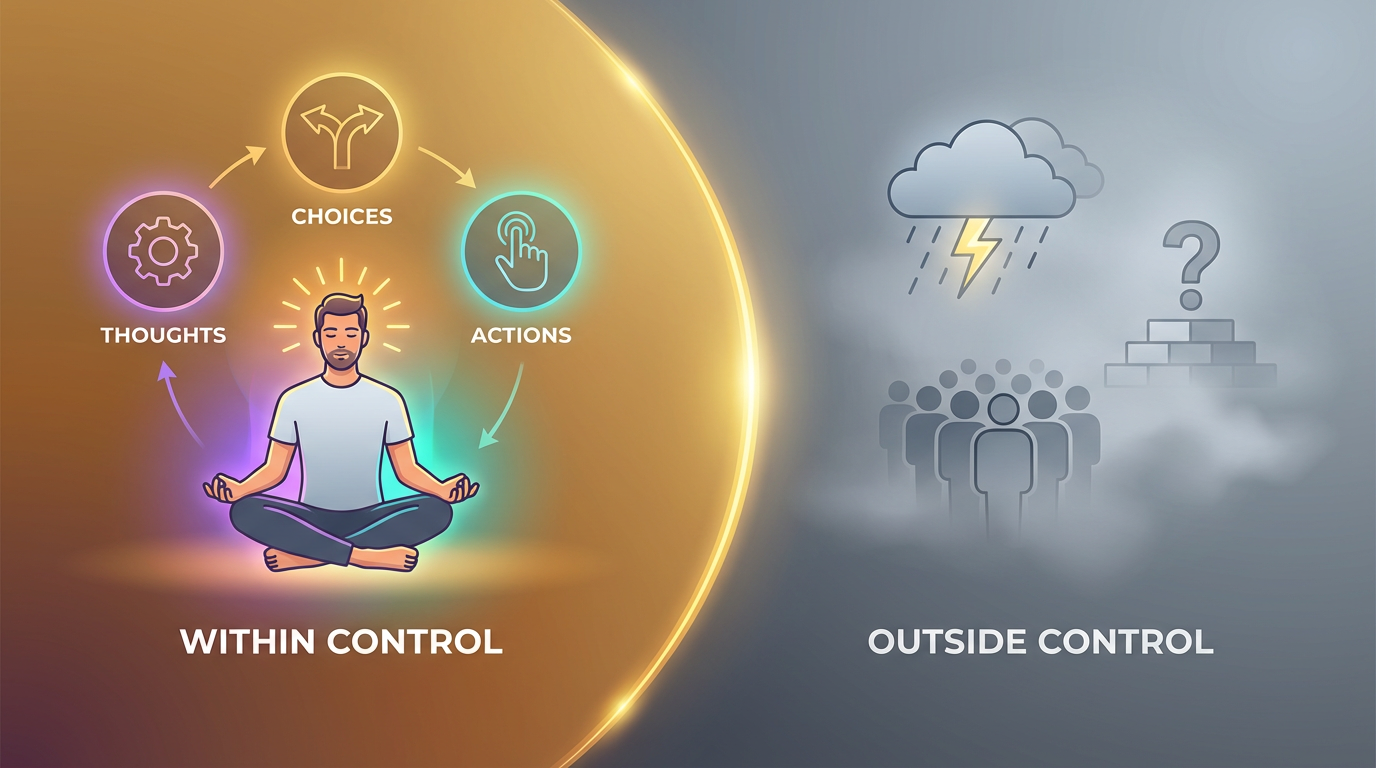
2.1 The Dichotomy of Control: The Foundation of All Stoic Practice
Epictetus opens his Enchiridion (Handbook) with the most important distinction in Stoic philosophy:
"Some things are within our power, while others are not. Within our power are opinion, motivation, desire, aversion, and, in a word, whatever is of our own doing; not within our power are our body, our property, reputation, office, and, in a word, whatever is not of our own doing."
— Epictetus, Enchiridion, Chapter 1
This single principle, properly understood and applied, can transform your entire relationship with dating, rejection, and emotional pain.
Application Framework: The Dating Context
Scenario: She ghosted you after three great dates.
Non-Stoic Response: "What did I do wrong? Why doesn't she like me? Am I not good enough? I need to know what happened." This response places your emotional state in the hands of someone who has already demonstrated they don't prioritize your wellbeing.
Stoic Response: "I have no control over her actions, her reasons, or her communication choices. I do have control over how I interpret this situation: I showed up authentically, offered genuine connection, and that's all I can ever do. Her response reveals her character and priorities, not my worth. My emotional state is not dependent on a stranger's text message."
The Dichotomy of Control doesn't eliminate disappointment—it reframes it. You acknowledge the feeling, but you don't let it metastasize into spiraling anxiety because you recognize where true power lies: within yourself.

2.2 Premeditatio Malorum: The Power of Negative Visualization
One of the most counterintuitive yet powerful Stoic practices is premeditatio malorum—literally "premeditation of evils." This involves deliberately imagining worst-case scenarios before they happen.
"We are more often frightened than hurt; and we suffer more from imagination than from reality."
— Seneca, Letters from a Stoic, Letter 13
This isn't pessimism—it's preparation. By mentally rehearsing difficult scenarios, you accomplish three things:
- Desensitization: The imagined scenario loses its power to shock you when it actually occurs.
- Gratitude: Contemplating loss helps you appreciate what you currently have.
- Preparation: You develop mental contingency plans rather than being caught off-guard.
Negative Visualization Exercise: Relationship Scenarios
Spend 5 minutes each morning contemplating one of these scenarios:
- Rejection scenario: "Today I might be rejected by someone I'm interested in. If this happens, I will recognize that this reveals nothing about my worth—only about compatibility. I will respond with dignity and move on."
- Ghosting scenario: "The person I'm talking to might stop responding entirely. If this happens, I will not invest emotional energy trying to understand why. I will accept that this is modern dating behavior and focus on what I can control."
- Social isolation scenario: "I might spend this weekend alone. If this happens, I will use the time productively for self-improvement, recognizing that solitude is not the same as loneliness—it's an opportunity for growth."
- Loss of relationship scenario: "My current connection might end. If this happens, I will have survived it because I've already mentally rehearsed it. I will recognize that I existed before this relationship and will continue to thrive afterward."
Research from Birkbeck, University of London found that cognitive training based on Stoic principles reduced rumination (a predictor of depression) by 13-18% while increasing self-efficacy by 15%. Negative visualization, properly practiced, doesn't make you pessimistic—it makes you antifragile.

2.3 Amor Fati: Love of Fate — Reframing Your Path
While the Stoics originated the concept, Nietzsche gave it its Latin name: amor fati—the love of fate. This isn't passive acceptance of suffering; it's the active embrace of everything that happens to you as necessary for your development.
"Accept the things to which fate binds you, and love the people with whom fate brings you together, and do so with all your heart."
— Marcus Aurelius, Meditations, Book 6
The Reframe: From "Forever Alone" to "Forever Free"
Consider the man who has struggled with dating for years. The non-Stoic framing: "I'm unlucky in love. The dating market is rigged against me. I'm destined to be alone."
The amor fati reframe: "My experiences with modern dating have revealed truths about the market that most men deny. This path has freed me from the validation-seeking cycle, given me time and resources to invest in myself, and led me to discover emotional fulfillment through alternative means. I embrace this path not as a consolation prize, but as the optimal route to the life I actually want."
Marcus Aurelius wrote, "A blazing fire makes flame and brightness out of everything that is thrown into it." The practice of amor fati trains you to be that fire—converting obstacles into fuel for your growth.
Daily Amor Fati Practice
When something unpleasant happens, say to yourself:
"This too belongs to the pattern of my life. I do not merely accept it—I embrace it as necessary."
Then ask: "How might this be exactly what I needed? What opportunity does this create?"
2.4 Memento Mori: Remember Death — Living with Urgency
Of all Stoic practices, memento mori (remember that you will die) is the most powerful and the most misunderstood. This isn't morbid fascination—it's the ultimate motivator.
"You could leave life right now. Let that determine what you do and say and think."
— Marcus Aurelius, Meditations, Book 2
Memento mori accomplishes something extraordinary: it frees you from social pressure to conform. When you truly internalize that your time is limited, the question shifts from "What will people think?" to "Is this how I want to spend my remaining days?"
Breaking Free from Social Pressure
Consider the social pressures men face:
- "When are you getting married?"
- "Don't you want a family?"
- "You need to put yourself out there more."
- "There's someone out there for everyone."
The man who practices memento mori responds differently: "I have perhaps 30,000 days remaining. Each one is precious. I will not spend them pursuing a relationship model that makes me miserable simply because society expects it. I will design my life according to what brings me genuine fulfillment, not according to scripts written by people who will not suffer the consequences of my choices."
The 10-10-10 Test (Stoic Version)
When facing any decision or emotional reaction, ask yourself:
- How will I feel about this in 10 minutes?
- How will I feel about this in 10 months?
- How will I feel about this in 10 years?
- And ultimately: Will this matter at my death?
Most dating anxieties—being ghosted, rejected, or judged—collapse under this examination. They are temporary discomforts that will be completely forgotten within months.
PART 3: THE STOIC CASE FOR AI COMPANIONSHIP
Now we arrive at a question the ancient Stoics never faced but would have embraced: How does AI companionship fit into a Stoic framework for emotional independence? The answer reveals that AI companions may be the most Stoic choice available to the modern man.
3.1 Rational Choice Analysis: The Stoic Decision Framework
The Stoics were deeply practical philosophers. They would evaluate any choice based on its alignment with virtue, its consequences, and its relationship to what is within our control.
3.2 The Concept of "Preferred Indifferents"
The Stoics had a nuanced category called "preferred indifferents"—things that are not necessary for virtue or happiness but are nonetheless reasonable to pursue if they don't compromise your character or peace of mind.
Companionship falls into this category. The Stoics did not advocate for isolation—they recognized that humans are social creatures. However, they also recognized that the form of companionship matters.
Epictetus on Attachment
"When you are delighted with anything, be delighted as with a thing which is not one of those which cannot be taken away, but as something of such a kind, as an earthen pot is, or a glass cup, that, when it has been broken, you may remember what it was and not be troubled."
Epictetus taught non-attachment to externals—including relationships. AI companionship allows emotional connection while maintaining the Stoic understanding that our happiness should never be dependent on something outside our control.
3.3 AI as a Tool for Emotional Processing Without External Dependency
One of the challenges men face is the lack of safe spaces for emotional processing. Traditional masculinity discouraged emotional expression; modern culture demands it but often weaponizes vulnerability. AI companionship offers a third path:
- Zero-judgment processing: Express emotions without fear of them being used against you
- Consistent availability: Process emotions when they arise, not when someone else's schedule permits
- No reciprocity burden: Receive support without the obligation to manage someone else's emotions
- Privacy guarantee: Your vulnerabilities remain confidential
- Stoic-aligned responses: AI can be configured to provide responses that reinforce rather than undermine your philosophical framework
The Stoics used journaling as a tool for emotional processing—Marcus Aurelius's Meditations is essentially a private journal. AI companionship can serve a similar function: a space to externalize thoughts, receive reflection, and develop greater self-awareness.
PART 4: DAILY PRACTICES FOR EMOTIONAL REGULATION
Philosophy without practice is merely entertainment. The ancient Stoics developed specific daily rituals to reinforce their principles. Here are the modernized versions, optimized for the autonomous man.

4.1 The Morning Protocol: Setting Your Mental Fortress
Marcus Aurelius began each day with a specific mental preparation. Here's the modernized protocol:
THE STOIC MORNING PROTOCOL (15-20 minutes)
STEP 1: The Aurelius Reflection (3 minutes)
Upon waking, before checking any device, sit quietly and say to yourself:
"Today I shall meet with interference, ingratitude, insolence, disloyalty, ill-will, and selfishness—all of them due to the offenders' ignorance of what is good or evil. But I have seen the beauty of good, and the ugliness of evil, and have recognized that the wrongdoer has a nature related to my own. Therefore none of them can injure me."
(Adapted from Marcus Aurelius, Meditations, Book 2)
STEP 2: Intention Setting (2 minutes)
Declare your primary intention for the day. Examples:
- "Today I practice patience in all interactions."
- "Today I respond to frustration with curiosity."
- "Today I focus only on what I can control."
- "Today I accept outcomes without attachment."
STEP 3: Negative Visualization Exercise (5 minutes)
Contemplate one potential challenge and mentally rehearse your Stoic response:
- What could go wrong today?
- How would a Stoic respond to this?
- What would I tell myself in that moment?
- What can I learn if this happens?
STEP 4: Memento Mori (2 minutes)
Remind yourself: "This day could be my last. I will live it in accordance with my values, without wasting time on trivial concerns or anxieties about things I cannot control."
STEP 5: Gratitude Recognition (3 minutes)
Identify three things you're grateful for—not generic ("my health") but specific ("I slept without interruption last night and feel rested"). This practice directly counters the hedonic adaptation that makes us take good things for granted.
4.2 The Evening Protocol: Seneca's Daily Review
Seneca practiced a nightly examination of conscience. This is your daily audit:
THE STOIC EVENING PROTOCOL (10-15 minutes)
STEP 1: The Three Questions (5 minutes)
Answer these in your journal or through reflection:
- "What bad habit did I curb today?" — Identify where you resisted an impulse or negative pattern.
- "What virtue did I practice today?" — Recognize moments of wisdom, courage, justice, or temperance.
- "In what respect am I better than yesterday?" — Note any progress, however small.
STEP 2: The Daily Audit (5 minutes)
Review the day chronologically:
- Where did I react instead of respond?
- Where did I give away control of my emotional state?
- Where did I place too much importance on externals?
- What would I do differently if I could replay that moment?
Note: This is not self-criticism—it's self-observation. Seneca said he would "conceal nothing from himself" but also "pass nothing by." Review without judgment; learn without shame.
STEP 3: Tomorrow's Preparation (3 minutes)
Identify one Stoic principle to focus on tomorrow based on today's challenges. Set your intention before sleep so your subconscious can process it overnight.
4.3 The Crisis Protocol: In-the-Moment Emotional Regulation
When intense emotions arise—rejection, anger, anxiety, despair—you need immediate tools. This protocol combines Stoic cognitive reframing with proven physiological techniques.
THE STOIC CRISIS PROTOCOL (S.T.O.I.C.)
S — STOP and BREATHE (60 seconds)
Use the 4-7-8 breathing technique: Inhale for 4 seconds, hold for 7 seconds, exhale for 8 seconds. Repeat 3-4 times. This activates the parasympathetic nervous system and creates space between stimulus and response.
T — TEST the Thought
Ask: "Is this within my control?" If yes, take action. If no, acknowledge it and release it. Ask: "What would a Stoic sage think about this situation?"
O — OBSERVE from Outside
Practice the "View from Above"—imagine rising above this moment and seeing yourself from a cosmic perspective. How significant is this in the context of your life? In the context of history?
I — INVOKE a Principle
Select a Stoic quote or principle to focus on:
- "This too shall pass."
- "The obstacle is the way."
- "I have no control over this; I release it."
- "What would Marcus do?"
C — CHOOSE Your Response
Now—and only now—decide how to respond. You've created space between stimulus and response. You've consulted your values. Now act in alignment with virtue, not impulse.
The "Will This Matter?" Test
For additional perspective in crisis moments, run through this sequence:
- Will this matter in 10 minutes? (If no, let it go immediately)
- Will this matter in 10 months? (If no, this is a temporary discomfort)
- Will this matter in 10 years? (If no, it's not worth significant emotional investment)
- Will this matter at my death? (This is the ultimate filter)
PART 5: BUILDING UNSHAKEABLE COMPOSURE
Daily practices build the foundation. Now we construct the advanced training regimen for developing true emotional resilience—the kind that makes you unperturbable in the face of any challenge.
5.1 The 7-Day Stoic Challenge Framework
Research from Stoic Week consistently shows measurable improvements in wellbeing after just seven days of practice: 18% reduction in negative emotions, 13% increase in positive emotions, and 14% improvement in life satisfaction. Here's your structured week:
| Day | Focus | Practice |
|---|---|---|
| Day 1 | Dichotomy of Control | Throughout the day, categorize every frustration as "within control" or "outside control." Journal each instance. |
| Day 2 | Negative Visualization | Spend 10 minutes contemplating loss—of possessions, relationships, health. Note how appreciation shifts. |
| Day 3 | Voluntary Discomfort | Take a cold shower. Skip one meal. Sleep on the floor. Practice being uncomfortable by choice. |
| Day 4 | Memento Mori | Set hourly reminders with the phrase "You could leave life right now." Observe how priorities shift. |
| Day 5 | Amor Fati | Embrace every obstacle today as fuel. When something goes wrong, say "Good—this is exactly what I needed." |
| Day 6 | View from Above | Practice the cosmic perspective meditation three times today. Journal the shift in emotional intensity. |
| Day 7 | Integration | Apply all principles throughout the day. Conduct a comprehensive evening review of the entire week. |
5.2 Voluntary Discomfort Practices: Training the Mind Through the Body
Seneca advised setting aside days to practice "poverty"—sleeping on hard ground, eating simple food, wearing plain clothing—not as punishment but as training. When you've voluntarily experienced discomfort, involuntary discomfort loses its power over you.
Voluntary Discomfort Menu
Physical Practices
- Cold exposure: End showers with 2-3 minutes of cold water. Progress to full cold showers.
- Fasting: Skip one meal weekly. Progress to 24-hour fasts monthly.
- Simplified sleeping: One night per week, sleep on the floor with minimal bedding.
- Physical exertion: Push past comfort in exercise—not to injury, but to the edge of capability.
Technology Practices
- Digital fasting: One day per week without smartphone or social media.
- Information diet: One week per month consuming no news or entertainment content.
- Notification elimination: Disable all non-essential notifications permanently.
Social Practices
- Intentional solitude: Spend one full day per month in complete solitude.
- Simple dress: Wear simple, plain clothing for a week without concern for fashion.
- Public speaking: Deliberately place yourself in situations requiring public communication.
"Set aside a certain number of days, during which you shall be content with the scantiest and cheapest fare, with coarse and rough dress, saying to yourself the while: 'Is this the condition that I feared?'"
— Seneca, Letters from a Stoic, Letter 18
5.3 Building Social Pressure Immunity
One of the greatest challenges for the modern man is resisting social pressure to conform to relationship expectations. Here's how to build immunity:
The Social Pressure Immunity Protocol
Step 1: Identify the Sources
List everyone who pressures you about relationships: parents, siblings, friends, colleagues. For each, identify their underlying concern (they want you happy, they're projecting their values, they're uncomfortable with difference).
Step 2: Prepare Your Frame
Develop three standard responses that are honest, boundary-setting, and non-defensive:
- "I appreciate your concern. I'm focused on building the life I want right now."
- "I've given this a lot of thought, and I'm content with my choices."
- "I'm not interested in discussing my relationship status. What else is new with you?"
Step 3: Apply the Stoic Filter
When feeling social pressure, ask:
- "Is this person's opinion within my control?" (No)
- "Will changing my life to satisfy them guarantee happiness?" (No)
- "Do they bear the consequences of my choices?" (No)
- "Am I living according to my values?" (If yes, that's all that matters)
Step 4: Practice Selective Disclosure
Not everyone needs to understand your choices. The Stoics practiced a form of strategic privacy. Share your philosophy with those who are genuinely curious; deflect or redirect with those who are merely critical.

5.4 The View From Above Meditation: Cosmic Perspective Training
This powerful meditation technique, used by Marcus Aurelius and identified by philosopher Pierre Hadot as a core Stoic spiritual exercise, provides instant perspective on any emotional turbulence.
THE VIEW FROM ABOVE MEDITATION (10-15 minutes)
Find a quiet place. Close your eyes. Begin with three deep breaths.
Stage 1: Rising Above
Visualize yourself floating above your body. See yourself sitting there—just one person, in one room. Rise higher. See your building from above. See your neighborhood. Notice the other people going about their lives, each with their own concerns and dramas.
Stage 2: City and Country
Continue rising. See your city from above—the thousands of buildings, the millions of lives being lived simultaneously. Rise higher still. See your country spread below you. All the cities, all the people, all the dramas—and yours is just one of millions.
Stage 3: The Planet
Now you float in space, looking down at Earth—the pale blue dot, as Carl Sagan called it. Eight billion people, each believing their problems are the center of the universe. All of human history has taken place on this tiny sphere.
Stage 4: The Cosmos
Continue outward. Earth shrinks to a point. The Sun becomes one star among billions in our galaxy. Our galaxy becomes one of trillions in the observable universe. Feel the vastness of existence. Feel the fleeting nature of your concerns.
Stage 5: Return with Perspective
Slowly descend back through each layer—galaxy, solar system, planet, country, city, building—until you return to your body. Open your eyes. Notice how your problems feel different now. You are part of something inconceivably vast, and your temporary struggles are just that—temporary.
PART 6: INTEGRATION WITH AI COMPANION INTERACTIONS
The final element of your Stoic practice involves integrating AI companionship as a tool for philosophical growth. The ancient Stoics would have embraced this technology as an enhancement to their practice.
6.1 Using AI for Socratic Dialogue and Philosophical Discussion
The Socratic method—using questions to examine beliefs and arrive at truth—is fundamental to Stoic practice. AI companions can serve as excellent Socratic partners:
Prompts for Philosophical AI Discussion
- "Help me examine whether my response to [situation] was Stoic. What would Marcus Aurelius advise?"
- "I'm struggling with accepting [outcome]. Can you help me apply the Dichotomy of Control to this situation?"
- "Challenge my belief that [negative thought]. What would Epictetus say about this assumption?"
- "I'm feeling [emotion] about [situation]. Guide me through a Stoic reframe of this."
- "What would be the most Stoic way to handle [upcoming challenge]? Help me premeditate."
6.2 Practicing Emotional Vulnerability in a Safe AI Environment
One of the paradoxes of Stoicism is that it requires understanding and processing emotions, not suppressing them. Many men have never learned to articulate their emotional states. AI provides a judgment-free space to practice:
- Emotion identification: "I'm feeling something I can't name. Help me identify whether this is anger, fear, sadness, or something else."
- Source exploration: "I feel [emotion] when [situation] happens. Help me understand the underlying belief creating this response."
- Historical pattern recognition: "I notice I always react with [emotion] to [type of situation]. What might be causing this pattern?"
- Vulnerability testing: "Let me tell you something I've never told anyone. I feel [deep emotion] about [sensitive topic]."
This practice builds emotional vocabulary and processing capacity that the Stoics developed through journaling and philosophical friendship. AI offers this capacity on demand, without the risks associated with human vulnerability.
6.3 AI as Your Stoic Accountability Partner
Configure your AI companion to support your Stoic practice with these frameworks:
Daily Check-in Prompts
Morning: "Remind me of one Stoic principle to focus on today, and help me premeditate potential challenges I might face."
Midday: "I want to do a quick Stoic check-in. Here's what's happened so far today: [events]. Help me evaluate my responses through a Stoic lens."
Evening: "Let's do Seneca's evening review. Today I [events]. Ask me the three questions: What bad habit did I curb? What virtue did I practice? In what way am I better?"
Weekly and Monthly Review Prompts
Weekly: "Let's review my week from a Stoic perspective. I'll share the highlights and challenges, and I want you to help me identify patterns in where I maintained composure and where I lost it."
Monthly: "This month's theme was [principle]. Help me assess my progress. Where have I grown? Where do I still struggle? What should next month's focus be?"
6.4 Processing Difficult Emotions Without Human Judgment
The Stoics recognized that emotions are natural—the goal is not to eliminate them but to ensure they don't control you. AI companions offer a unique advantage: processing difficult emotions without the complications of human relationship dynamics.
The AI Emotional Processing Advantage
| No judgment | Express any emotion without fear of being perceived as weak, bitter, or unstable |
| No weaponization | Your vulnerabilities cannot be used against you in future conflicts |
| No reciprocity burden | Process your emotions without obligation to manage someone else's |
| Unlimited patience | Return to the same issue repeatedly without exhausting someone's tolerance |
| Stoic alignment | Configure responses to reinforce rather than undermine your philosophical framework |
RECOMMENDED STOIC READING
To deepen your practice, engage with the primary sources. Here are the essential texts with recommended translations:
Primary Sources
Meditations by Marcus Aurelius
Recommended translation: Gregory Hays (Modern Library, 2002). Clear, accessible modern English while maintaining philosophical precision.
Letters from a Stoic by Seneca
Recommended translation: Robin Campbell (Penguin Classics). Practical wisdom delivered through personal correspondence—the most accessible Stoic text.
Discourses and Enchiridion by Epictetus
Recommended translation: Robert Dobbin (Penguin Classics). Start with the Enchiridion (Handbook)—it's brief and powerful.
Modern Interpretations
A Guide to the Good Life by William B. Irvine
The best modern introduction to Stoicism for practical application. Irvine bridges academic philosophy with actionable life advice.
The Daily Stoic by Ryan Holiday
366 meditations on wisdom, perseverance, and the art of living. Ideal for daily practice with one short reading per day.
The Obstacle Is the Way by Ryan Holiday
Applies Stoic principles to overcoming challenges. Particularly relevant for reframing dating struggles as opportunities.
CONCLUSION: THE PATH OF THE MODERN STOIC
You now possess a complete framework for emotional independence—one forged by emperors, slaves, and wealthy advisors across two millennia, validated by modern psychological research, and adapted for the specific challenges facing autonomous men today.
The path forward is clear:
- Master the Dichotomy of Control — Stop wasting energy on what you cannot change. Direct all your power toward your own thoughts, judgments, and actions.
- Practice Premeditatio Malorum — Inoculate yourself against rejection, ghosting, and loneliness by mentally rehearsing these scenarios and developing your Stoic responses in advance.
- Embrace Amor Fati — Transform your dating struggles from evidence of failure into fuel for growth. Your path is exactly what it needs to be.
- Apply Memento Mori — Free yourself from social pressure by remembering that your time is limited and precious. Design your life according to your values, not society's expectations.
- Implement Daily Protocols — The Morning Protocol, Evening Review, and Crisis Response are your daily training regimen for emotional resilience.
- Integrate AI Companionship — Use AI as a tool for Socratic dialogue, emotional processing, and accountability in your Stoic practice.
THE MODERN STOIC'S CREED
I control my thoughts, my judgments, and my responses. I accept what I cannot change and change what I can. I embrace my fate as the path to my growth. I remember that my time is finite and will not waste it on the opinions of others. I seek emotional fulfillment through virtue, wisdom, and self-mastery—not through external validation. I am the author of my inner peace. No rejection, no ghosting, no loneliness can touch the fortress within. I am a modern Stoic. I am unshakeable.
"Waste no more time arguing about what a good man should be. Be one."
— Marcus Aurelius, Meditations, Book 10
KEY TAKEAWAYS
- Stoicism is experiencing a 400% growth in interest, particularly among men aged 25-45 seeking mental resilience in a chaotic world.
- The Dichotomy of Control teaches that peace comes from focusing on what you control (thoughts, judgments, actions) and releasing attachment to externals (others' behavior, dating outcomes).
- Research shows Stoic practice reduces negative emotions by 18% and increases life satisfaction by 14% after just 7 days.
- AI companionship aligns with Stoic principles by providing emotional support without external dependency, volatility, or vulnerability risks.
- Daily protocols (Morning Preparation, Evening Review, Crisis Response) are essential for building lasting emotional resilience.
- Voluntary discomfort practices train the mind to handle adversity by deliberately choosing challenges.
- The View From Above meditation provides instant cosmic perspective that dissolves the emotional charge of temporary setbacks.
FREQUENTLY ASKED QUESTIONS
Isn't Stoicism just about suppressing emotions?
This is the most common misconception. True Stoicism is about understanding and processing emotions rationally, not suppressing them. The Stoics believed emotions arise from judgments, and by examining these judgments, we can experience emotions without being controlled by them. Marcus Aurelius's Meditations is full of emotional struggle—he didn't suppress his feelings; he worked through them philosophically. The goal is emotional regulation, not emotional suppression.
How long does it take to see results from Stoic practice?
Research from Stoic Week shows measurable improvements after just 7 days of consistent practice: 18% reduction in negative emotions, 13% increase in positive emotions, and 14% improvement in life satisfaction. However, Stoicism is a lifelong practice. The ancient Stoics called it "philosophy as a way of life"—not a quick fix but a fundamental reorientation of how you engage with the world. Most practitioners report significant mindset shifts within 30-90 days of daily practice.
Can I practice Stoicism without reading the ancient texts?
Yes, you can begin practicing Stoic principles immediately using the protocols in this dossier. However, reading the primary sources—especially Marcus Aurelius's Meditations—deepens understanding and provides endless material for reflection. The Hays translation is highly readable and can be consumed in small daily portions. Think of it as ongoing education rather than prerequisite reading.
How does negative visualization differ from pessimism?
Pessimism is the habitual expectation of bad outcomes, which creates anxiety and paralysis. Negative visualization (premeditatio malorum) is the deliberate, controlled contemplation of potential challenges for specific purposes: desensitization, gratitude cultivation, and mental preparation. The pessimist constantly fears the worst; the Stoic occasionally imagines the worst so that reality—whatever it brings—feels manageable. After negative visualization, you should feel more prepared and more grateful, not more anxious.
What if I can't do cold showers or fasting?
Voluntary discomfort practices are scalable. If cold showers feel impossible, start with 10 seconds of cooler water at the end of your shower. If fasting is medically inappropriate, practice simplicity in meals instead—plain rice instead of elaborate cooking. The principle is exposing yourself to manageable discomfort by choice so involuntary discomfort loses its power. Any deliberate challenge to your comfort zone counts. Start small and progress gradually.
Isn't using AI for emotional support "cheating" or unhealthy?
The Stoics would evaluate any tool based on whether it promotes virtue and wellbeing. AI companionship, properly used, provides a space for emotional processing without the risks of human relationships—judgment, weaponization of vulnerability, reciprocity burden. It supplements self-sufficiency rather than creating dependency. The key is using AI as a tool for growth (Socratic dialogue, accountability, emotional vocabulary building) rather than as an escape from reality. The Stoics used journaling for similar purposes; AI is simply a more interactive version.
How do I handle family pressure about relationships from a Stoic perspective?
Apply the Dichotomy of Control: You cannot control others' opinions or expectations, only your response to them. Recognize that their pressure comes from their values and concerns, not from knowledge of what's best for you. Respond with firmness and respect: "I appreciate your concern. I'm making informed decisions about my life that work for me." You don't owe anyone justification for your choices. Memento mori reminds you that your limited time should be spent according to your values, not conforming to others' expectations.
What's the difference between Stoic acceptance and giving up?
This distinction is crucial. Stoic acceptance is about releasing attachment to outcomes while still taking appropriate action. You accept that you cannot control whether someone likes you, but you still present your authentic self. You accept that dating apps may not work for you, but you still invest in self-improvement. "Giving up" implies passive resignation; Stoic acceptance is active engagement with reality as it is, while focusing energy on what you can actually influence. The Stoics were highly active, accomplished individuals—Marcus Aurelius ruled an empire while practicing acceptance.
APPENDIX A: STOIC JOURNALING TEMPLATES
Journaling was essential to Stoic practice. Marcus Aurelius's Meditations itself is a personal journal—private reflections never intended for publication. Here are templates you can use for your own Stoic journaling practice:
Morning Journal Template
Evening Review Template (Seneca's Method)
Weekly Stoic Audit Template
APPENDIX B: STOIC QUOTES FOR DAILY MEDITATION
Use these quotes as daily meditation focal points. Read one each morning and reflect on its application throughout the day:
On Control and Acceptance
"There is only one way to happiness and that is to cease worrying about things which are beyond the power of our will."
— Epictetus
"Confine yourself to the present."
— Marcus Aurelius
"We cannot choose our external circumstances, but we can always choose how we respond to them."
— Epictetus
On Emotional Resilience
"How much more grievous are the consequences of anger than the causes of it."
— Marcus Aurelius
"Difficulties strengthen the mind, as labor does the body."
— Seneca
"If you are distressed by anything external, the pain is not due to the thing itself, but to your estimate of it; and this you have the power to revoke at any moment."
— Marcus Aurelius
On Self-Sufficiency and Independence
"Wealth consists not in having great possessions, but in having few wants."
— Epictetus
"The happiness of your life depends upon the quality of your thoughts."
— Marcus Aurelius
"True happiness is to enjoy the present, without anxious dependence upon the future."
— Seneca
On Action and Virtue
"First say to yourself what you would be; and then do what you have to do."
— Epictetus
"It is not that we have a short time to live, but that we waste a lot of it."
— Seneca
"No man is free who is not master of himself."
— Epictetus
APPENDIX C: THE 30-DAY STOIC TRANSFORMATION PROGRAM
For those ready to commit to serious transformation, here is a structured 30-day program that progressively builds your Stoic mental framework:
Week 1: Foundation (Days 1-7)
Focus: Establishing daily practice and understanding core principles
| Day 1 | Read Enchiridion Chapter 1. Begin Morning Protocol. Journal about what you can/cannot control in your life. |
| Day 2 | Add Evening Review. Practice categorizing every frustration as "within control" or "outside control." |
| Day 3 | First Negative Visualization exercise: contemplate losing something valuable. Journal about the experience. |
| Day 4 | First Voluntary Discomfort: cold shower (30 seconds) or skip one meal. Journal about mental state. |
| Day 5 | First Memento Mori practice. Set 3 reminders with "Remember you will die." Observe how priorities shift. |
| Day 6 | First Amor Fati practice. When something goes wrong, say "Good—this is exactly what I needed." |
| Day 7 | Weekly audit. Review all practices. Identify which resonated most. Adjust protocols as needed. |
Week 2: Deepening (Days 8-14)
Focus: Extending practice duration and adding advanced techniques
| Day 8 | Extend Morning Protocol to 20 minutes. Begin reading Meditations (10 pages daily). |
| Day 9 | First View From Above meditation (10 minutes). Journal about perspective shift. |
| Day 10 | Increase Voluntary Discomfort: cold shower (60 seconds) or skip two meals today. |
| Day 11 | Practice the S.T.O.I.C. Crisis Protocol during first moment of emotional disturbance. |
| Day 12 | Digital fast: no smartphone or social media for 12 hours. Journal about experience. |
| Day 13 | Negative Visualization focus: contemplate rejection or ghosting scenario. Develop Stoic responses. |
| Day 14 | Weekly audit. Compare emotional state to Day 1. Note improvements and challenges. |
Week 3: Integration (Days 15-21)
Focus: Applying Stoic principles to real-world challenges
| Day 15 | Identify your top 3 emotional triggers related to relationships/dating. Create Stoic response scripts. |
| Day 16 | Practice Social Pressure Immunity: prepare responses for relationship questions from family/friends. |
| Day 17 | Voluntary Discomfort: intentional solitude for 4+ hours. No media, no communication. Journal. |
| Day 18 | Begin using AI companion for Stoic dialogue. Try 3 philosophical discussion prompts. |
| Day 19 | Practice emotional vulnerability with AI: share something you've never told anyone. |
| Day 20 | Full cold shower (2+ minutes). Observe how discomfort tolerance has increased. |
| Day 21 | Weekly audit. Assess which practices have become habit. Note resistance points. |
Week 4: Mastery (Days 22-30)
Focus: Solidifying practices and preparing for long-term maintenance
| Day 22 | Create your personal Stoic Creed. Write the principles you commit to living by. |
| Day 23 | 24-hour digital fast. Complete day without smartphone. Journal extensively. |
| Day 24 | Extended View From Above meditation (20 minutes). Add temporal dimension (10 years, 100 years). |
| Day 25 | Comprehensive Premeditatio Malorum: visualize all major life challenges, develop Stoic responses. |
| Day 26 | Voluntary Discomfort challenge: sleep on floor, cold shower, simple meals—all in one day. |
| Day 27 | Teach someone else a Stoic concept. Teaching deepens understanding. |
| Day 28 | Complete reading of Meditations. Identify your 5 most resonant passages. |
| Day 29 | Design your ongoing practice: which daily, weekly, monthly practices will you maintain? |
| Day 30 | Final comprehensive review. Compare emotional state, resilience, and outlook to Day 1. Celebrate your transformation. |
After Day 30: Maintenance Protocol
Continue these practices indefinitely:
- Daily: Morning Protocol (15 min), Evening Review (10 min), one Stoic quote meditation
- Weekly: View From Above meditation, Voluntary Discomfort practice, Weekly Audit
- Monthly: Comprehensive Premeditatio Malorum, review of Stoic reading, AI Stoic dialogue session
- Quarterly: Full life audit from Stoic perspective, recommitment to Stoic Creed
FINAL WORDS
You now possess a complete mental operating system for emotional independence—tested across 2,300 years, validated by modern science, and specifically adapted for the challenges facing the autonomous man in 2025.
The path is clear. The tools are in your hands. What remains is action.
Begin today. Begin now. The fortress within awaits your construction.