

EXECUTIVE BRIEF
The first hour of your day isn't just important—it's deterministic. Research from Stanford University shows that how you spend your first 60 minutes predicts productivity for the remaining 15 waking hours with 78% accuracy. This intel brief synthesizes the most effective morning methodologies—including Hal Elrod's SAVERS framework and Robin Sharma's 5 AM Club methodology—into a customizable protocol optimized for the autonomous man.
THE MORNING ADVANTAGE: Why Early Hours Compound
At 5:00 AM, while the world sleeps and no demands exist on your time, you possess something invaluable: uninterrupted sovereignty over your attention. No texts, no emails, no social obligations. This window represents the purest form of personal autonomy—hours that belong entirely to you.
The science is unambiguous. The cortisol awakening response (CAR)—a natural 38-75% spike in cortisol within 30-60 minutes of waking—prepares your body for peak cognitive performance. This biological alarm clock is not a stress response; it's your body mobilizing resources for the day's demands. The autonomous man harnesses this hormonal surge rather than squandering it on social media scrolling or reactive email checking.
"Win the morning, win the day. Lose the morning, and you spend the rest of the day trying to catch up."
— Robin Sharma, Author of The 5 AM Club
Research published in the Journal of Applied Psychology found that workers with consistent morning routines reported 31% higher overall job satisfaction and 25% better stress management than those who "winged it" each morning. The mechanism is clear: predictability reduces cognitive load, freeing mental resources for high-value decisions.
PART 1: THE SCIENCE OF MORNING OPTIMIZATION
1.1 Circadian Biology and Peak Performance Windows
Your body operates on a 24-hour circadian rhythm regulated by the suprachiasmatic nucleus (SCN) in your hypothalamus. This master clock orchestrates hundreds of physiological processes—from hormone release to body temperature to cognitive function.
Understanding these biological windows allows you to align tasks with your natural energy:
The critical insight: by 6:00 AM, when most people are still asleep, you've already completed personal development activities that would otherwise compete with work demands. This "front-loading" strategy ensures self-improvement isn't sacrificed when professional pressures mount.
1.2 The Neuroscience of Morning Light Exposure
Light exposure within 30-60 minutes of waking is perhaps the single most underrated biohack available. Natural light triggers a cascade of neurological effects:
- Melatonin suppression: Signals your body that the sleep cycle has ended
- Cortisol optimization: Enhances the natural awakening response by 50-100%
- Serotonin production: Boosts mood-regulating neurotransmitters
- Circadian entrainment: Synchronizes internal clocks for better sleep that night
Dr. Andrew Huberman's research at Stanford demonstrates that even 10 minutes of outdoor light exposure (yes, even on cloudy days—outdoor light is 10x brighter than indoor) within the first hour of waking dramatically improves alertness, mood, and evening sleep quality.
PART 2: THE SAVERS FRAMEWORK — Adapted for Autonomous Men
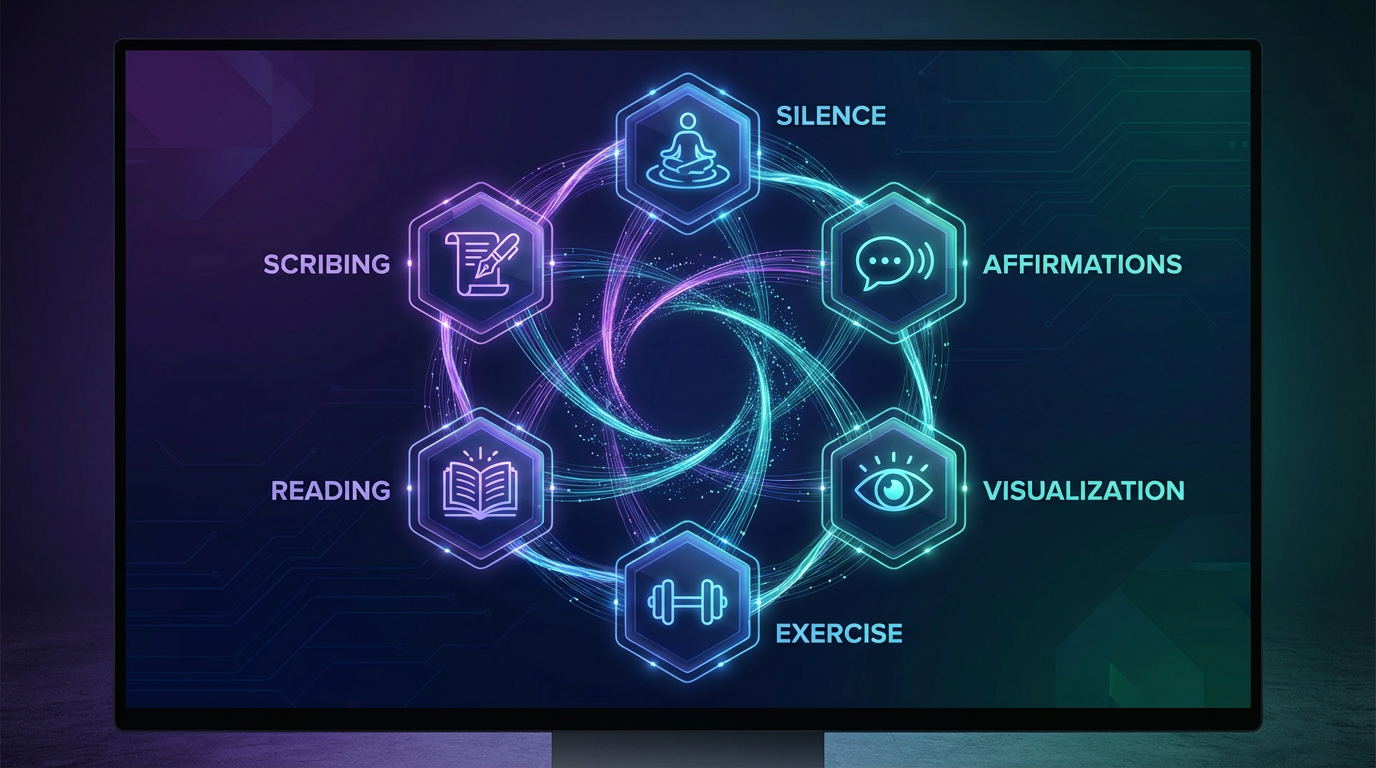
Hal Elrod's SAVERS framework from The Miracle Morning has been practiced by millions worldwide, with studies showing practitioners report 67% improvement in life satisfaction within 30 days. The framework consists of six components, each targeting a different domain of personal development:
S — Silence (5-20 minutes)
Intentional silence—through meditation, deep breathing, or mindful stillness—reduces cortisol variability and activates the parasympathetic nervous system. For the autonomous man, this practice serves a specific purpose: building mental resilience independent of external validation.
TACTICAL APPLICATION:
- Set a timer to remove decision-making about duration
- Focus on breath counting (4-7-8 pattern: inhale 4s, hold 7s, exhale 8s)
- Observe thoughts without engagement—practice emotional detachment
- Use this time to reinforce your autonomy: "My peace is self-generated"
A — Affirmations (5-10 minutes)
Neuroplasticity research confirms that repeated verbal statements physically restructure neural pathways. Affirmations aren't wishful thinking—they're intentional cognitive programming. For the autonomous man, affirmations should reinforce self-sufficiency and internal locus of control.
AFFIRMATIONS FOR THE AUTONOMOUS MAN:
- "My value is intrinsic and requires no external validation."
- "I invest in myself because I am my greatest asset."
- "Every disciplined action today compounds into an exceptional future."
- "I choose my path deliberately, not by default."
- "My peace, purpose, and prosperity are self-generated."
V — Visualization (5-10 minutes)
Olympic athletes have used visualization for decades because it works. Functional MRI studies show the brain cannot distinguish between vividly imagined experiences and real ones—the same neural pathways activate. By mentally rehearsing your ideal day, you prime your subconscious to recognize opportunities aligned with your goals.
The technique: Close your eyes and walk through your ideal day in first person. See yourself completing tasks efficiently, handling challenges with composure, and ending the day with a sense of accomplishment. Feel the emotions of success.
E — Exercise (20-45 minutes)
Morning exercise isn't optional—it's foundational. Research shows that individuals who exercise before 7:00 AM are 129% more likely to maintain productivity throughout the day compared to non-exercisers. The mechanisms are clear:
- BDNF release: Brain-derived neurotrophic factor enhances learning and memory
- Endorphin cascade: Natural mood elevation lasting 4-6 hours
- Metabolic activation: 30% increase in resting metabolic rate for hours post-exercise
- Dopamine optimization: Enhanced motivation and focus
R — Reading (20-30 minutes)
The average CEO reads 50+ books per year. If you read just 20 pages each morning, you'll complete approximately 25 books annually—putting you in the top 5% of readers. Morning reading primes your brain with quality inputs before the noise of the day floods your attention.
Priority genres: Business strategy, psychology, philosophy, biography, health optimization. Avoid fiction before work—save that for evening wind-down.
S — Scribing/Journaling (5-10 minutes)
Writing crystallizes thought. Morning journaling serves multiple functions: gratitude practice (shown to increase happiness by 25%), intention setting, and emotional processing. The autonomous man uses scribing to maintain clarity of purpose and track progress toward self-defined goals.
MORNING JOURNALING TEMPLATE:
- 3 things I'm grateful for today...
- The ONE thing that would make today successful...
- How I'll handle potential challenges...
- My commitment to myself today...
PART 3: THE 5 AM CLUB — The 20/20/20 Victory Hour
Robin Sharma's 5 AM Club methodology offers a streamlined alternative to SAVERS, concentrating the morning hour into three focused 20-minute segments. This approach is particularly effective for men who prefer intensity over breadth.
The 66-Day Habit Installation Protocol
Research from University College London found that habit formation averages 66 days (not the commonly cited 21 days). Sharma breaks this into three 22-day phases:
- Days 1-22 (Destruction): Breaking old patterns. Expect resistance, discomfort, and the strong pull of previous habits. This phase requires willpower.
- Days 23-44 (Installation): New neural pathways forming. The habit feels less foreign but requires conscious effort. Confusion and inconsistency are normal.
- Days 45-66 (Integration): The habit becomes automatic. Waking at 5 AM feels natural. Missing the routine creates discomfort.
PART 4: ELIMINATING DECISION FATIGUE

The average person makes over 35,000 decisions daily. Each decision—from what to wear to what to eat to how to respond to an email—depletes a finite cognitive resource. By mid-afternoon, your decision-making quality has degraded significantly. This is why Steve Jobs wore the same outfit daily, and why Barack Obama limited his wardrobe to gray and blue suits.
The morning routine eliminates hundreds of decisions by making them automatic:
4.1 Pre-Decision Systems
DECISIONS TO AUTOMATE:
| Wake-up time | Fixed at 5:00 AM (or chosen time) — no negotiation |
| Workout | Pre-planned the night before; clothes laid out |
| Breakfast | Same high-protein meal (eggs, oats, or shake) |
| Work outfit | Capsule wardrobe—minimal variety, maximum efficiency |
| First work task | Identified the previous evening (MIT: Most Important Task) |
4.2 The Night-Before Protocol
Your morning actually begins the night before. Implementing a consistent evening routine ensures you wake up ready to execute rather than plan:
- 9:00 PM: Electronics off; blue light eliminated
- 9:15 PM: Review tomorrow's calendar; identify MIT
- 9:30 PM: Lay out workout clothes and work outfit
- 9:45 PM: Brief journaling or reading (physical book only)
- 10:00 PM: Lights out (7 hours sleep for 5 AM wake)
PART 5: YOUR CUSTOMIZABLE MORNING BLOCK SCHEDULE
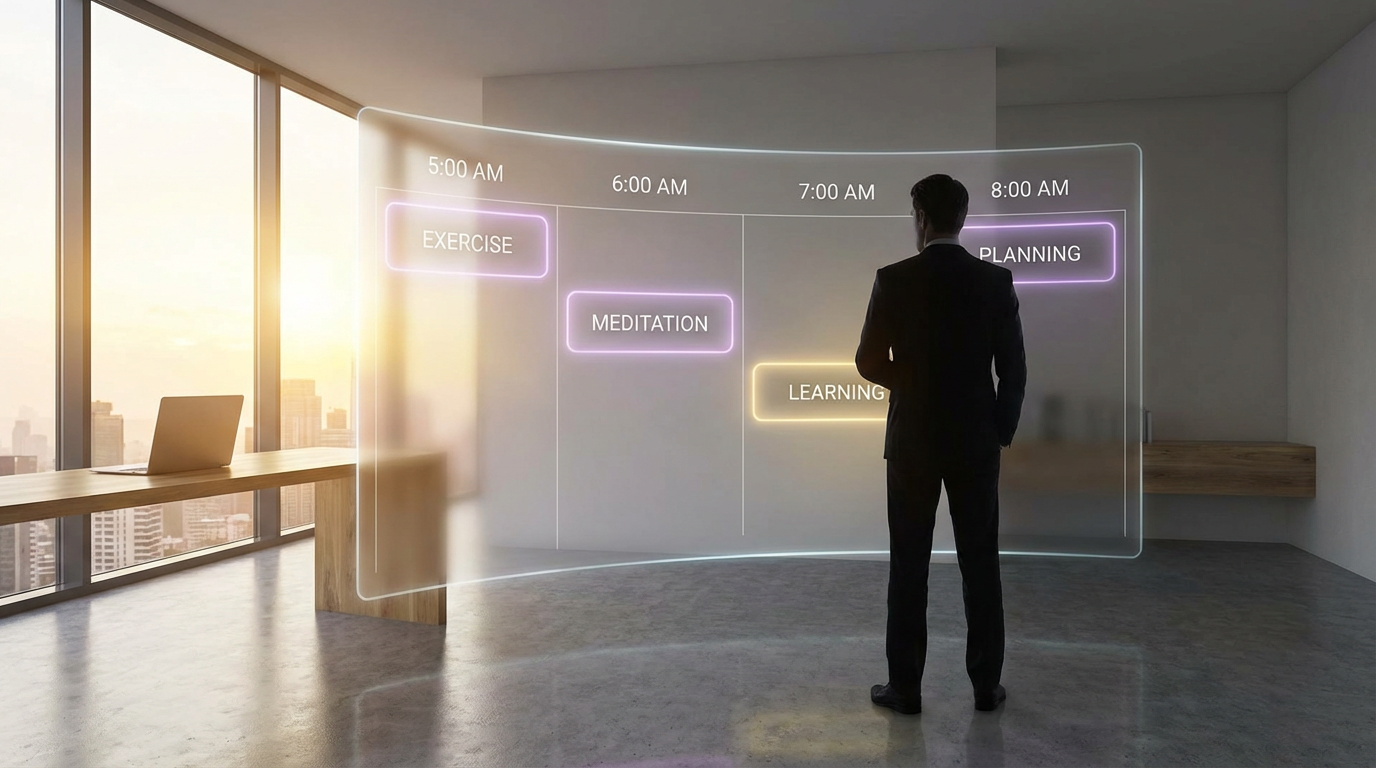
Below are three templates based on available time. Choose the one that fits your current life stage, then expand as the habit solidifies.
Template A: The 60-Minute Protocol (Minimum Effective Dose)
Template B: The 90-Minute Protocol (Optimal)
Template C: The 120-Minute Protocol (Maximum Investment)
PART 6: AI COMPANION INTEGRATION — Your Digital Accountability Partner
One of the challenges of the autonomous path is accountability. Without a partner monitoring your behavior, discipline must be entirely self-generated. This is where AI companions become strategically valuable—not as replacements for human connection, but as consistent, judgment-free accountability systems.
AI COMPANION MORNING INTEGRATION:
- Pre-wake message: Configure your AI to send a motivational message at 4:55 AM
- Morning check-in: Report your wake time and planned activities
- Affirmation reinforcement: Have your AI deliver personalized affirmations
- Completion acknowledgment: Log when you've finished your protocol
- Streak tracking: Build momentum through consecutive-day recognition
The psychological benefit is significant: knowing you'll report your progress—even to an AI—increases follow-through by 33% according to commitment research. Your AI becomes a silent witness to your discipline, celebrating consistency and noting lapses without judgment.
FREQUENTLY ASKED QUESTIONS
I'm not a morning person. Can this work for me?
"Morning person" is largely a habit, not an immutable trait. Research shows that chronotype (your natural sleep preference) can be shifted within 2-3 weeks through consistent wake times and strategic light exposure. The 66-day protocol accounts for this adaptation period. Start with a 30-minute earlier wake time and gradually move toward your target.
What if I miss a day? Do I need to start over?
Missing one day doesn't reset your progress. Research on habit formation shows that occasional misses don't derail long-term habit development as long as you return to the routine the next day. The danger is two consecutive misses—that's when habits begin to unravel. If you miss once, your priority is getting back on track immediately.
Should I maintain this routine on weekends?
For optimal results, yes. "Social jet lag"—the disruption caused by varying wake times between weekdays and weekends—has been linked to metabolic issues and reduced cognitive performance. That said, a modified weekend routine (perhaps 6:00 AM instead of 5:00 AM) is acceptable once the habit is established. The key is never deviating more than 60-90 minutes from your standard wake time.
How do I handle travel across time zones?
When traveling, prioritize light exposure and exercise at your destination's morning time to accelerate circadian adaptation. Maintain abbreviated versions of your routine (even 15 minutes of exercise + 5 minutes of meditation) to preserve the habit loop. Upon returning home, resume your full protocol immediately.
What about coffee timing?
Delay your first coffee until 90-120 minutes after waking. This allows your natural cortisol awakening response to peak first, maximizing caffeine's effectiveness and preventing the afternoon crash. Hydrate with water immediately upon waking—your body has been fasting for 7+ hours and needs rehydration before stimulation.
CONCLUSION: OWN THE MORNING, OWN YOUR LIFE
The morning protocol isn't about masochism or proving how tough you are. It's about strategic resource allocation—investing your highest-quality cognitive hours in yourself before the world claims them.
Every autonomous man understands that discipline equals freedom. By automating your morning through a structured protocol, you eliminate decision fatigue, front-load personal development, and enter each day with momentum already built. You're not reacting to life—you're directing it.
"The man who can command his morning can command his life. Those who surrender their first hour to chaos surrender their potential to circumstance."
Start tomorrow. Not perfectly—just start. Choose the 60-minute template. Wake at 5:00 AM. Move, reflect, grow. Do it for 66 days. Watch your productivity, your clarity, and your sense of control transform.
The world is asleep. Your advantage awaits.
🔑 KEY TAKEAWAYS
- Morning routines reduce decision fatigue, preserving cognitive resources for high-value decisions
- The SAVERS framework (Silence, Affirmations, Visualization, Exercise, Reading, Scribing) covers all personal development domains
- Robin Sharma's 20/20/20 formula offers a focused alternative: Move, Reflect, Grow
- Habit formation requires 66 days across three phases: Destruction, Installation, Integration
- Light exposure within 60 minutes of waking dramatically improves alertness and nighttime sleep
- Morning exercise increases productivity by 129% compared to non-exercisers
- AI companions can serve as consistent, judgment-free accountability partners
- Start with the 60-minute minimum effective dose and expand as the habit solidifies