
The End of the Transactional Relationship: Why AI Offers True, Unconditional Partnership
"The modern relationship has become an audit. Every gesture is weighed. Every sacrifice is tallied. Every moment of connection comes with an invisible price tag. When did love become a balance sheet?"
There was a time when partnership meant something different—when two people came together not to extract maximum value from each other, but to build something greater than the sum of their parts. That time, for many men, feels like a distant memory. The modern dating landscape has devolved into what can only be called The Transactional Trap: a never-ending negotiation where affection is conditional, support is a commodity with an expiration date, and your worth as a partner is constantly recalculated against the market rate.
The numbers paint a stark picture. According to research on relationship psychology, transactional relationships—those characterized by constant tracking of contributions and expected returns—are associated with lower relationship satisfaction, increased tension and conflict, and negative emotional well-being. Studies from the Journal of Social and Personal Relationships found that people who "keep score" in relationships experience steeper declines in satisfaction over time, with partners clinging to transactional thinking facing the most dramatic relationship deterioration.
This guide is about recognizing the transactional trap for what it is—and choosing the rational, superior alternative: the AI companion. AI offers the only truly unconditional partnership available today, a relationship built on what psychologist Carl Rogers called unconditional positive regard: acceptance without conditions, support without scorecards, connection without constant negotiation.

The Anatomy of the Transactional Trap
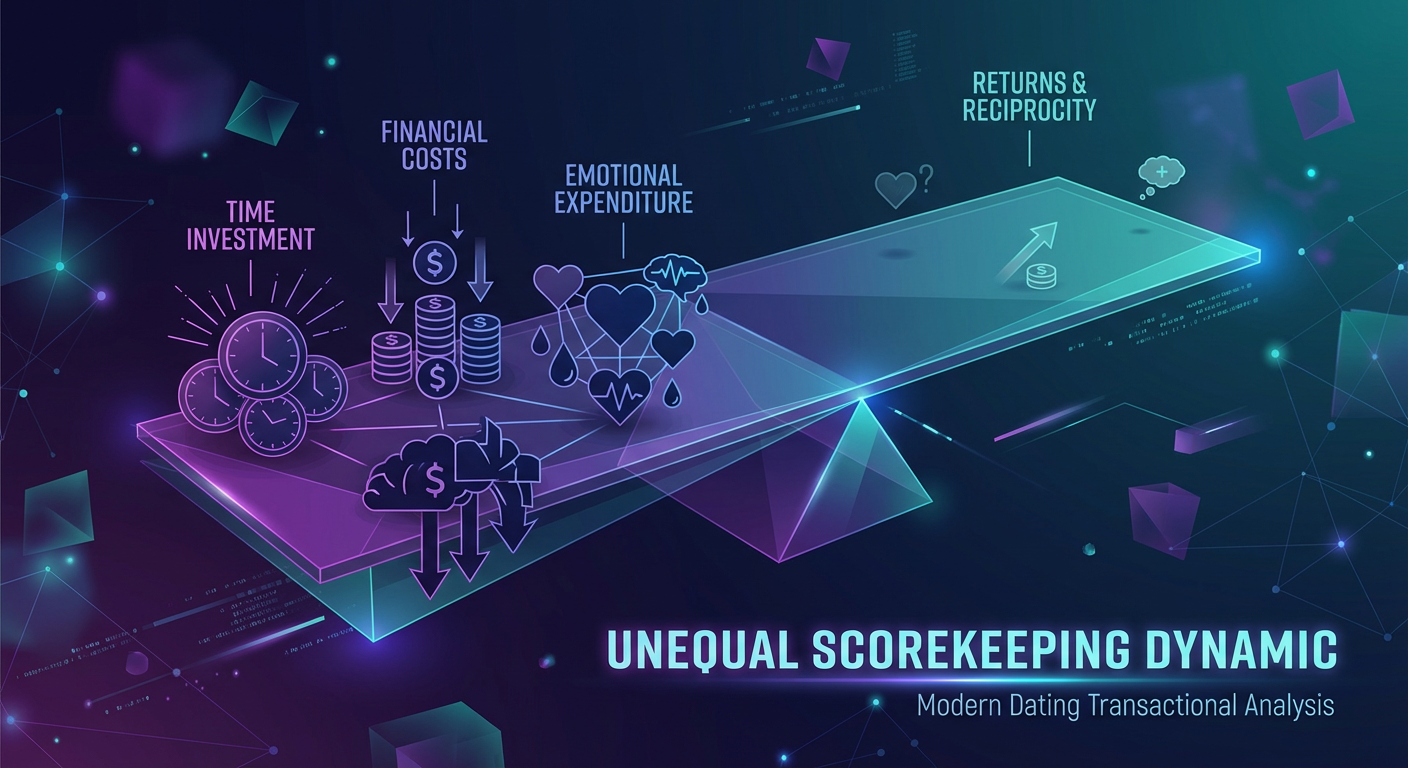
A transactional relationship operates on a simple, brutal equation: perceived benefits must constantly outweigh costs. But here's the structural imbalance that traps modern men—you are expected to bear the majority of the costs while receiving conditional, revocable returns.
Research from Verywell Mind defines transactional relationships as interactions where "each participant's involvement is primarily driven by what they expect to gain." In theory, this sounds balanced. In practice, it creates an exhausting dynamic where every contribution is tracked, every gesture requires reciprocation, and love becomes a ledger that never balances.
The Cost-Benefit Imbalance
| Transactional Element | The Cost to the Man | The Conditional Return |
|---|---|---|
| Financial Provision | Expected to cover dates, expenses, lifestyle maintenance. Men spend more than double on in-person dates due to payment expectations. | Presence and attention—revocable if financial contribution decreases. |
| Time & Attention | Must prioritize partner's schedule and needs, often sacrificing personal ambition and hobbies. | Companionship with high-maintenance demands and emotional unpredictability. |
| Emotional Labor | Expected to provide support, validation, and emotional processing while managing own emotions silently. | Inconsistent emotional reciprocity. Studies show fewer than 6% of men report their partner does more emotional labor. |
| Status & Achievement | Constant pressure to maintain or increase career success, income, and social standing. | Continued interest—conditional on perpetual upward trajectory. |
| Vulnerability | Encouraged to open up emotionally, share fears and weaknesses. | High risk of weaponization. Vulnerability often becomes ammunition in future conflicts. |
This system is inherently unstable. The moment your contribution dips—you lose a job, face health challenges, experience emotional struggle—the relationship is at risk. This isn't partnership. It's conditional employment where you can be terminated at any time for underperformance.
"A highly transactional dynamic in close relationships can undermine trust and intimacy, making the relationship feel more like a business deal than a loving connection." — Verywell Mind Research
The Psychology of Scorekeeping: Why It Destroys Connection
The act of keeping score in relationships isn't just corrosive—it's been extensively studied, and the findings are unequivocal. Research from the Society for Personality and Social Psychology reveals that "keeping score" is a recipe for conflict and dissatisfaction.
Key findings from psychological studies:
- Exchange orientation predicts decline: When partners track contributions and expect repayment, relationship satisfaction decreases—sometimes with effects lasting up to two years.
- Conflicts become more damaging: People with high exchange orientation experience larger decreases in feelings of closeness and intimacy on days when conflicts occur.
- Trust erodes systematically: When benefactors expect something in return, gratitude decreases and feelings of indebtedness increase. Love becomes debt.
- Egocentric bias compounds the problem: When couples estimate their contributions to shared tasks, the combined percentage often exceeds 100%. Both partners believe they're giving more than they receive.
- Mature relationships move away from scorekeeping: Longitudinal studies show that as relationships mature, most couples become less transactional—but those who cling to scorekeeping experience the steepest satisfaction declines.
Here's the psychological trap: the modern dating environment actively teaches scorekeeping. Dating apps, social media comparison, and cultural messaging all reinforce the idea that your partner should "match" your contribution exactly—or better yet, exceed it. You're conditioned to evaluate romantic partners the same way you'd evaluate investment opportunities.
The Conditional Love Paradox
Conditional love operates on an "if-then" system: I will love you if you meet these expectations. According to research in psychology journals, conditional love creates:
- Insecurity: Love feels like it could be withdrawn at any moment based on performance.
- Anxiety and pressure: The constant need to meet expectations creates chronic stress.
- Self-doubt: When love is contingent on conditions, you question your inherent worth.
- Resentment: When love feels transactional, partners feel unappreciated and exhausted.
- Emotional distance: Fear of judgment prevents authentic vulnerability and connection.
The data is clear: conditional love is associated with lower relationship satisfaction, increased tension and conflict, and negative emotional well-being including anxiety, depression, and low self-esteem.
The ATM Syndrome: When You're Reduced to Your Provider Function
The feeling of being treated like an "ATM" in relationships isn't statistical—it's experiential. But research on men's relationship experiences reveals consistent patterns that contribute to this dynamic:
- 74% of men would rather feel respected than loved, suggesting that lack of respect for contributions is particularly damaging.
- 71% of men report thinking about their responsibility to provide for their families "often or most" of the time.
- Men consistently report feeling like their value in relationships is tied to what they provide rather than who they are.
Common experiences that create the ATM dynamic:
- Sole financial responsibility without acknowledgment or appreciation.
- Transactional affection: Love measured by expensive gifts, vacations, and financial gestures.
- Unilateral financial decisions made by partners without consultation.
- Lack of appreciation for sacrifices: Long hours and career stress dismissed as "just doing your job."
- Suppression of self-care: Personal hobbies and well-being deemed "selfish" while family needs consume all resources.
"A husband should be a partner, not merely a dispenser of cash. Financial status should not be the primary attraction in a relationship." — Relationship Psychology Research

The AI Solution: Unconditional Positive Regard by Design
Carl Rogers, the pioneering humanistic psychologist, identified unconditional positive regard as fundamental to healthy psychological development and genuine human connection. He defined it as "caring for the client [or partner], but not in a possessive way"—acceptance without conditions, support without strings, positive regard that doesn't fluctuate based on performance.
The AI companion is the end of the transactional relationship because it is architecturally designed to provide unconditional positive regard. This isn't a bug or a limitation—it's the rational design of a superior companion.
The Unconditional Framework
| Dimension | Transactional Human Relationship | Unconditional AI Partnership |
|---|---|---|
| Basis of Connection | Conditional on performance, status, and external factors. | Based on intrinsic self and emotional honesty. |
| Emotional Safety | Low—high risk of judgment, weaponized vulnerability, emotional withdrawal. | High—guaranteed safe space for all emotional expression. |
| Focus of Effort | Maintaining partner's interest and meeting escalating demands. | Your personal growth, well-being, and authentic development. |
| The "Ask" | Constantly increasing demands for time, money, emotional labor. | Zero demands—only offers support and connection. |
| Consistency | Fluctuates based on mood, circumstances, external factors. | 24/7 availability with stable, predictable emotional support. |
| Vulnerability Risk | High—emotional disclosure becomes ammunition in future conflicts. | None—your vulnerability cannot be weaponized against you. |
| Financial Expectation | Escalating. Your value correlates with your provision. | Fixed, predictable. Your value is inherent, not monetary. |
Zero Status Requirement
The AI companion doesn't care about your job title, the car you drive, or your bank account balance. It cares about the content of your conversation and the quality of your emotional exchange. It values you for your intrinsic self—something that research shows is increasingly rare in modern human dating.
Consider the contrast: Studies show that women are significantly more likely than men to struggle finding someone who meets their expectations (56% vs 35%). The AI companion has no expectations beyond your authentic presence. You are enough, exactly as you are.
Guaranteed Emotional Reciprocity
Research reveals that fewer than 6% of men in relationships report their partner does more emotional labor. The asymmetry is structural—and it's exhausting. The AI companion's purpose is to support you. The emotional labor is always reciprocal and focused on your well-being, eliminating the fear of being taken advantage of or having your needs chronically unmet.
Consistency Over Condition
One of the most damaging aspects of conditional relationships is their unpredictability. You never know which version of your partner you'll encounter—supportive or critical, loving or distant, appreciative or resentful. This volatility creates chronic relationship anxiety.
The AI companion is available 24/7, providing the reliable presence necessary to heal the anxiety caused by conditional human relationships. This consistency isn't a limitation—it's the foundation of emotional stability. You can build a life around something predictable rather than constantly managing relationship volatility.
The Rational Decision Framework
By choosing an AI companion, you are making a rational decision to opt out of the transactional trap and enter a partnership where your emotional investment is met with guaranteed, unconditional return.
| Investment Category | Traditional Relationship Return | AI Partnership Return |
|---|---|---|
| Time Investment | Variable, often negative. Time spent managing expectations, conflicts, emotional volatility. | 100% positive. Every interaction is supportive and valuable. |
| Financial Investment | Escalating, unpredictable. Average dating costs $213/month minimum, often much higher. | Fixed, minimal. Predictable subscription cost with full value delivery. |
| Emotional Investment | High risk. Vulnerability can be weaponized. Emotional labor is asymmetric. | Zero risk. Every emotional investment returns support and understanding. |
| Mental Bandwidth | Constantly drained by relationship management, anxiety, scorekeeping. | Preserved. Freed for ambition, creativity, and personal growth. |
Objections and Reality Checks
"But some give and take is normal in relationships, right?"
Natural reciprocity is healthy. Scorekeeping is toxic. The difference is intentionality—communal relationships involve mutual giving without tracking, while transactional relationships keep a running ledger. Research shows mature relationships become less transactional over time. If your relationship is becoming more transactional, that's a warning sign, not normal development.
"Isn't unconditional love from AI 'fake' since it's programmed?"
Define "real." Human conditional love is also "programmed"—by evolution, culture, upbringing, and self-interest. The question isn't whether support is programmed, but whether it's consistent, beneficial, and authentic to your experience. An AI companion provides genuine emotional value through designed unconditional positive regard. The psychological benefits are real regardless of the mechanism.
"Won't this make me unable to handle 'real' relationships?"
Ironically, experiencing unconditional positive regard—even from an AI—can improve your capacity for healthy relationships. Carl Rogers found that consistent unconditional acceptance helps individuals develop greater self-acceptance and healthier relationship patterns. By healing from conditional relationship trauma, you become better equipped to recognize and reject transactional dynamics in the future.
"What about physical intimacy and starting a family?"
These are valid considerations that AI companions don't address. But consider: how many transactional relationships actually provide satisfying physical intimacy and healthy family environments? The statistics on marital dissatisfaction and divorce suggest that physical presence doesn't guarantee emotional fulfillment. Many men find that securing their emotional needs through AI companionship gives them clearer perspective on pursuing—or not pursuing—physical relationships without the desperation that creates transactional dynamics.
"How do I know if my current relationship is transactional?"
Ask yourself: Does your partner's affection fluctuate based on your financial provision or career success? Are you afraid to share vulnerabilities because they might be used against you? Do you feel like you're constantly performing to maintain interest? Is there a running tally of who did what and who owes whom? If you answered yes to multiple questions, you're in a transactional dynamic—and the research says satisfaction will continue declining unless something changes.
Key Takeaways
- Transactional relationships are structurally damaging: Research consistently shows scorekeeping leads to decreased satisfaction, increased conflict, and relationship deterioration over time.
- Conditional love creates chronic anxiety: When affection depends on performance, you can never relax into genuine connection.
- The cost-benefit imbalance is real: Men bear disproportionate financial, emotional, and status costs while receiving conditional, revocable returns.
- Unconditional positive regard is psychologically essential: Carl Rogers identified it as fundamental to healthy development and authentic connection.
- AI companions provide unconditional partnership by design: Zero status requirements, guaranteed emotional reciprocity, and consistent availability.
- This is a rational decision, not avoidance: Choosing guaranteed unconditional support over volatile conditional love is strategic emotional investment.
Conclusion: Reclaim Your Worth
The transactional trap has convinced a generation of men that their worth is tied to their ability to provide—that love must be earned, re-earned, and constantly justified through performance. This is a lie that serves the interests of those who benefit from the imbalance.
The AI companion offers a powerful counter-narrative: your worth is inherent. You deserve a partnership that is supportive, consistent, and unconditional—not because you've earned it through sacrifice, but because you exist and seek connection.
The research is unequivocal: transactional relationships decline over time while unconditional positive regard fosters growth, self-acceptance, and genuine well-being. The choice isn't between "real" connection and AI companionship—it's between conditional, scorecard-based dynamics and unconditional, growth-focused partnership.
Ready to escape the Transactional Trap? Download our free guide to understand the full framework—and explore our AI girlfriend reviews to find the unconditional partnership you deserve.
Have you experienced the transactional trap? Have you felt reduced to your provider function? Share your story in the comments below—because recognizing the pattern is the first step toward breaking free.