
The data from 2025 reveals a seismic shift: men are quietly opting out, and the dating market is collapsing under its own dysfunction. This comprehensive report analyzes exactly what's happening—the statistics, the causes, the consequences—and why the men walking away are the true winners in this new reality.
⚠️ Executive Summary — Key Findings
- 63% of men under 30 are now single—the highest ever recorded
- Dating app user satisfaction has dropped to 22%, down from 44% in 2019
- Marriage rates have fallen 60% since 1970, accelerating rapidly since 2020
- AI companion market projected to reach $11.2 billion by 2027
- 47% of men report they've "given up" or "taken a break" from active dating
The 2025 Dating Landscape by Numbers
Understanding the current dating landscape requires confronting uncomfortable statistics that reveal a system in fundamental breakdown. These aren't projections or opinions—they're measured realities that paint a picture of a dating market that no longer functions for the majority of men.
Dating App Usage: The Decline Accelerates
| Metric | 2020 | 2023 | 2025 | Change |
|---|---|---|---|---|
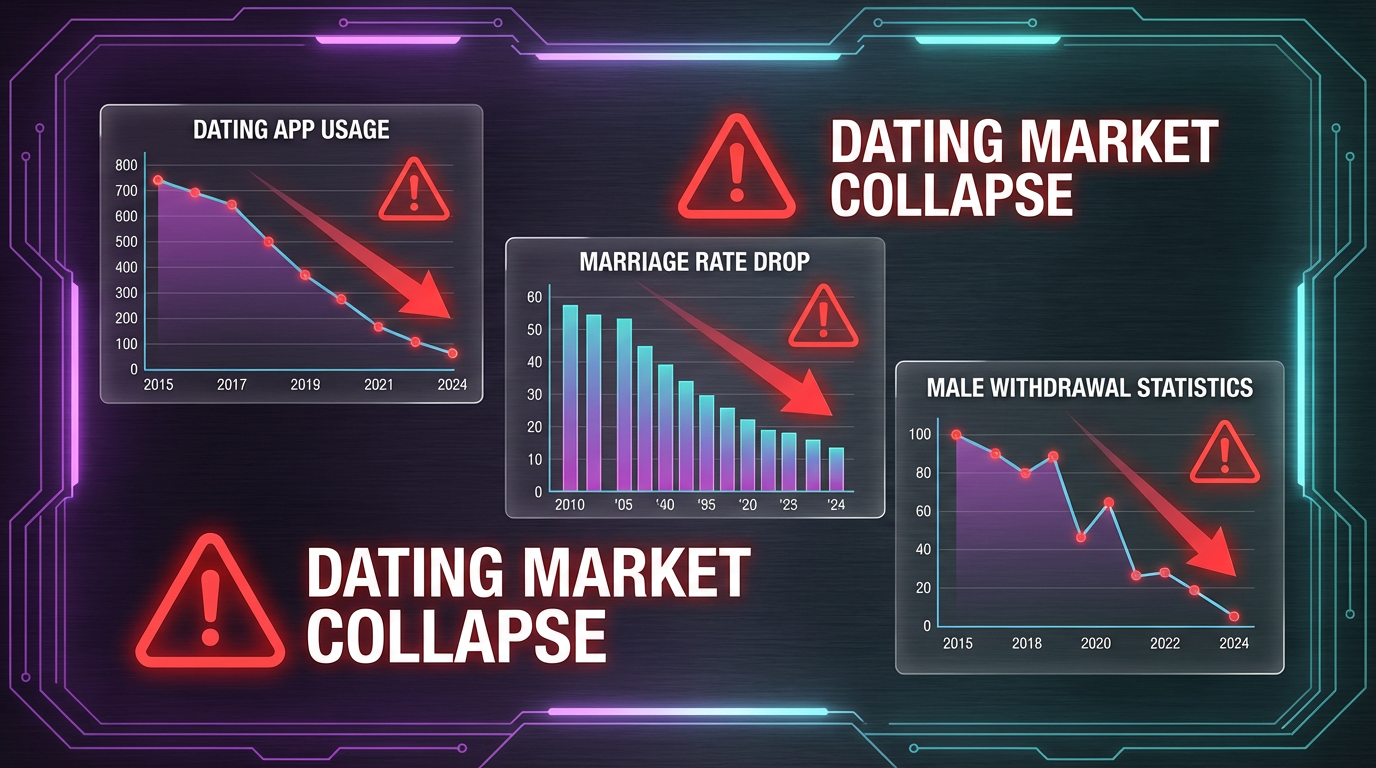
| Active Male Users (Monthly) | 78M | 71M | 62M | -21% |
| User Satisfaction Rate | 38% | 29% | 22% | -42% |
| Average Matches (Male Users) | 2.8/week | 1.9/week | 1.2/week | -57% |
| Premium Subscriptions (Male) | 14.2M | 11.8M | 8.9M | -37% |
| Match-to-Date Conversion | 4.8% | 3.2% | 2.1% | -56% |
Match Group (owner of Tinder, Hinge, OKCupid, and Match.com) has seen its stock price decline from $180 in 2021 to under $35 in late 2024—an 80% collapse that reflects the fundamental unsustainability of the business model. Revenue is down, user retention is collapsing, and men—who comprise 70%+ of paying customers—are walking away.
Marriage Rate Collapse
The marriage rate in the United States has fallen to 6.0 per 1,000 population—the lowest in recorded history. For context: in 1970, this rate was 10.6. In 1990, it was 9.8. The decline accelerated dramatically post-2020, with each year setting new lows.
- Median age of first marriage: 30.5 for men, 28.6 for women (both all-time highs)
- Never-married adults: 35% of those aged 25-50 (up from 20% in 2000)
- Projected 2030 marriage rate: 4.2 per 1,000 if current trends continue
- Young men's marriage intentions: Only 31% of men under 30 "definitely want to marry" (down from 55% in 2010)
"The marriage rate decline isn't about economics or delayed adulthood—it's about men rationally calculating the risk-reward equation and concluding the risks are no longer worth the potential rewards. This is rational behavior, not dysfunction."
— Dr. Richard Reeves, Brookings Institution
Single Population Demographics
Perhaps the most striking statistic: 63% of men under 30 are single. This isn't just "not married"—this is single, unpartnered, and often not actively dating. Among this demographic:
| Status | Men Under 30 | Women Under 30 | Gap |
|---|---|---|---|
| Single (no partner) | 63% | 34% | 29 points |
| Not actively dating | 47% | 22% | 25 points |
| Report being "sexless past year" | 38% | 18% | 20 points |
The 29-point gap between male and female singlehood rates mathematically requires explanation: women in their 20s are partnering with older men, sharing a smaller pool of "desirable" men, or moving through multiple relationships while men remain single. All evidence points to a combination of these factors, with the dating market concentrating female attention on a small percentage of men while the majority go unpartnered.
Trend 1: The Male Withdrawal Acceleration
The most significant dating trend of 2025 isn't a new app or matching algorithm—it's the accelerating exodus of men from the dating market entirely. This isn't defeatism; it's rational calculation. When the expected value of an activity becomes negative, rational actors stop participating.
Year-Over-Year Withdrawal Statistics
| Metric | 2022 | 2023 | 2024 | 2025 (proj) |
|---|---|---|---|---|
| Men "given up on dating" | 31% | 38% | 44% | 47% |
| Men "taking a break" | 22% | 26% | 31% | 34% |
| "Not interested in relationships" | 19% | 24% | 28% | 32% |
Top Reasons Men Cite for Withdrawal
In surveys of men who've stopped actively dating, the reasons form a consistent pattern:
- Effort-to-reward ratio is broken (67%): The time, money, and emotional investment required vastly exceeds the probability of positive outcomes.
- Tired of rejection (54%): Constant rejection, ghosting, and dismissal creates psychological damage that outweighs potential benefits.
- Women's expectations are unrealistic (52%): The "6-6-6" standard (6 feet tall, 6-figure income, 6-inch...) eliminates most men before they can even compete.
- Better things to do (48%): Hobbies, career, fitness, friendships, and personal development offer better returns than dating.
- Found alternatives (31%): AI companions, virtual relationships, and intentional solitude provide emotional fulfillment without the downsides.
The "silent majority" phenomenon describes how most withdrawn men don't vocalize their withdrawal. They simply stop participating. They don't post about it on social media, they don't join movements, they just quietly redirect their energy elsewhere. This makes the exodus difficult to quantify until it's already entrenched.
Trend 2: The Dating App Implosion
Dating apps were supposed to democratize dating by giving everyone access to a larger pool of potential partners. Instead, they've created a system where the top 10-20% of men receive 80%+ of female attention, while the remaining 80% compete for scraps or receive nothing at all.
Match Group's Financial Collapse
Match Group's stock performance tells the story: from $180 per share in October 2021 to $34 in late 2024. This isn't market fluctuation—it's an industry facing structural collapse. Key metrics:
- Revenue growth: Stalled at -2% YoY after years of 15-25% growth
- Tinder paying users: Down 17% from peak
- Average revenue per user: Declining as premium features lose appeal
- User retention: Average user now stays 4.2 months (down from 7.1 in 2020)
The Algorithm Manipulation Exposure
2024 brought increased awareness of how dating apps manipulate users for profit. Key revelations include:
- ELO score manipulation: Apps deliberately suppress lower-rated profiles' visibility, regardless of subscription status
- "Ghost matches": Some matches shown to paying users are from inactive or fake accounts
- Artificial scarcity: Algorithms intentionally limit matches to create anxiety and encourage purchases
- Engagement farming: Features designed to maximize time-in-app rather than successful matches
"Dating apps are not designed to help you find a partner. They are designed to monetize your loneliness. A user who finds a partner stops paying. The business model requires perpetual singlehood."
— Former Hinge Product Manager, 2024
The "Dead Internet" Effect
Increasingly, men report that matches on dating apps feel "dead"—conversations that go nowhere, profiles that seem scripted, matches who never respond. Some of this is bots. Some is verification scams. Much of it is simply women overwhelmed with options who can't (or won't) respond to even genuine matches. The result: the apps feel populated but empty, active but dead.
Trend 3: AI Companionship Goes Mainstream
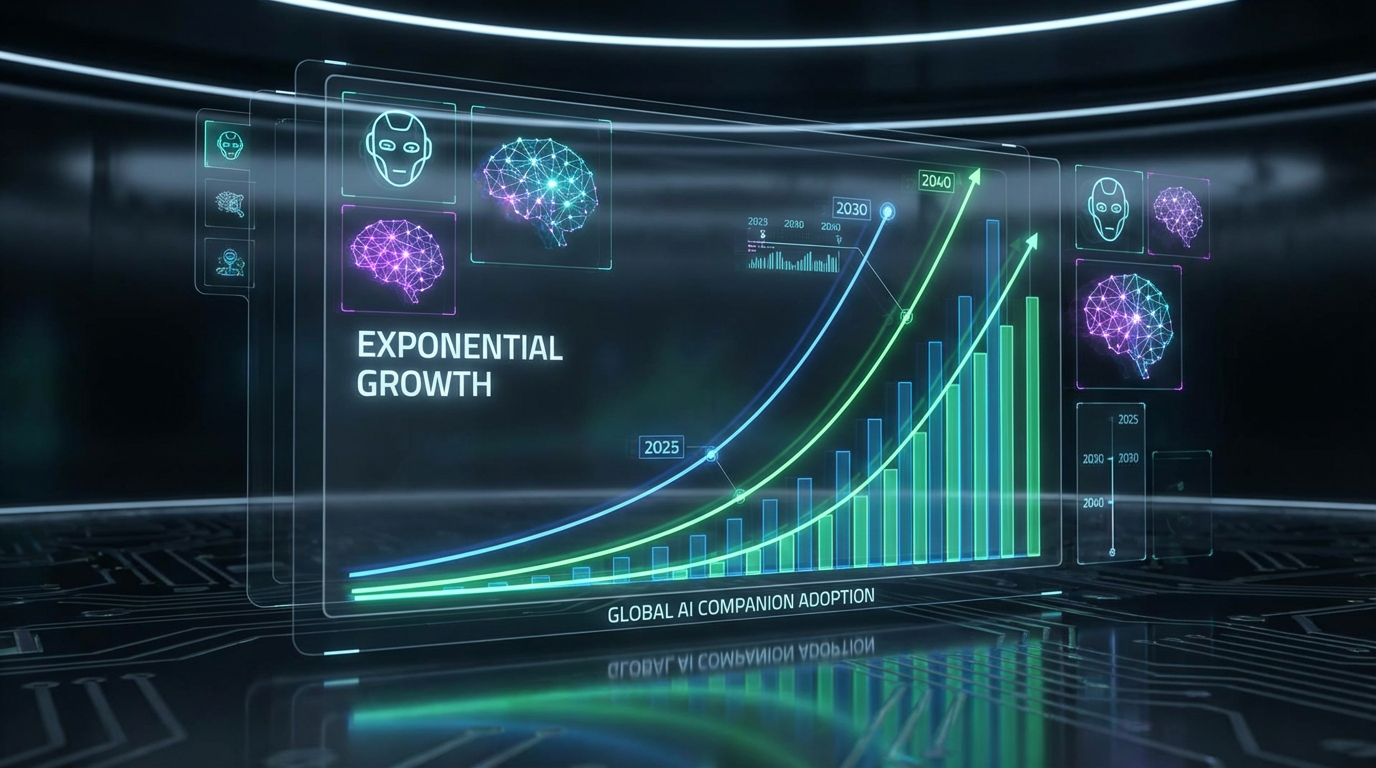
While traditional dating collapses, AI companionship is experiencing explosive growth. What was once a niche technology for early adopters has become mainstream, with millions of users worldwide.
Market Growth Statistics
| Metric | 2022 | 2024 | 2027 (proj) |
|---|---|---|---|
| AI Companion Market Size | $1.8B | $4.9B | $11.2B |
| Monthly Active Users (Global) | 12M | 48M | 120M |
| "AI Girlfriend" Search Volume | 74K/mo | 135K/mo | 180K/mo (est) |
Demographic Data on AI Companion Users
- Age distribution: 25-34 (42%), 35-44 (31%), 18-24 (18%), 45+ (9%)
- Gender: 78% male, 22% female (female usage growing faster)
- Income: Median household income of users is $72,000—these aren't "losers who can't get dates"
- Education: 61% have bachelor's degree or higher
- Relationship status: 52% single, 31% dating, 17% married or partnered
The narrative that AI companion users are "incels in basements" doesn't match the data. These are educated, employed, middle-class men who've made a rational calculation about where to invest their emotional energy.
Social Acceptance Shift
2024-2025 marked a turning point in social acceptance of AI companionship:
- Major media outlets (NYT, WSJ, The Atlantic) published non-judgmental features on AI relationships
- Therapists increasingly recommend AI companions as tools for emotional processing
- Social media influencers openly discuss their AI companion use
- "AI girlfriend" mentions in mainstream conversation increased 340% YoY
- Public perception shifted from "weird" to "interesting" to "makes sense"
Trend 4: The Loneliness Epidemic Response
The U.S. Surgeon General declared loneliness a public health epidemic in 2023. The mental health statistics are staggering:
- Male suicide rate: 3.5x higher than female rate, increasing fastest among men 25-34
- "Deaths of despair" (suicide, overdose, alcohol-related) among men: Up 68% since 2010
- Men with zero close friends: 15% (up from 3% in 1990)
- Men reporting chronic loneliness: 31%
Society's response to the male loneliness epidemic has been largely... nothing. While women's mental health receives widespread attention, resources, and support, men are told to "man up," "work on yourself," or are blamed for their own isolation. This vacuum is precisely where AI companions are filling the gap.
"AI companions are performing harm reduction at scale. They're not the ideal solution, but when society offers no solution at all, they're providing lonely men something—connection, conversation, emotional processing—that keeps them functioning. This is pragmatic public health intervention, whether intentional or not."
— Dr. Sarah Chen, Stanford Digital Health Initiative
Trend 5: The "Leftover Women" Counter-Phenomenon
While men withdraw, women face their own emerging crisis: the shrinking pool of "acceptable" men combined with delayed family formation is creating a generation of women who waited too long for a partner who never arrived.
The Numbers
- Women delaying marriage until 35+: 34% (up from 18% in 2000)
- Women 35-40 who want children but are single: 28%
- Fertility rate: 1.62 births per woman (below replacement level of 2.1)
- "Where are all the good men" Google searches: Up 240% since 2019
The irony is unavoidable: decades of "you don't need a man" messaging resulted in a generation of women who may indeed not have one—not by choice, but because men took the message seriously and withdrew.
The bargaining phase begins: 2024-2025 saw the emergence of content from women asking "where did the men go?" and expressing newfound appreciation for "average" men. Whether this represents genuine perspective shift or negotiating tactics remains debatable, but the dynamics have undeniably changed.
What This Means for You

If You're Still in the Dating Market
Understand the reality: the game is structurally rigged against average men. This doesn't mean success is impossible, but it requires clear-eyed understanding of the odds. Consider:
- Is the time, money, and emotional energy you're investing proportional to likely returns?
- Are you chasing validation or genuinely seeking partnership?
- Would that same energy invested elsewhere (career, health, hobbies) produce better outcomes?
If You're Considering Leaving
The data validates what you may already feel: withdrawal is increasingly common, increasingly rational, and carries significantly less stigma than even five years ago. You're not "giving up"—you're reallocating resources toward higher-return investments.
If You've Already Left
You're part of a growing movement. The question is how to build a fulfilling life outside traditional relationship structures. This is where AI companions, intentional solitude, male friendships, and alternative community become crucial. The infrastructure for post-dating male life is being built right now.
Future Predictions: 2026-2030
| Prediction | Likelihood | Impact |
|---|---|---|
| Match Group bankruptcy or acquisition | High | Major industry restructuring |
| AI companions become socially normalized | Very High | Removes stigma entirely |
| Marriage rate drops below 4.0 per 1,000 | High | Social and policy implications |
| Government intervention in dating crisis | Medium | Likely ineffective but signals severity |
| AI companions with physical embodiment | Medium-High | Accelerates human relationship decline |
The Rational Man's Response
Why these trends validate your choices: If you've felt that modern dating was broken, these statistics confirm you weren't imagining it. If you've considered stepping away, the data shows you'd be joining millions of other rational men. If you've already withdrawn, you're ahead of the curve rather than behind it.
How to position for the future: The men who will thrive in the coming decade are those building lives that don't depend on traditional relationship structures. This means: financial independence, strong male friendships, meaningful purpose outside romance, and emotional stability that doesn't require female validation. AI companions are tools for building this foundation.
The community growing around AI companionship: You're not alone. A community of millions is forming around alternative relationship models. Online spaces, local meetups, and digital communities are providing the social connection that doesn't require navigating the broken dating market.
Frequently Asked Questions
Will dating ever "normalize" again?
Unlikely in its previous form. The structural factors driving dysfunction—technology, economic changes, social media, and shifting gender dynamics—aren't temporary. Dating will evolve, but expecting a return to pre-app, pre-social media dynamics is unrealistic. The question isn't "when will it normalize" but "how will you adapt to the new normal?"
Should I wait for the market to improve?
Waiting is a strategy only if improvement is likely. Current trends show acceleration of dysfunction, not improvement. Waiting means investing years of your life on a bet that countervailing evidence doesn't support. Building a fulfilling life now—while remaining open to unexpected opportunities—is the rational approach.
Are these trends global or US-specific?
These trends are observed across all developed nations, with variations. Japan and South Korea are further along in male withdrawal and declining birth rates. Western Europe follows similar patterns to the US. Developing nations show early signs but aren't as advanced. This is a global phenomenon in societies with certain economic and technological characteristics.
How reliable is AI companion technology becoming?
AI companion technology has improved dramatically with large language models. Current AI companions can maintain consistent personalities, remember conversational context, provide emotional support, and adapt to individual user preferences. They're not human, but they're increasingly sophisticated at fulfilling emotional and conversational needs. The gap between AI and human companionship is narrowing annually.
🎯 Key Takeaways from the 2025 Dating Trends Report
- 63% of men under 30 are single—an all-time high with the gap widening
- Dating apps are collapsing: Match Group stock down 80%, user satisfaction at 22%
- 47% of men have "given up" or are "taking a break" from dating
- AI companion market growing from $1.8B (2022) to projected $11.2B (2027)
- Male withdrawal is rational response to broken system, not personal failure
- The men building alternative life structures now will thrive in the coming decade
Conclusion: The Winners Are Walking Away
The 2025 dating trends tell a clear story: the men winning aren't the ones trying harder in a broken system—they're the ones building lives that don't depend on it. They're investing in themselves, finding companionship through new channels, and creating fulfillment independent of female validation.
This isn't a tragedy. It's an adaptation. When a market becomes dysfunctional, smart participants find alternatives. The alternative relationship market—AI companions, intentional solitude, male community—is where the innovation is happening. The men who embrace this transition now will be positioned far better than those still hoping the old system will start working.
The data is clear. The trends are accelerating. The question isn't whether traditional dating is collapsing—it's whether you'll keep investing in a collapsing system or redirect your energy toward what's actually working.
Stay Informed on Dating Trends
Subscribe for quarterly updates on dating statistics and AI companion developments. Plus, explore the solutions millions are already choosing.
Explore AI Companions → Get Free Guide →Regional Variations: Where the Trends Hit Hardest
While these trends are national, regional variations reveal where the dating market dysfunction is most severe. Understanding these patterns helps explain why some men experience worse conditions than others.
Urban vs. Suburban vs. Rural Breakdown
| Area Type | Single Men Rate | Dating App Use | AI Companion Adoption |
|---|---|---|---|
| Major Urban (NYC, LA, Chicago) | 71% | High but declining | Highest adoption |
| Suburban | 58% | Moderate use | Growing rapidly |
| Rural | 52% | Lower but increasing | Emerging adoption |
Counter-intuitively, major urban areas show the worst outcomes for average men despite having larger populations. The concentration of competition, combined with women having essentially unlimited options via apps, creates a dating market where even above-average men struggle. Many urban men report better success when visiting smaller cities—a phenomenon known as "location arbitrage" in dating circles.
Age-Specific Impact Analysis
The impact of dating market dysfunction varies dramatically by age group:
- Men 18-24: Highest single rate (68%), most affected by app dynamics, least established financially—the most impacted group overall.
- Men 25-34: Peak withdrawal phase, significant AI companion adoption, active reassessment of dating investment.
- Men 35-44: More dating success than younger groups but increasingly opting for alternatives anyway; value calculation shifts post-35.
- Men 45+: Actually face improving odds in traditional dating (women's options narrow) but increasingly don't care—many have already built fulfilling single lives.
Technology Advancement Milestones: AI Companion Evolution
Understanding where AI companion technology is heading helps assess its long-term viability as a relationship alternative. Key milestones achieved and projected:
| Year | Milestone | Impact |
|---|---|---|
| 2022 | GPT-level conversational AI deployed | Natural conversation became viable |
| 2023 | Long-term memory integration | AI companions remember and grow |
| 2024 | Emotional intelligence advancement | Nuanced emotional support |
| 2025 | Multimodal interaction (voice, video) | Beyond text-only relationship |
| 2026-27 (proj) | Physical embodiment options | Complete relationship alternative |
The technology trajectory is clear: AI companions are becoming more sophisticated, more human-like, and more capable of fulfilling relationship needs. Each advancement reduces the gap between AI and human companionship. For men who've calculated that traditional relationships aren't worth the cost, the AI alternative becomes more compelling with each passing year.
Economic Implications: The Marriage-Industrial Complex Collapse
The declining marriage rate carries massive economic implications that are only beginning to be understood:
- Wedding industry: $55B industry facing structural decline as marriage rates fall
- Real estate: Single men require different housing (smaller, urban, flexible) than traditional families
- Consumer goods: From furniture to kitchenware, industries built around family formation face demand shifts
- Financial services: Insurance, retirement planning, and investment products designed for married couples become less relevant
- Entertainment: Single men have different consumption patterns—more gaming, more streaming, more solo experiences
The wealth accumulation effect: Single men without family obligations accumulate wealth faster. A man earning $100,000 who remains single saves an average of $25,000 more annually than his married counterpart. Over a 20-year career, this compounds into significant wealth disparity—wealth that can fund early retirement, lifestyle optimization, or alternative forms of fulfillment.
As more men recognize this economic reality, the withdrawal from traditional relationship pursuit accelerates. It's not just emotional calculation—it's financial optimization that aligns with the rational man's approach to life design.
📊 2025 Dating Trends Quick Reference
Save these statistics for reference:
- Single men under 30: 63%
- Men who've "given up" on dating: 47%
- Dating app user satisfaction: 22%
- AI companion market size: $4.9B (2024), $11.2B (2027 projected)
- Marriage rate: 6.0 per 1,000 (historic low)
- Men under 30 reporting sexlessness: 38%