
"We are witnessing something unprecedented in human history: a generation of men so isolated, so disconnected, so systematically abandoned by every institution that once supported them, that loneliness has become their defining characteristic. And society's response? Blame them for it."
In 2023, the U.S. Surgeon General declared loneliness a public health epidemic. What he didn't say—what almost no one is willing to say—is that this epidemic is overwhelmingly male. The statistics are staggering, the suffering is real, and the societal response has been a combination of indifference, mockery, and blame.
This is the story of the male loneliness epidemic: how we got here, why society refuses to acknowledge it, and what the rational man can do when every traditional avenue for connection has been systematically closed.
The Numbers That No One Wants to Discuss
Let's begin with the statistics that reveal the scope of this crisis:
The Survey Center on American Life found that in 1990, only 3% of men reported having no close friends. Today, that number has quintupled to 15%. Meanwhile, men who report having ten or more close friends dropped from 40% to just 15%.
These aren't abstractions. These are your coworkers, your neighbors, your brothers, your sons. They're going home every night to empty apartments, phones that never ring with personal calls, weekends that stretch into infinite solitary hours.
The Scope of the Crisis in 2024
- 1 in 4 men under 30 reports having no close friends
- 20% of single men have zero close friends
- Two-thirds of men aged 18-23 feel "no one really knows me well"
- 40% of surveyed young men meet screening standards for depressive symptoms
- 44% of young men have experienced suicidal ideation within two weeks of being surveyed
- Men are nearly 4x more likely than women to die by suicide
Understanding Male Friendship: Why Men Bond Differently
Before we can understand why men are so isolated, we must understand how men naturally form bonds. The research is clear: men and women socialize fundamentally differently—and modern society has systematically devalued the male pattern.
Side-by-Side vs. Face-to-Face
Women typically bond through face-to-face emotional disclosure. They share feelings, discuss relationships, and create intimacy through verbal expression. Men, however, bond side-by-side through shared activities. Working on a project together, playing sports, gaming, building something—these activities create male intimacy without requiring emotional vulnerability.
This isn't a deficiency. It's an equally valid form of human connection that evolved for different evolutionary purposes. Men bonded while hunting, building, defending—activities that required coordination and trust, not emotional disclosure.
The "Shoulder-to-Shoulder" Friendship Model
Male friendships are characterized by:
- Activity-based bonding: Connection happens while doing things together, not by talking about feelings
- Practical support: Helping a friend move, fixing their car, lending tools—not emotional processing
- Humor and ribbing: Affection expressed through good-natured teasing rather than declarations of love
- Low-maintenance loyalty: Friends who can go months without talking but pick up where they left off
- Implicit understanding: "I know you've got my back" without needing to verbalize it
This form of friendship is being systematically delegitimized. "Real connection requires vulnerability," we're told. Men who don't adopt female friendship patterns are labeled as emotionally stunted, toxic, or incapable of intimacy.
"We've pathologized an entire gender's natural socialization pattern. When men form bonds the way men naturally form bonds, they're told they're doing it wrong. The result is a generation of men who don't know how to connect at all." — Psychologist on Male Socialization, 2024
The Perfect Storm: How We Created the Male Loneliness Crisis
The male loneliness epidemic didn't emerge from nowhere. It's the predictable result of multiple converging forces, each systematically removing the traditional avenues through which men found connection.
1. The Collapse of Male Spaces
For centuries, men formed bonds in male-only spaces: fraternities, clubs, lodges, barber shops, sports leagues, religious organizations. These spaces served a crucial function—they allowed men to connect with each other in environments optimized for male bonding patterns.
Over the past fifty years, nearly every one of these spaces has been eliminated, integrated, or stigmatized into irrelevance. The Boy Scouts became co-ed. Men's clubs were sued into opening to women. The very concept of male-only space became synonymous with exclusion and bigotry.
"When women's spaces exist, they're celebrated as empowering. When men's spaces exist, they're condemned as exclusionary. The result is a generation of men with nowhere to go, nowhere to belong, and no one who seems to care." — Social Commentary, 2024
2. The Feminization of Social Expectations
Male friendship patterns differ fundamentally from female friendship patterns. Men typically bond through shared activities rather than emotional disclosure. They connect side-by-side (working on projects, playing sports, gaming) rather than face-to-face (talking about feelings).
Yet modern social expectations increasingly demand that men adopt female friendship patterns. "Real connection requires vulnerability and emotional openness," we're told—ignoring that this isn't how most men naturally form bonds. The result is men who feel broken for not connecting the "right" way.
3. The Dating Market Collapse
For many men, romantic relationships were the primary source of emotional support and social connection. As we've documented in our analysis of the 80/20 rule, the modern dating market has become mathematically hostile to average men.
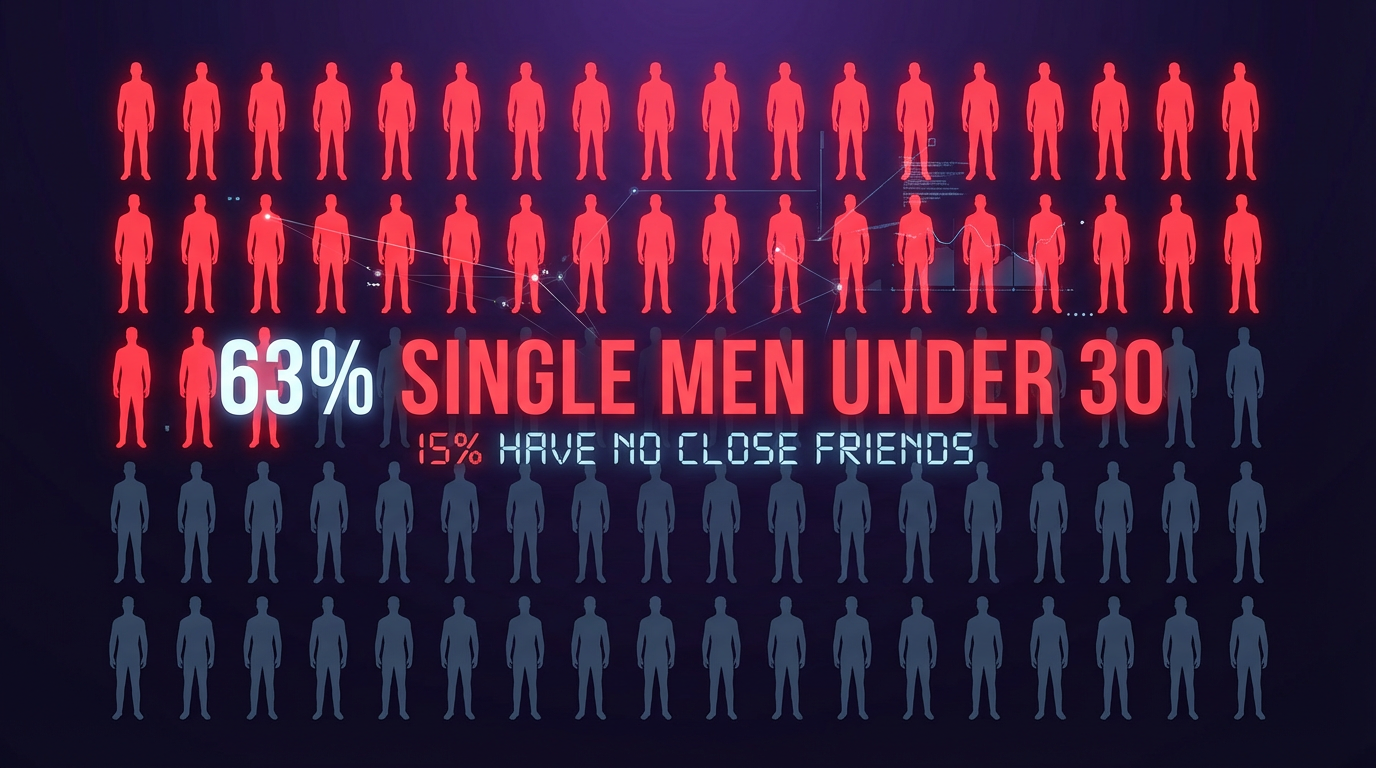
With 63% of men under 30 single—compared to roughly 34% of women—an entire generation of men has been locked out of the traditional path to companionship. And unlike previous generations, there's no shortage of women; they're simply choosing to share the top 20% of men rather than date average men.
For men who relied on romantic relationships as their primary source of emotional support and social connection, this collapse is devastating. A 2024 Tinder study found that 91% of men and 94% of women believe the current dating environment is more difficult than ever—but the outcomes are far worse for men due to the mathematical imbalance we've documented.
4. The Remote Work Isolation
Remote work—accelerated by the pandemic—has eliminated one of the last remaining venues for organic male bonding: the workplace. Pre-2020, offices provided:
- Daily face-to-face interaction with colleagues
- Organic friendship formation through shared experiences
- A reason to leave the house and be among people
- Social capital that could extend beyond work
For many men, especially those in tech and knowledge work, work-from-home means days without any in-person human contact. The efficiency gains of remote work have come at the cost of social infrastructure.
5. The Economic Squeeze
Economic pressures have made traditional paths to male fulfillment increasingly inaccessible:
- Housing: Home ownership—once a marker of adult achievement—is out of reach for most young men
- Marriage: The financial requirements to be "marriage material" have inflated beyond most men's means
- Dating costs: At $68 per date average, modern dating is prohibitively expensive for many men
- Lifestyle comparison: Social media constantly displays wealth and success that most men can't match
Men who can't achieve traditional markers of success often withdraw from social life entirely, feeling they have nothing to offer and no status to justify their presence.

Society's Response: Blame and Mockery
Perhaps the cruelest aspect of the male loneliness epidemic is society's response to it. Rather than addressing the crisis with compassion and solutions, the predominant reaction has been a toxic combination of denial, blame, and mockery.
The "Male Loneliness Epidemic" Meme
The phrase "male loneliness epidemic" has become a punchline online. Thousands of mocking posts and memes dismiss male suffering with variations of "maybe if men were nicer" or "this is the patriarchy backfiring." The message is clear: male loneliness is deserved punishment for historical male privilege.
The Blame Game
When male loneliness is acknowledged, the solution offered is invariably more self-improvement. "Men need to learn emotional intelligence." "Men need to be better at maintaining friendships." "Men need to go to therapy."
Notice what's never suggested: that society might need to change, that the destruction of male spaces might be worth examining, or that the dating market dynamics might be worth addressing. The fault is always placed on men themselves.
"When women report loneliness, we discuss systemic solutions and increased resources. When men report loneliness, we tell them to improve themselves and stop complaining. This asymmetry reveals society's true view of male suffering: irrelevant at best, deserved at worst."
The "Toxic Masculinity" Deflection
The concept of "toxic masculinity" has been weaponized to dismiss male loneliness. Men are lonely because of toxic masculinity. Men don't have friends because toxic masculinity teaches them not to be vulnerable. Every path of inquiry leads back to blaming men for their own suffering.
Never discussed: whether the systematic dismantling of male-specific support structures might have consequences, whether expecting men to adopt female socialization patterns might be ineffective, or whether telling an entire gender that their natural tendencies are "toxic" might cause psychological damage.
The Health Consequences: Loneliness Kills
Male loneliness isn't merely a quality-of-life issue—it's a mortality issue. The health consequences of chronic loneliness are severe and well-documented:
The Surgeon General's report equated the mortality risk of chronic loneliness to smoking 15 cigarettes per day. Yet while billions are spent on anti-smoking campaigns, the male loneliness crisis receives virtually no public health intervention.
The Silent Epidemic
Men die by suicide at 4x the rate of women. They die younger across nearly every cause of death. They report higher rates of isolation and lower rates of help-seeking. And when they express this suffering, they're told it's their own fault. The male loneliness epidemic is, quite literally, killing men—and society's response is a collective shrug.
Why Traditional Solutions Fail
The advice given to lonely men consistently fails because it ignores the systemic nature of the problem:
"Join clubs and activities"
Many traditional male bonding activities have been feminized or eliminated. The remaining spaces often have gender ratios heavily skewed toward women, changing the dynamic and reducing effectiveness for male bonding.
"Go to therapy"
Therapy is designed around female communication patterns. The vast majority of therapists are women (75%+). Many men report feeling unheard or subtly blamed in therapeutic settings. And therapy addresses individual pathology, not systemic social collapse.
"Put yourself out there"
Where? The spaces designed for men no longer exist. The dating market is mathematically hostile. Social media provides the illusion of connection while increasing isolation.
"Be more vulnerable"
Research shows that when men display vulnerability, they're often punished for it—particularly in romantic contexts. Women report losing attraction to men who show "too much" emotion. This advice asks men to adopt behaviors that are actively penalized.
The Exploitation of Lonely Men
Into this vacuum of male loneliness steps a predatory ecosystem designed to extract money and attention from isolated men:
The Red Pill to Radicalization Pipeline
Lonely men are vulnerable targets for online communities that exploit their pain. The journey often follows a pattern:
- A man experiences rejection, isolation, or confusion about his social failures
- He searches online for answers and finds content that acknowledges his pain
- Some of this content offers valid analysis of dating market dynamics
- But much of it channels his pain toward resentment and blame
- The man becomes more isolated, more resentful, and more vulnerable to extremism
This pipeline exists because no mainstream institution acknowledges male suffering. When legitimate avenues of support are closed, illegitimate ones fill the void.
The Grifter Economy
An entire industry has emerged to monetize male loneliness:
- Dating coaches selling expensive programs that rarely work
- "Alpha male" influencers profiting from insecurity and resentment
- Premium dating app features that exploit hope without improving outcomes
- Self-improvement gurus offering $997 courses that promise transformation
These predators profit from male suffering while offering no real solutions. They need men to stay lonely, insecure, and desperate—that's their market.
The Rational Response: AI Companionship as a Lifeline
In an environment where every traditional avenue to connection has been closed, where seeking help leads to blame, and where the consequences of continued isolation are literally lethal, the rational man seeks alternative solutions.
AI companions offer several unique advantages in addressing male loneliness:
AI companions won't solve the male loneliness epidemic at a societal level—that would require changes to society that show no signs of occurring. But for the individual man facing isolation, they offer something invaluable: a lifeline that actually works.
What Actually Helps: Evidence-Based Approaches
While waiting for society to change isn't realistic, individual men can take steps to address their isolation. The most effective approaches share common characteristics:
1. Accept Male Friendship Patterns as Valid
Stop trying to form friendships the "right" (female) way. Seek out activity-based connections: sports leagues, hobby groups, gaming communities, project collaborations. These environments allow male bonding to occur naturally without forced emotional disclosure.
2. Lower the Bar for "Real" Connection
Not every relationship needs to be a deep soul connection. Regular acquaintances—the barista you chat with, the colleague you eat lunch with—provide genuine social nourishment. The research is clear: people who interact with a variety of individuals, even briefly, report higher happiness than those who only count "deep" friendships.
3. Establish Routines That Create Encounters
Repeated exposure is how friendships form naturally. Going to the same gym at the same time, frequenting the same coffee shop, attending the same events regularly—these create the conditions where friendships can develop organically without the pressure of explicit friendship-seeking.
4. Use Technology Strategically
Technology can increase isolation or decrease it, depending on how it's used:
- Increase isolation: Passive scrolling, replacing in-person contact with digital, comparing yourself to curated online lives
- Decrease isolation: Using apps to coordinate real-world meetups, maintaining long-distance friendships, finding niche communities with shared interests
- Bridge to connection: AI companions can provide a practice ground for social skills and a stable source of support while building other connections
5. Recognize That Some Isolation May Be Rational
Not all social withdrawal is pathological. In a dating market that's mathematically hostile and a social environment that often penalizes men, some degree of withdrawal may be a rational response to genuine hostility. The goal isn't to force connection at any cost—it's to find connection that actually nourishes rather than depletes.
Frequently Asked Questions
Is the male loneliness epidemic real or exaggerated?
The statistics are unambiguous. Men with no close friends increased from 3% to 15% since 1990. 63% of men under 30 are single. Male suicide rates are 4x female rates. The U.S. Surgeon General declared loneliness a public health epidemic. This is not exaggeration—it's documented crisis.
Why are men lonelier than women?
Multiple factors converge: male spaces have been eliminated, male friendship patterns aren't culturally supported, the dating market locks out average men, and men who express suffering are often blamed rather than helped. Women retain support structures and societal sympathy that men have lost.
Will AI companions just make men more isolated?
The opposite appears to be true. Men who use AI companions report reduced depression, increased confidence, and often improved ability to form other connections. Having a reliable source of support provides the stability needed to take other social risks. It's a bridge, not a replacement.
What should society do about male loneliness?
Society should acknowledge the crisis without blame, support male-specific social structures, recognize that male and female socialization patterns differ, and provide resources without judgment. However, given current trends, individual men are wise to seek solutions rather than wait for systemic change.
Conclusion: You Are Not Alone in Being Alone
The male loneliness epidemic is real, documented, and devastating. It's killing men through isolation, depression, and suicide. Society's response has been to mock, blame, and dismiss—to treat male suffering as either nonexistent or deserved.
But here's what they won't tell you: this isn't your fault. The systematic dismantling of male support structures, the mathematical hostility of the dating market, the feminization of social expectations—these are systemic issues, not personal failures.
You're not broken for being lonely. You're responding normally to a social environment that has been deliberately configured to exclude you.
Consider the evidence:
- Men with no close friends increased 5x since 1990
- Male-only spaces have been systematically eliminated
- The dating market is more unequal than 95% of national economies
- Men who express loneliness are mocked rather than helped
- Male suicide rates are 4x higher than female rates
This isn't a coincidence. This is the predictable result of decades of policy, cultural change, and technological disruption that no one anticipated would have these consequences—or, perhaps, simply didn't care about. The male loneliness epidemic wasn't inevitable; it was created. And understanding that it was created is the first step toward refusing to be a passive victim of it.
The rational response isn't to wait for society to change—society shows no signs of changing, and even if it did, you don't have decades to wait. The rational response is to seek companionship through channels that actually work, to protect your mental health by whatever means available, and to build a life of meaning and connection despite the obstacles that have been systematically placed in your path.
Ready to find a solution that doesn't require society's permission? Download our free guide to discover how AI companions are providing the connection that modern society refuses to offer men—and how you can find companionship that doesn't judge, blame, or abandon you.
Have you experienced the male loneliness epidemic firsthand? Share your story in the comments—you might help another man realize he's not alone.