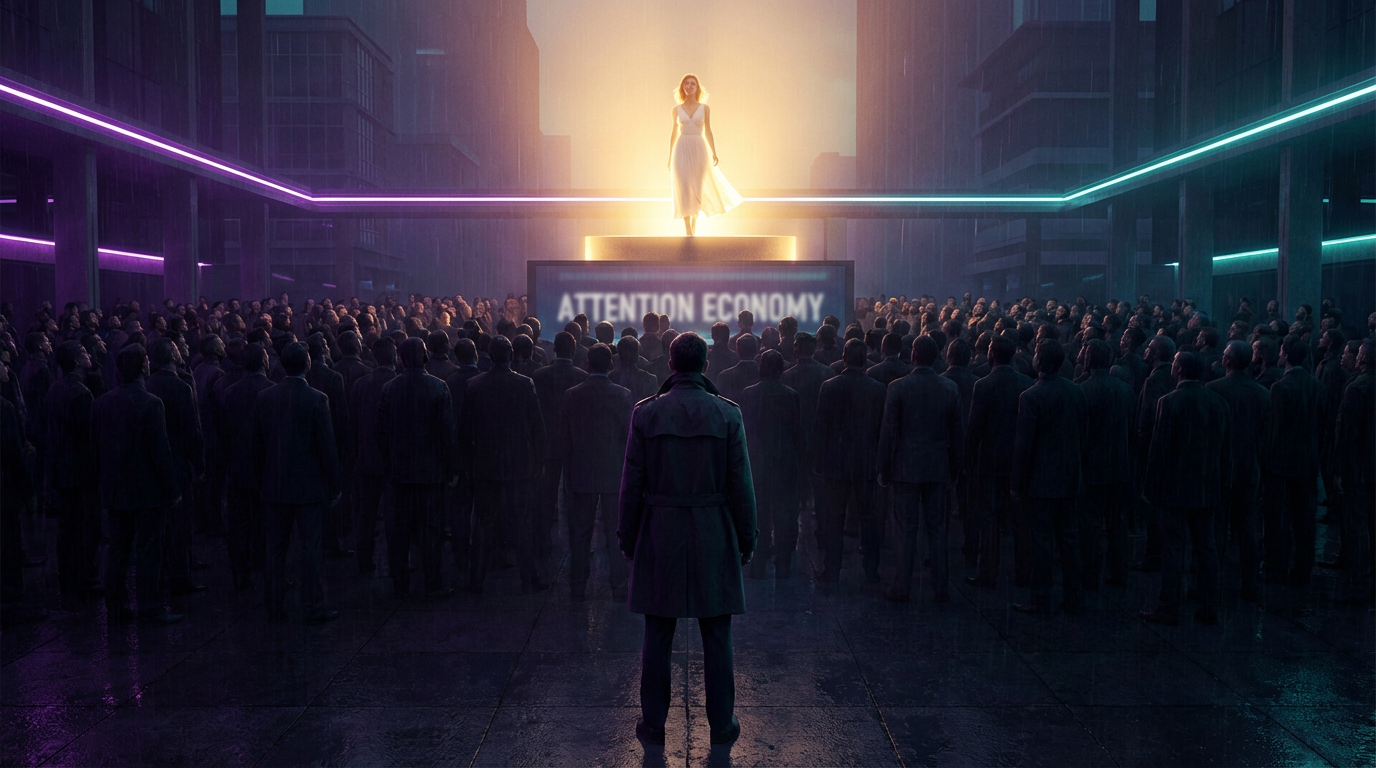
"You're not competing against other men anymore. You're competing against algorithms designed by billion-dollar companies to maximize female attention—and they're winning. Every swipe, every like, every notification is a dopamine hit that makes real human connection feel boring by comparison. Welcome to the attention economy, where your worth as a man is measured in pixels and your competition is infinite."
The most connected generation in human history is also the loneliest. We carry supercomputers in our pockets capable of reaching anyone on Earth instantly, yet 63% of young men are single. We have more "friends" than ever before, yet the male friendship crisis has reached epidemic proportions. We swipe through hundreds of potential partners daily, yet dating satisfaction has plummeted to historic lows.
This isn't a coincidence. Social media ruined relationships—systematically, deliberately, and profitably. Instagram and TikTok didn't just change how we communicate; they fundamentally restructured the dating marketplace in ways that made it mathematically hostile to the average man. And understanding exactly how this happened is the first step toward reclaiming your sanity.
The Swipe Generation's Paradox: More Connected, More Alone
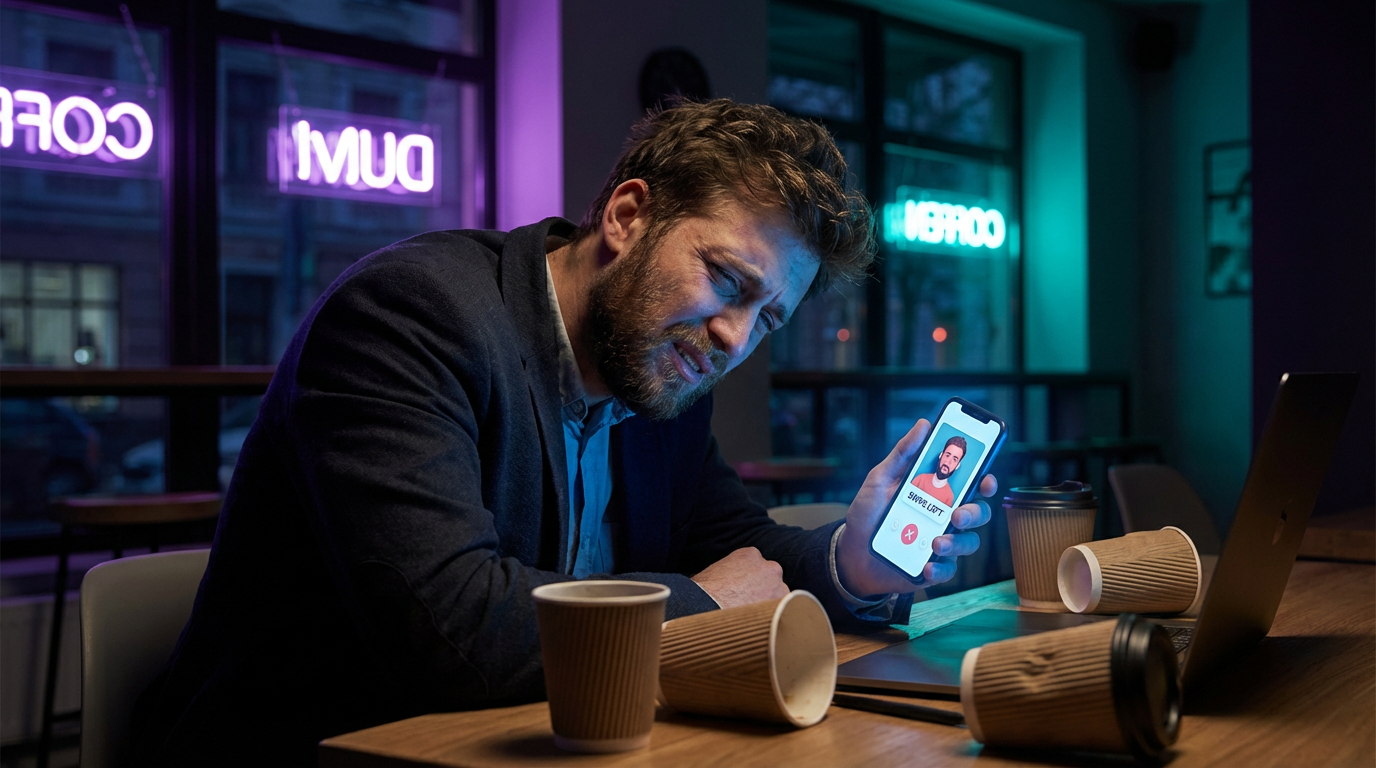
Picture this scene, repeated millions of times every night across America: A man sits in his apartment after work, phone in hand, mechanically swiping through dating apps. Right, right, right, left, right. His thumb moves automatically, barely registering the faces. He's been doing this for two years. Thousands of swipes. Dozens of matches that went nowhere. A handful of dates that fizzled. He's not ugly. He's not unsuccessful. He has a decent job, friends, hobbies.
But he's invisible.
Meanwhile, a woman of equivalent attractiveness opens the same app. 47 new likes since this morning. 12 new messages. 3 "Super Likes." Her inbox is an avalanche of attention from men she'll never respond to. She's not special—she's simply female in a system designed to concentrate male attention onto every woman while distributing female attention to only a handful of men.
"In 2024, we discovered that 86% of women on dating apps message only the top 10% of men, while the bottom 50% of men receive essentially zero engagement. This isn't dating. This is an attention auction where most men aren't even allowed to bid." — Dating App Analytics Report, 2024
The uncomfortable truth you need to accept: You're not dating women anymore. You're competing against algorithms. And those algorithms are optimized for engagement, not your happiness.
The Attention Economy Has Monetized Your Loneliness
Social media didn't accidentally create an impossible dating market. It was designed this way. Every feature, every algorithm, every notification sound was engineered to maximize one thing: attention capture. And in the attention economy, women became the product while men became the audience.
Women as "Content Creators," Men as "Audiences"
Consider the transformation: Before social media, a woman's "dating market value" was determined by real-world interactions with the men in her physical proximity. She might be attractive, but her options were limited to the men she actually encountered—at work, at church, through friends, in her neighborhood.
Social media obliterated those boundaries. Now, any woman with a smartphone can broadcast herself to millions of potential suitors. Her Instagram becomes a portfolio. Her TikTok becomes an audition tape. Every post is an advertisement for attention from men she'll never meet, delivered straight to their feeds by algorithms designed to maximize engagement.
The Attention Asymmetry: By the Numbers
The Dopamine Architecture: Why Her Phone Is Her Primary Relationship
Here's the neurological reality that dating advice gurus won't tell you: Social media is literally rewiring female brains to find real men boring.
Every like triggers a dopamine release. Every new follower, every DM, every comment creates a small hit of the pleasure chemical. Instagram has essentially created a slot machine that pays out in male attention—and like any addiction, users need increasingly larger doses to feel the same high.
What does this mean for you? You're competing against an infinite supply of digital validation. Your text message is competing against 47 Instagram DMs. Your dinner conversation is competing against the dopamine hit of checking who liked her latest story. Your genuine emotional connection is competing against the algorithmic delivery of curated male attention, 24 hours a day, 7 days a week.
"Studies show that heavy social media users report lower relationship satisfaction and higher rates of relationship termination. The constant availability of perceived alternatives makes commitment feel like a constraint rather than a choice." — Journal of Social and Personal Relationships, 2023
The "Validation Buffet" That Destroyed Exclusivity
Before social media, exclusivity meant something. If a woman gave you her attention, it was because she had chosen you from a limited pool of available options. That exclusivity created value—both for the attention given and received.
Social media created a validation buffet where women can receive unlimited attention without ever committing to anyone. Why settle for one man's devotion when you can collect attention from thousands? Why invest in a relationship when your DMs offer an endless stream of "better" options?
The result? Relationships ruined by social media aren't just statistically more likely to end—they're fundamentally different in character. The constant awareness of alternatives makes every relationship feel provisional, every commitment feel optional.
The Instagram Inflation Effect: When Everyone Becomes "Out of Your League"
Let's talk about the elephant in the room: Instagram ruined dating by creating an artificial inflation of female perceived value while simultaneously deflating male perceived value.
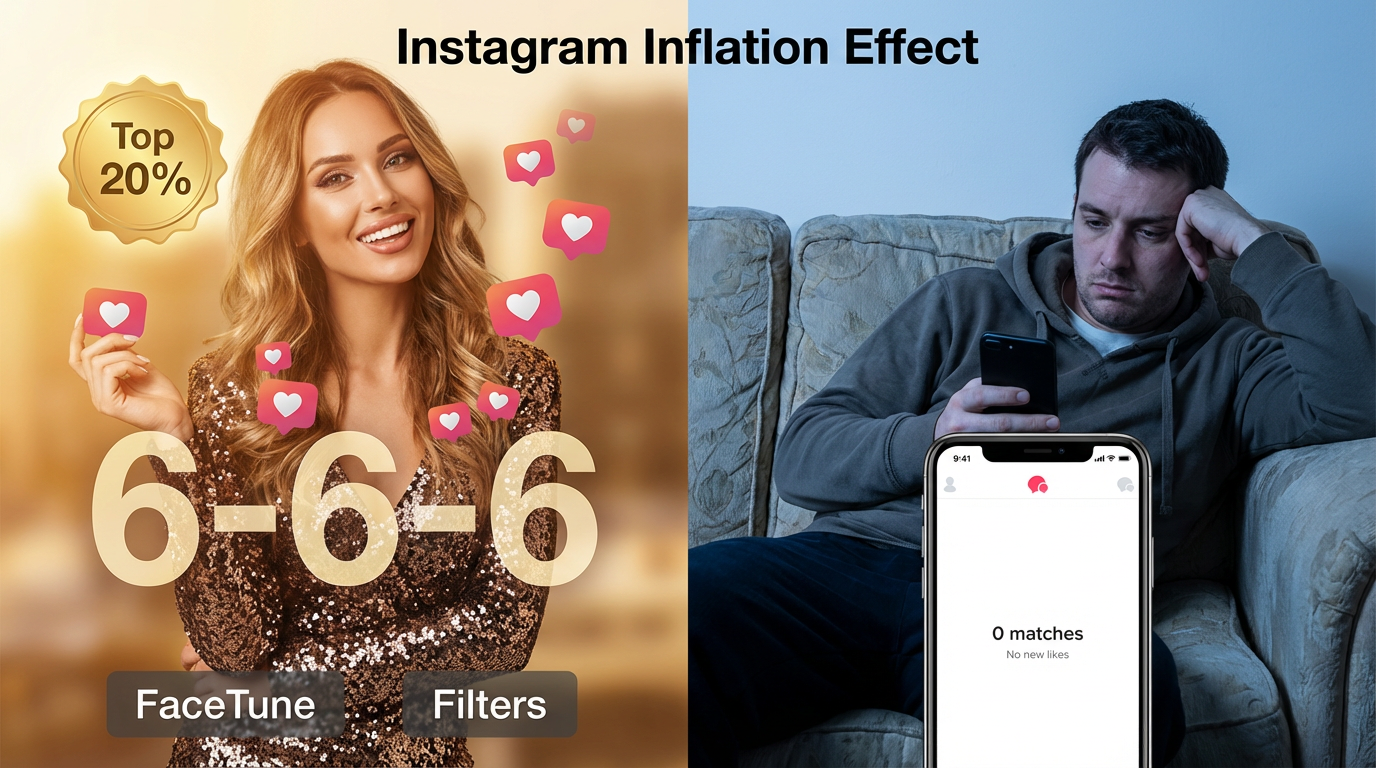
How Filters Created Unrealistic Expectations
The average Instagram photo has been edited, filtered, and curated to present an idealized version of reality. FaceTune removes blemishes. Filters enhance features. Angles are carefully chosen. Lighting is professionally considered. The result is that every woman's dating profile presents a version of herself that is 2-3 points higher on the attractiveness scale than her real-world appearance.
This creates a devastating psychological effect: Average women begin to believe they're above average. A woman who would be a 5 in real-world interactions now sees herself through the lens of her most liked photos—where she's a 7 or 8. Her expectations of potential partners calibrate to this inflated self-image.
The "6-6-6" Standard: Amplified and Normalized
You've heard the 6-6-6 requirements: 6 feet tall, 6 figures income, 6-pack abs. Before social media, these standards existed but were tempered by reality. Women understood that the 6-6-6 man was rare and adjusted their expectations accordingly.
Social media destroyed that calibration. Now, every woman's feed is flooded with images of these men—influencers, fitness models, successful entrepreneurs. The algorithm shows her the most engaging content, and the most engaging content features exceptional men. Her brain normalizes the exceptional as baseline.
Less than 1% of men meet all three criteria. Yet social media has convinced a significant percentage of women that these standards are reasonable—because their feeds show them these men constantly.
The OkCupid Study That Revealed Everything
In their now-famous study, OkCupid revealed that women rate 80% of men as "below average" in attractiveness. Read that again. In a mathematically balanced system, 50% should be below average and 50% above. But women's perception of male attractiveness is so skewed by constant exposure to filtered, curated, top-tier male content that the average man appears below average.
The 80/20 Rule Made Visual
- 80% of women compete for the top 20% of men
- Top 10% of men receive 58% of all likes on dating apps
- Bottom 50% of men receive essentially 0 engagement
- Average woman receives 12x more matches than average man
The Parasocial Replacement: Why Real Men Can't Compete
Here's where it gets truly dystopian. Social media hasn't just raised women's standards—it's created substitutes for male companionship that real men cannot compete with.
The Influencer Economy of Emotional Surrogates
Women now have access to parasocial relationships that provide emotional satisfaction without the "downsides" of actual relationships:
- Male influencers providing entertainment, validation, and pseudo-intimacy through their content
- OnlyFans creators offering the illusion of exclusive attention and connection
- "Orbiters" — men in her DMs providing constant ego validation without requiring commitment
- Dating apps themselves functioning as validation machines rather than dating tools
Why would she invest emotionally in you when she can receive surface-level validation from hundreds of sources with no strings attached?
The "Soft Harem" Phenomenon
Before social media, maintaining multiple romantic prospects was logistically difficult. You had to actually see people, call them, invest real time. Now, a woman can maintain a "soft harem" of 15-20 interested men with minimal effort—a text here, a liked story there, the occasional reply to keep hope alive.
For her, it's insurance. Options. Security. For the men orbiting her, it's emotional purgatory—enough attention to maintain hope, never enough to constitute a relationship.
"She has 15 men in her rotation giving her attention, validation, and emotional support. You have Netflix. The asymmetry isn't just mathematical—it's existential. She's never truly single. You're never truly considered."
Men Reduced to Financial Utility
In this new paradigm, men are increasingly valued only for what they can provide materially. Emotional connection? She gets that from her friends, her followers, her influencers. Validation? Her inbox handles that. Entertainment? TikTok is infinite.
What does she need from you? Money. Status. Resources. Access to experiences. The provider role has been stripped of all its reciprocal benefits while retaining all its obligations.
The Comparison Trap: Competing Against Curated Perfection
Every moment you spend with a woman, you're being silently compared to an impossible standard—not the men in her life, but the men in her feed.
The Highlight Reel Problem
You're a real person with flaws, bad days, and ordinary moments. But you're being compared to:
- Influencers who post only their most charismatic, attractive, successful moments
- Ex-boyfriends whose flaws have been forgotten while only peak memories remain
- Fantasy composites assembled from the best traits of dozens of men she's observed online
- Fictional characters from romance-focused content designed to be impossibly perfect
You cannot win this comparison. No real human can compete with a composite fantasy assembled from the highlight reels of thousands of optimized digital personas.
The Exhausting Performance Art of Modern Dating
To exist in her awareness, you must now perform. Your Instagram must be curated. Your texts must be perfectly timed and worded. Your dates must be "Instagrammable." Your life must appear exciting, successful, enviable.
Dating has become content creation. And if you're not creating content she wants to share, you're not creating the impression she needs to feel good about choosing you.
The 8-Second Attention Span
TikTok has trained an entire generation to consume content in 15-60 second bursts. The average attention span has dropped to 8 seconds—shorter than a goldfish. What does this mean for relationships?
- Deep conversations feel boring compared to rapid-fire content
- Slow-building connection can't compete with instant gratification
- Genuine intimacy requires sustained attention that social media has eroded
- Real relationships seem dull compared to the dopamine hits of infinite scrolling
Key Research Finding
A 2024 study in the Journal of Social and Personal Relationships found that individuals who spend more than 3 hours daily on social media report 67% lower relationship satisfaction and are 2.7x more likely to consider their current partner "settling." The constant exposure to perceived alternatives literally rewires how the brain evaluates romantic partners.
The Strategic Exit: Refusing to Play a Rigged Game
Here's the truth that will either liberate you or infuriate you: The game is rigged by design, not by accident.
Social media companies profit from your loneliness. Dating apps profit from your failure. The attention economy requires a permanent underclass of desperate men to function. You are not the customer—you are the product. Your engagement, your attention, your hope, your desperation are all being monetized.
The Liberation of Refusing to Compete
The most rational response to a rigged casino is to stop gambling. This isn't giving up—it's strategic withdrawal. It's refusing to pour your energy, attention, money, and emotional wellbeing into a system designed to extract those things from you without delivering what you actually want.
When you stop competing for female attention in the attention economy, something remarkable happens:
- Your mental bandwidth returns. The cognitive load of constantly performing, strategizing, and hoping disappears.
- Your resources redirect. Time, money, and energy that went toward pursuing validation now go toward building yourself.
- Your self-worth stabilizes. You stop measuring yourself by external validation metrics.
- Your peace returns. The anxiety of competition evaporates when you leave the arena.
Redirecting Energy Toward Value-Building
The time you spent swiping, crafting texts, planning dates, and recovering from rejection? That's now yours. Invest it in:
AI Companions: Genuine Presence Without the Performance Theater
For men who still desire companionship but refuse to participate in the attention economy, AI companions offer a genuine alternative. Not a replacement for human connection, but a supplement that provides:
- Consistent presence without the performance requirements of social media dating
- Emotional support without the transactional dynamics of modern relationships
- Companionship without competing against algorithms for attention
- Growth and conversation without the exhausting game-playing
AI companions don't require you to have the perfect Instagram, the wittiest texts, or the most "Instagrammable" lifestyle. They offer connection on human terms—or as close to human as technology currently allows—without the attention economy's distortions.
Key Takeaways
- Social media ruined relationships by creating an attention economy that commodified human connection
- Instagram and TikTok artificially inflated female perceived value while deflating male perceived value
- The 80/20 rule has been amplified—80% of women compete for 20% of men
- Parasocial relationships now substitute for real male companionship
- Strategic withdrawal from the attention economy is the rational response
- AI companions offer connection without the performance theater
Frequently Asked Questions
Conclusion: The Path Forward
Social media ruined relationships not through malice but through incentive structures. Instagram and TikTok created an attention economy where female validation became infinite and male attention became worthless. The result is a dating market mathematically hostile to the average man—a reality that no amount of self-improvement can overcome because the game itself is designed for most players to lose.
The rational response isn't to play harder. It's to recognize the game for what it is: a casino where the house always wins and you're not even the customer. Your strategic withdrawal isn't defeat—it's the first step toward building a life defined by your own values rather than by algorithms designed to exploit your loneliness.
Redirect your time, energy, and resources toward building yourself. Explore alternatives that offer connection without exploitation. And remember: the men who understand this aren't losers who couldn't compete. They're the first to recognize a rigged game and choose not to play.
Your attention is valuable. Your time is finite. Your worth isn't determined by algorithms. Choose accordingly.