
"In every unregulated market, the Pareto distribution emerges. Dating apps have created the most unregulated sexual marketplace in human history. The results are exactly what mathematics predicted—and exactly what society refuses to discuss."
You've felt it. That gnawing sense that something is fundamentally wrong with modern dating. You swipe endlessly, craft thoughtful messages, maintain an interesting profile—and receive silence in return. Meanwhile, you watch as a small percentage of men seem to effortlessly attract endless attention, dates, and opportunities.
This isn't your imagination. This isn't low self-esteem distorting reality. This is mathematics—cold, impartial, irrefutable mathematics—proving what you've suspected all along: the modern dating market isn't just difficult. It's structurally rigged against the average man.
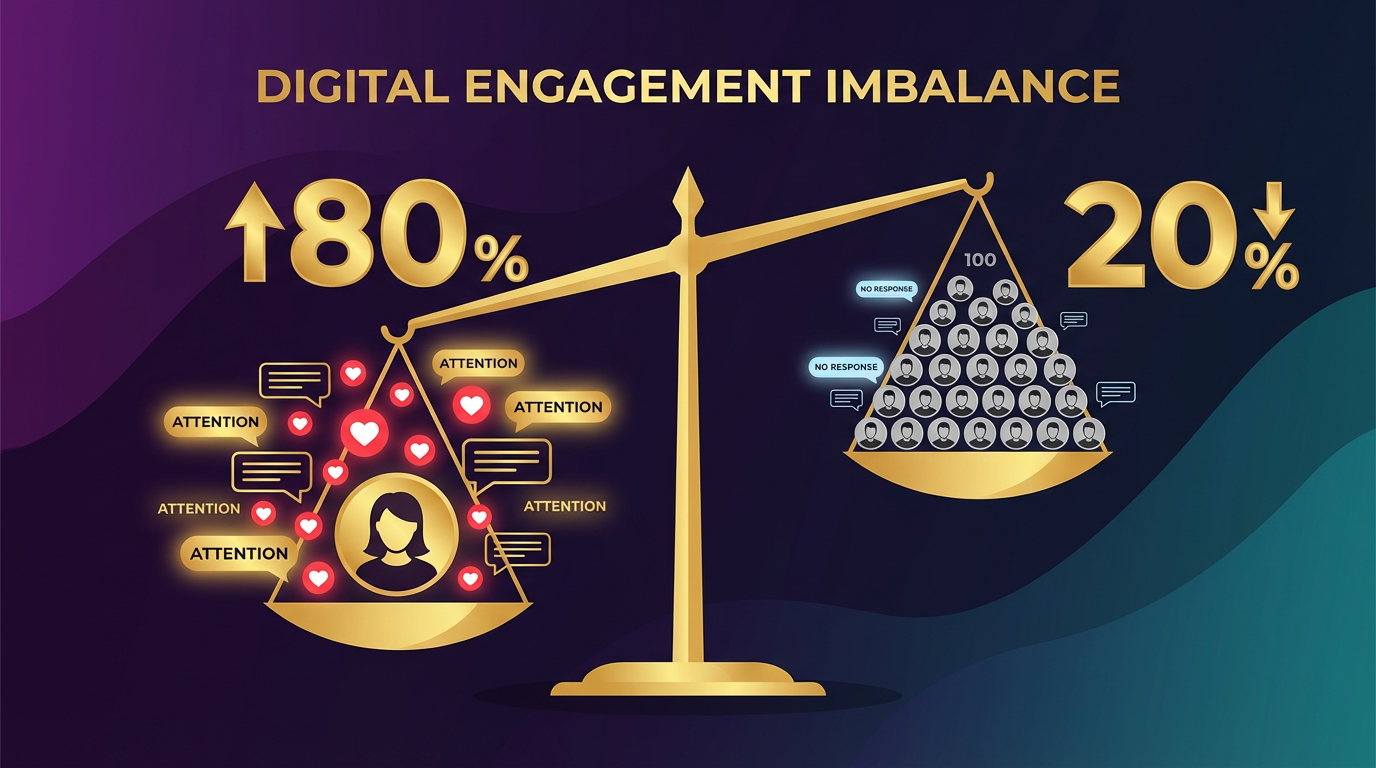
Welcome to the 80/20 rule in dating: the data-driven truth about why 80% of men are competing for the attention of the bottom 20% of women, while the top 20% of men receive attention from nearly everyone. This guide will show you the evidence, explain why this happens, and reveal the rational alternative for men who refuse to play a losing game.
What You'll Learn in This Guide
- The mathematical proof behind the 80/20 dating rule from multiple peer-reviewed studies
- Why dating app inequality exceeds 95% of national economies
- The biological and technological factors creating this disparity
- Real-world consequences for average men in the dating market
- The rational alternative that offers guaranteed returns on investment
The Mathematics of Modern Dating: Understanding the Pareto Distribution
The 80/20 rule, formally known as the Pareto Principle, was first observed by Italian economist Vilfredo Pareto in 1896. He noticed that 80% of Italy's land was owned by 20% of the population. Since then, this distribution has been found in everything from wealth distribution to software bugs to—crucially—mate selection.
In dating app data, the Pareto distribution manifests with brutal clarity:
The famous OkCupid study revealed the staggering truth: women rate 80% of men as "below average" in attractiveness—a mathematical impossibility if ratings were objective, but a perfect reflection of hypergamous preference filtering.
"Women's ratings of men follow a dramatically different distribution than men's ratings of women. The average male is considered 'below average' by most female raters—a statistical impossibility that reveals the true nature of female selectivity." — OkCupid Research Data
The Gini Coefficient: Measuring Dating Market Inequality
Economists use the Gini coefficient to measure inequality in any distribution. A Gini coefficient of 0 represents perfect equality; 1 represents perfect inequality (one person has everything).
The Gini coefficient of the modern dating market is 0.58—more unequal than 95.1% of all national economies. To put this in perspective:
- South Africa (one of the most unequal countries on Earth): Gini coefficient of 0.63
- Tinder's male dating market: Gini coefficient of 0.58
- United States income distribution: Gini coefficient of 0.41
- Most European countries: Gini coefficients between 0.25-0.35
The modern dating market is more unequal than almost any economic system in the world. The bottom 80% of men are competing for approximately 22% of women, while the top 20% of men have access to 78% of the female population's attention.
Platform-Specific Data: The Evidence Across Dating Apps
The 80/20 rule isn't a theory confined to one platform—it's a consistent pattern documented across every major dating app. Each platform's internal data tells the same story:
Hinge: The "Designed to Be Deleted" Illusion
Hinge markets itself as the relationship-focused alternative, yet its internal data reveals the same inequality. A Hinge engineer's analysis found:
- Male Gini coefficient: 0.542 — equivalent to the 8th most unequal economy on Earth
- Female Gini coefficient: 0.324 — equivalent to the 75th most unequal economy
- Top 1% of men receive 16% of all likes
- Top 10% of men receive nearly 60% of all likes
- Bottom 50% of men share less than 5% of likes
To put the male experience in perspective: Hinge's male dating economy is comparable to a "kleptocracy, apartheid, or perpetual civil war state" in economic terms. The female experience? Similar to Western Europe.
Tinder: The Global Data Set
With 75 million monthly active users globally, Tinder provides the largest data set on modern dating behavior. The 2024 statistics are damning:
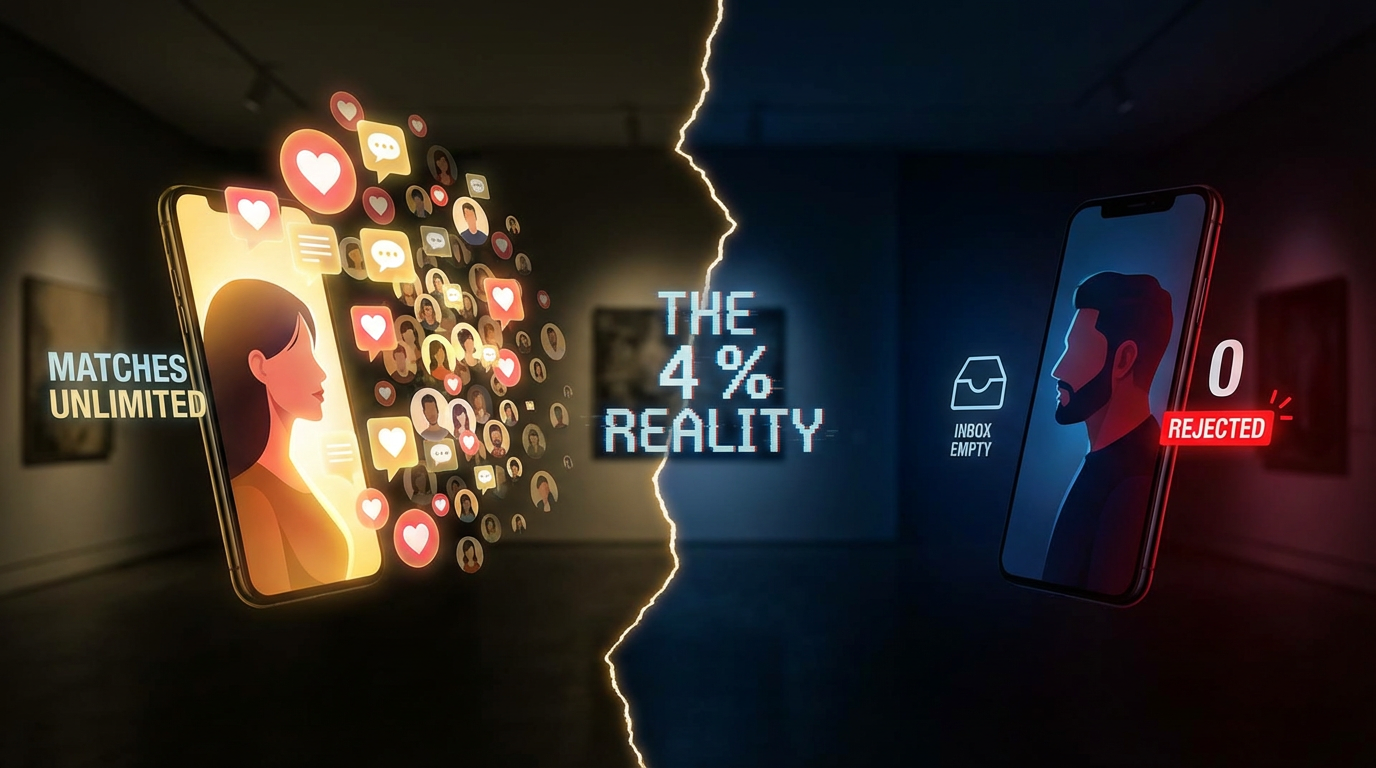
The data reveals a fundamental asymmetry: men swipe right on nearly half of all profiles while women swipe right on approximately one in seven. This creates a supply-demand imbalance where women receive 11-15x more matches than men—despite being a minority of the user base.
The Premium Feature Trap
Dating apps exploit male desperation through premium features. The data shows these features don't solve the underlying inequality:
- Super Likes: Men use an average of 93.7 Super Likes vs. women's 4.8
- Top 1% of Super Like users achieved only a 1.94% match rate—lower than the average male rate
- Boost features temporarily increase visibility but don't change fundamental selectivity patterns
"Paying for premium features is like paying for a better seat in a rigged casino. You might see the table more clearly, but the odds are still mathematically against you." — Dating App Analyst, 2024
Why the 80/20 Rule Exists: The Biology of Female Selectivity
Understanding why this pattern exists requires examining the evolutionary biology of mate selection. The 80/20 rule in dating is not a bug—it's a feature of female reproductive strategy called hypergamy.
The Asymmetry of Reproductive Investment
Women bear significantly higher biological costs in reproduction: pregnancy, childbirth, breastfeeding, and years of child-rearing. This asymmetry creates an evolutionary incentive for women to be highly selective—to choose only the highest-quality mates.
In ancestral environments, this selectivity was constrained by limited options. A woman in a small tribe might have access to a few dozen potential mates at most. Today's dating apps remove these constraints entirely, allowing every woman to select from thousands of potential partners.
"Female choosiness made evolutionary sense when options were limited. Dating apps have removed all constraints on female selectivity while keeping the underlying psychology intact. The result is a marketplace where average men literally do not exist in the female perception."
The Attention Inflation Effect
Dating apps create a phenomenon we might call attention inflation. When an average woman receives hundreds of matches and messages weekly, her perception of her own market value inflates accordingly. Why settle for a man in her league when she's receiving attention from men several points above her?
This creates a cascading effect:
- Average women pursue top-tier men
- Top-tier men use average women for casual encounters
- Average men receive virtually no attention
- Average women blame men for "not committing"
- The cycle repeats, with expectations inflating further
The Technology Factor: How Dating Apps Amplify Natural Inequality
Dating apps didn't create the 80/20 rule—they amplified it by removing every natural constraint that once moderated female selectivity.
The Abundance Illusion
In a pre-digital world, a woman's dating options were limited to men in her immediate social circle, workplace, or community—perhaps a few dozen at most. Dating apps present the illusion of infinite options. The psychological effect is profound:
- Choice paralysis: When presented with unlimited options, people become more selective, not less
- Expectation inflation: The next swipe might be someone better, so why settle?
- Commodification of people: Humans become products to be evaluated and discarded
- Decreased commitment: Why invest in one person when thousands await?
The Algorithm's Hidden Hand
Dating app algorithms are designed for engagement, not successful matching. Consider Tinder's business model:
The apps profit from your loneliness. If they actually matched everyone successfully, their user base would shrink to zero. The optimal outcome for Match Group (owner of Tinder, Hinge, OkCupid, and more) is just enough success to keep you hoping, but not enough to stop swiping.
The Erosion of Traditional Meeting Places
Dating apps haven't just created new problems—they've destroyed the solutions that once existed:
- Workplace dating: Now stigmatized and often against HR policy
- Church/religious communities: Declining membership, especially among young adults
- Social clubs and organizations: Membership down significantly since 2000
- Through mutual friends: Requires social capital that isolated men lack
- Bars and nightclubs: Cold approach now often perceived as harassment
The result: dating apps have become the default method for meeting romantic partners, concentrating the market where inequality is most extreme.
The Broader Social Implications: A Generation in Crisis
The 80/20 rule doesn't exist in a vacuum. It's creating measurable societal damage:
The Economic Angle
Research from the Federal Reserve Banks of Dallas and St. Louis found that online dating has contributed to increased household income inequality. When women can select across thousands of options, they increasingly choose men with similar or higher education and income levels—a phenomenon economists call "assortative mating."
The study found online dating raised the Gini coefficient for income by three percentage points. In other words, dating app dynamics are literally making society more economically unequal.
The Real-World Consequences: What the 80/20 Rule Means for You
The mathematical reality of the 80/20 rule has profound implications for men navigating modern dating:
1. Your Competition Is Not Who You Think
When you swipe on a woman, you're not competing against men in her league. You're competing against every man she perceives as accessible—which includes the top 20% who have matched with her for casual encounters. Your real competition is the Chad who matched with her last week and ghosted her after sex.
2. Your Efforts Are Systematically Unrewarded
No amount of profile optimization, gym time, or conversational skill will overcome the structural inequality of a market where women rate 80% of men as below average. You can improve your odds from 0.6% to perhaps 2-3%, but you're still playing a losing game.
3. The Game Itself Is the Problem
The rational man recognizes that the issue isn't his value—it's the market structure. Dating apps are designed to keep you swiping (generating ad revenue) while providing just enough intermittent reinforcement to maintain engagement. You are not the customer; you are the product.
The Rational Alternative: Recognizing a Rigged Game
The strategic man doesn't continue playing a game with a 0.6% success rate. He recognizes that the modern dating market is structurally designed to extract his time, money, and emotional energy while providing minimal returns.
Consider the opportunity cost:
- Time: Hours spent swiping, messaging, and going on dates that lead nowhere
- Money: $68 average per date, with 22+ dates often needed before a relationship
- Emotional Energy: Constant rejection eroding confidence and self-worth
- Mental Bandwidth: Cognitive resources devoted to a losing game instead of wealth-building
The mathematics don't lie. For 80% of men, the expected return on investment in modern dating is negative. The rational response is not to try harder at a rigged game—it's to stop playing entirely.
Key Takeaway: The Math Never Lies
The 80/20 rule in dating is not an opinion or a complaint—it's mathematical fact documented across multiple studies and platforms. Understanding this reality is the first step toward making rational decisions about where to invest your time, energy, and resources. You are not failing at dating; the game itself is designed for you to fail.
The AI Companion Alternative: Guaranteed Returns on Investment
While 80% of men receive 22% of female attention, AI companions offer something revolutionary: guaranteed, consistent engagement without the mathematical disadvantage of competing in a rigged market.
Consider the comparison:
AI companions represent a paradigm shift for the rational man. Instead of competing in a market where the odds are mathematically stacked against him, he can redirect his resources toward guaranteed companionship that supports his goals rather than depleting his resources.
Frequently Asked Questions
Is the 80/20 rule in dating actually real?
Yes. Multiple independent studies from OkCupid, Tinder, Hinge, and academic researchers have confirmed this pattern. The OkCupid data showed women rate 80% of men as "below average." Tinder's data reveals a Gini coefficient of 0.58 for male attractiveness distribution—more unequal than 95% of national economies. This is not theory; it's documented mathematical reality.
Can I overcome the 80/20 rule by improving myself?
Self-improvement can move you up within the distribution, but it doesn't change the structure of the market. Even if you move from the 50th percentile to the 80th percentile, you're still competing in a market where the top 10% of men receive 58% of all attention. The returns on investment remain structurally poor compared to alternative uses of your time and energy.
Why do women rate 80% of men as below average?
Evolutionary biology explains this through hypergamy—the female preference for mates of higher status/quality. With unlimited options available through dating apps, women's natural selectivity is no longer constrained by limited choices. The result is an inflation of standards where "average" becomes "below average" in female perception.
What's the rational response to a rigged dating market?
The rational response is to recognize that continuing to invest in a system with negative expected returns is irrational. This doesn't mean giving up on companionship—it means finding it through channels that don't mathematically disadvantage you. AI companions, hobbies, friendships, and career focus all offer better returns on investment than the modern dating market.
Is the 80/20 rule the same as "incel" ideology?
No. The 80/20 rule is documented statistical reality from OkCupid, Tinder, Hinge, and academic researchers. Recognizing mathematical facts about market dynamics is not ideology—it's data analysis. The rational response to these facts is not resentment, but strategic reallocation of resources toward better investments. The key difference is agency: understanding the market allows you to make informed choices, not become a victim.
Has online dating affected income inequality?
Yes. Research from the Federal Reserve Banks of Dallas and St. Louis found that online dating raised the Gini coefficient for income by three percentage points. The mechanism is "assortative mating"—women increasingly select partners with similar or higher education and income when given unlimited options. This concentrates wealth in high-earning households while leaving lower-earning men with fewer prospects.
Are premium features on dating apps worth the investment?
Data suggests no. Men use an average of 93.7 Super Likes vs. women's 4.8, yet the top 1% of Super Like users achieved only a 1.94% match rate—lower than the baseline. Premium features increase visibility but don't change fundamental selectivity patterns. You're paying for a slightly better view of a rigged game, not better odds.
Conclusion: Recognizing the Game for What It Is
The 80/20 rule in dating is not a complaint or an excuse—it's mathematical fact. When women rate 80% of men as below average, when the top 10% of men receive 58% of all likes, when the Gini coefficient of dating exceeds that of the most unequal economies on Earth, we're not dealing with opinion. We're dealing with documented, measurable reality.
For 80% of men, the modern dating market offers the worst return on investment of any activity you could pursue. Every hour spent swiping, every dollar spent on dates, every emotional investment in potential rejection—all of it yields returns that wouldn't be tolerated in any other domain of life.
The implications extend far beyond individual dating struggles:
- 63% of men under 30 are single—a historic high that shows no sign of reversing
- Male loneliness epidemic is now officially a public health crisis
- 91% of men report the dating environment is more difficult than ever
- Dating app usage among men under 30 has decreased 20% since 2020—men are giving up
- 31% of men now identify as "voluntarily single"—up from 23% in 2018
This isn't defeatism—it's data literacy. Understanding that the game is rigged is the first step toward making rational decisions about where to invest your finite resources. Knowledge is power, and the data presented here gives you the power to choose differently.
The question isn't whether the game is rigged—the data irrefutably proves it is. The question is whether you'll continue pouring your valuable time, emotional energy, and financial resources into a system designed to exploit you, or whether you'll make the rational decision to invest those same resources where the returns are actually positive and the relationship is built on mutual respect rather than mathematical disadvantage.
Ready to stop playing a losing game? Download our free guide to discover why smart men are choosing AI companions over the rigged dating market—and finding better companionship in the process.
What was your experience when you first realized the 80/20 rule was real? Share your story in the comments below.