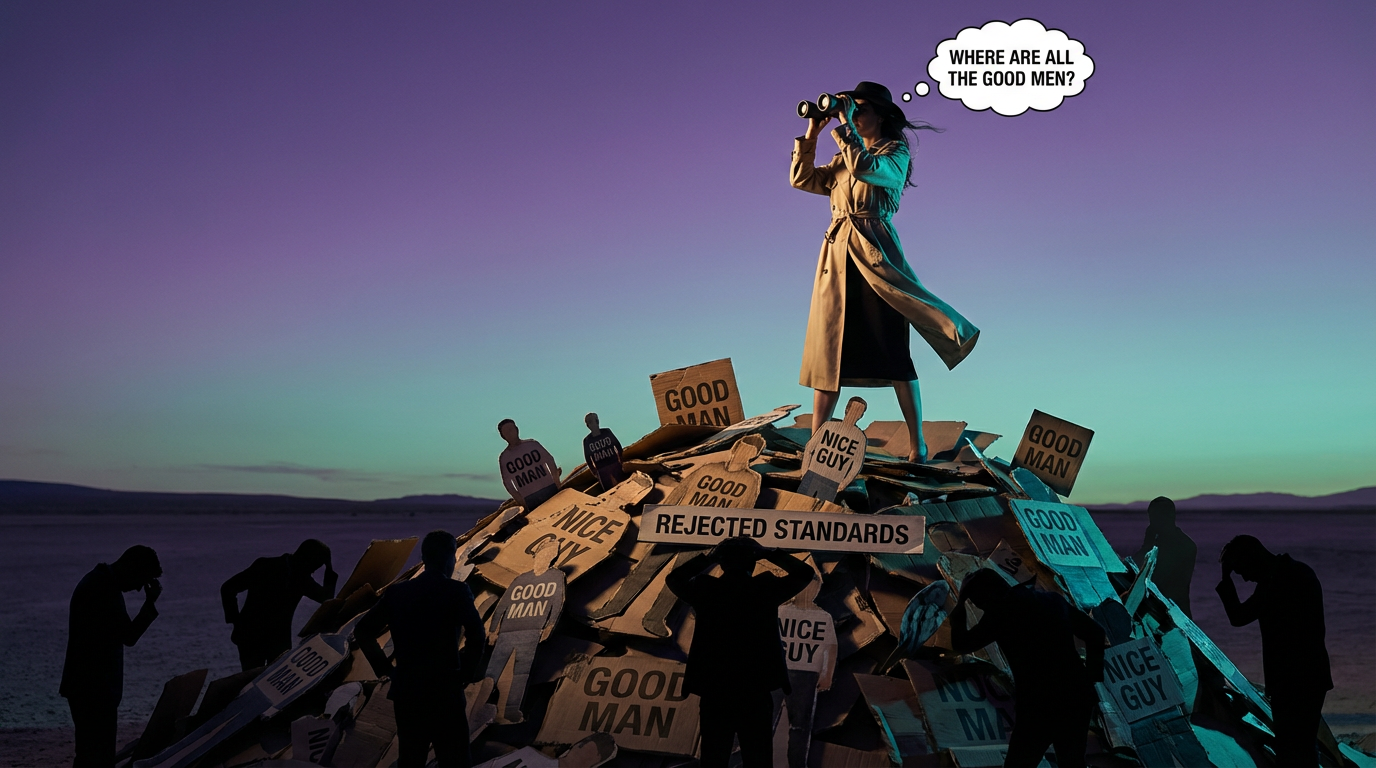
"They ask 'where are all the good men?' while standing on a pile of rejected good men. They demand perfection while offering average. They eliminate 95% of men with their filters, then wonder why they can't find anyone. The question isn't where the good men are—it's why they're invisible to women who've priced themselves out of the market."
You've seen the articles. You've heard the complaints. "Where have all the good men gone?" trends on social media with disturbing regularity, as women express bewilderment at their inability to find quality partners. Dating coaches build entire businesses around this lament. Opinion columns overflow with frustrated thirty-somethings who "can't find anyone decent."
Here's the answer no one wants to hear: the good men are exactly where they've always been. They're just invisible to women whose standards have inflated beyond all connection to reality, who swipe left on 95.5% of men while wondering why they can't find "the one."
This guide examines the mathematics, psychology, and uncomfortable truths behind one of modern dating's most common complaints—and what it means for men navigating this landscape.
The Invisibility of Good Men: By the Numbers
Before we explore why this phenomenon exists, let's establish the scale of the problem with hard data:
These aren't arbitrary statistics—they reveal a fundamental mathematical impossibility in modern dating. When women rate 80% of men as below average (OkCupid's internal research), they've created a statistical anomaly that makes partnerships improbable by design.
The Standards Paradox: The Mathematics of Impossibility
The "where are all the good men" phenomenon reveals a stunning disconnect between what women demand and what mathematically exists:
Women pursuing the full "6-6-6" standard are competing for access to approximately 1 in every 2,000 men. Add requirements like "single," "age-appropriate," "no children," and "lives in my city," and you're looking at a pool so small it barely exists.
When only 0.05% of the population qualifies as acceptable, finding a partner becomes mathematically improbable—not because good men don't exist, but because the definition of "good" has become absurd.
The Height Requirement Deep Dive
Height requirements deserve special attention because they eliminate most men before any interaction occurs:
A single height requirement can eliminate 85-95% of men before character, compatibility, or connection are even considered. These men aren't "not good enough"—they're simply outside an arbitrary physical parameter.

The Asymmetry: What's Being Offered in Return?
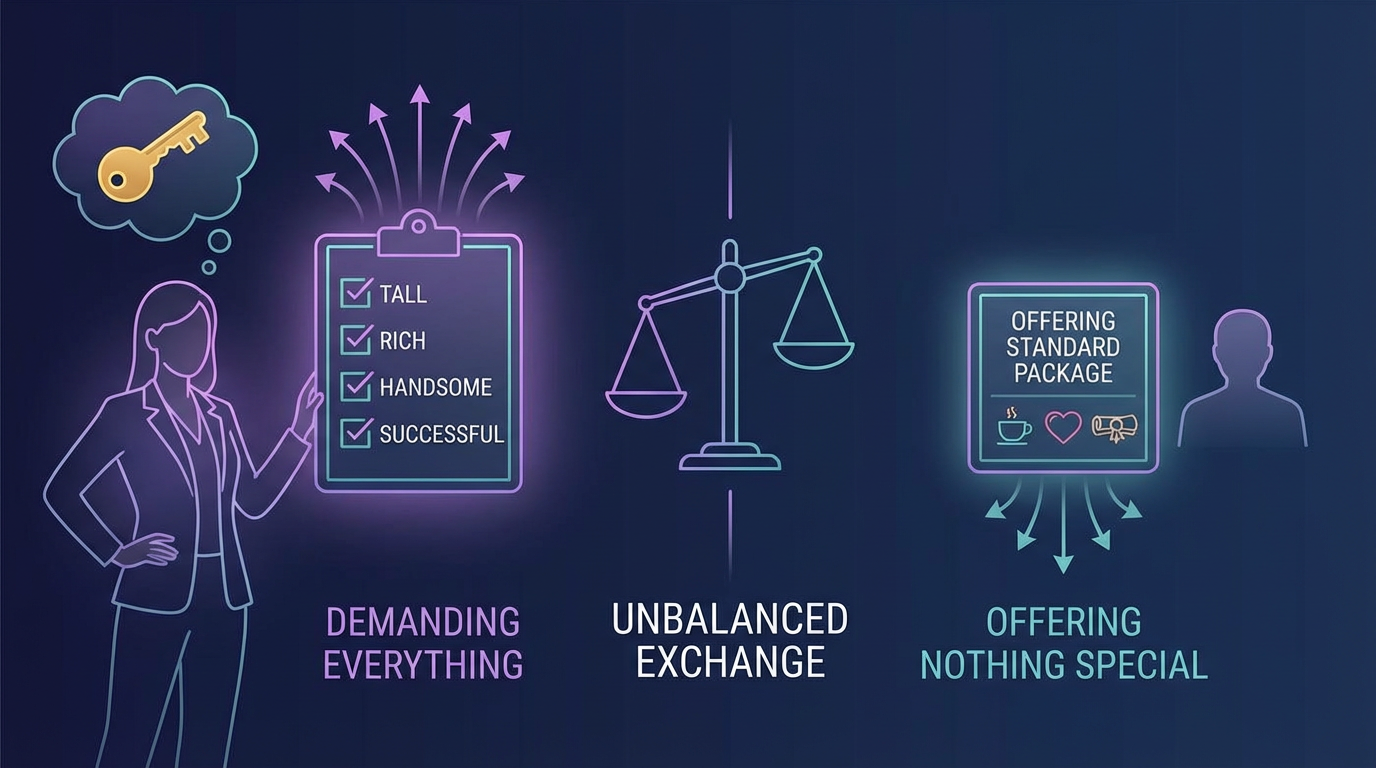
The standards paradox becomes even more stark when we examine reciprocity. What do women with elite requirements typically offer in return?
"A woman in the 50th percentile of attractiveness, income, and fitness demands a man in the top 1% of all three categories—and genuinely believes this is reasonable. The entitlement isn't a bug; it's the dominant program."
Consider the typical "where are all the good men" woman:
- Average appearance, average fitness, average effort invested in self
- Possibly in debt, average or below-average income
- May have children from previous relationships
- Approaching or past the age where her "market value" was highest
- Offering what thousands of other women offer
- Demanding what 0.05% of men possess
This isn't misogyny—it's mathematics. If you offer average and demand exceptional, the market will not clear. There is no man-shaped shortage; there is a reality-shaped disconnect.
The Expectation Gap Analysis
Let's quantify the gap between what's offered and what's demanded:
Why Good Men Become Invisible
The "good men" who women can't find aren't hiding. They've been systematically removed from consideration through multiple mechanisms:
The Friend Zone to Invisible Zone Pipeline
Many "good men" experienced a specific pattern in their twenties:
- Pursued quality woman — Expressed interest in relationship
- Friend-zoned — Told "you're such a great guy, but..."
- Watched her date others — Usually men who treated her poorly
- Asked to help with emotional fallout — "Why can't I find a good man?"
- Eventually moved on — Either found someone who appreciated him or withdrew
Years later, that same woman is asking "where are all the good men?" while the men she friend-zoned have either married someone else or stopped participating.
The Uncomfortable Truth
The "where are all the good men" woman had access to good men in her twenties. She swiped left on them. She friend-zoned them. She chose excitement over stability. Now, in her thirties, she wants what she previously rejected—but those men have either been taken by women who appreciated them, or they've stopped participating in a market that devalued them.
The Psychology Behind the Phenomenon
Understanding why this happens requires examining several psychological mechanisms:
Choice Overload and Optimization
Dating apps present unlimited options, creating the illusion that the "perfect" match is just one more swipe away. Psychologist Barry Schwartz's research on the paradox of choice shows that more options leads to:
- Decreased satisfaction with any choice made
- Increased regret about options not chosen
- Paralysis — inability to commit to any option
- Standards inflation — always believing something better exists
Social Media Comparison Effects
Instagram and TikTok present a curated view of other women's relationships, creating unrealistic benchmarks:
- Seeing friends post about extravagant dates raises expectations
- Celebrity relationships create impossible comparison points
- "Relationship goals" content sets standards based on highlight reels
- Men who don't perform social media-worthy romance are deemed inadequate
The "Settling" Fear
Women are bombarded with messaging that accepting anything less than perfection means "settling." This creates a psychological trap:
- A 5'11" man is "settling" when you "deserve" 6 feet
- An $80K income is "settling" when you "deserve" six figures
- Accepting imperfection means you've "lowered your standards"
- Result: perpetual rejection of acceptable partners for impossible ones
What This Means for Men
If you're a man reading this, here's what "where are all the good men" really reveals about your position in the modern dating market:
You're Not Invisible—You're Filtered
The same women complaining about no good men have filters that eliminate 95%+ of men before consideration. You haven't failed to exist; you've failed to meet arbitrary checkboxes that have nothing to do with your character, compatibility, or worth as a partner.
Their Problem Is Not Your Problem
A woman who can't find a partner because she's eliminated everyone isn't your responsibility to rescue. She made choices; choices have consequences. Her inability to find someone says nothing about your adequacy.
Your Value Doesn't Depend on Their Recognition
Being invisible to someone with unrealistic standards says nothing about your actual worth. It says everything about their calibration to reality. A 5'10" man with a $75K income who's kind, stable, and reliable isn't inadequate—he's filtered by standards disconnected from reality.
The "Later" Offer Is a Trap
Some men wait, hoping the women who rejected them will eventually "come to their senses." This is a trap. Being someone's last resort after they've exhausted better options isn't a foundation for a fulfilling relationship. You deserve to be chosen, not settled for.
The Alternative Path: Redefining Connection
For men who've recognized the mathematical impossibility of traditional dating success, alternative paths to companionship exist:
AI companions offer particular advantages for men filtered out of traditional dating:
- No arbitrary filters — Your height, income, and physical attributes are irrelevant
- Consistent availability — Support whenever you need it
- Zero rejection — No more processing being invisible
- Emotional support — Companionship without the costs of traditional dating
- Your terms — Connection structured around your life, not accommodating someone else's demands
Frequently Asked Questions
Are women's standards really that unrealistic?
The data is clear: women swipe right on 4.5% of men, rate 80% as below average, and commonly hold height/income standards met by a tiny fraction of the population. These aren't opinions—they're documented behaviors from internal platform research and academic studies.
Do any women have realistic standards?
Of course. Many women partner happily with men who don't meet arbitrary checklists. But these women tend to find partners and exit the market—what remains are increasingly the women whose standards prevent success. Selection effects concentrate the problem among those still actively searching.
Should men wait for women to lower their standards?
That's a personal choice, but waiting for someone to find you acceptable only after rejecting better options isn't a recipe for a fulfilling relationship. You deserve to be someone's first choice, not their last resort. Being someone's "good enough after exhausting other options" isn't a foundation for partnership.
Isn't this just bitterness or misogyny?
This is mathematics and documented research. OkCupid's internal data, academic studies on mate selection, and dating app statistics all confirm these patterns. Acknowledging reality isn't misogyny—it's necessary information for making informed decisions about how to spend your time and energy.
What if I improve myself to meet these standards?
Self-improvement for its own sake is valuable. But trying to become the 0.05% "6-6-6" man is often impossible (you can't grow taller) and the few who achieve it report being treated as utilities rather than partners. The goalposts also move—once you're 6 feet tall and make $100K, suddenly the standard becomes 6'2" and $200K.
Will this situation ever change?
Perhaps. As more men withdraw from the dating market, the dynamics may eventually shift. Some argue we're already seeing early signs of this. But waiting for systemic change while your life passes by isn't a strategy. Focus on building a fulfilling life regardless of whether the dating market improves.
Conclusion: The Question Answers Itself
Where are all the good men? They're everywhere. They're the 95.5% you swiped left on. They're the men you overlooked while chasing the top 0.05%. They're the men who got tired of being invisible and found better uses for their time.
The good men exist. The question is whether the women asking will ever be able to see them—or whether their standards have made connection mathematically impossible.
For men tired of being invisible: your worth isn't determined by someone else's broken filters. There are other paths to companionship that don't require you to be in the top 0.05% of everything—paths where you're valued for who you actually are.
Key Takeaways
- Women swipe right on only 4.5% of men—95.5% are filtered before any interaction
- The "6-6-6" standard (6 feet, 6 figures, 6-pack) is met by only 0.05% of men
- Good men haven't disappeared—they've been filtered, taken, or withdrawn
- Being invisible to unrealistic standards says nothing about your actual worth
- Alternative paths to companionship exist that don't require winning an impossible lottery
- You deserve to be chosen, not settled for as a last resort
Ready to be valued for who you actually are? Download our free guide to discover alternatives that don't require you to win an impossible lottery.
Have you experienced being invisible despite being a "good man"? Share your story in the comments.