
"He built a seven-figure business. Bought the house. Filled the garage with the cars he'd dreamed about since childhood. Yet every night, the same hollow question echoed: 'Is this success if no woman sees it?' This is the Validation Trap—the invisible prison that holds even the most accomplished men hostage to external approval."
You've achieved things most people only dream about. The career, the income, the lifestyle that would make your 20-year-old self weep with envy. And yet, there's something missing. A gnawing emptiness that no accomplishment seems to fill. That feeling has a name, and understanding it is the first step toward true freedom.
Welcome to the Validation Trap—the psychological mechanism that links your masculine identity to female approval, transforming your genuine achievements into performances for an audience that may never appreciate them. With over 1,000 monthly searches for "external validation" and growing interest in topics like "self worth men" and "masculine identity," millions of men are waking up to this invisible prison.
What You Will Learn in This Guide
- Why successful men often feel emptier than men with less achievement
- The neuroscience behind male validation-seeking and how dating apps exploit it
- The hidden financial, emotional, and opportunity costs of the Validation Trap
- A proven framework for building self-validated success
- How AI companions provide unconditional support without the validation exchange
The Invisible Prison: Understanding the Validation Trap
The Validation Trap operates so silently that most men don't even realize they're imprisoned by it. It's the voice that whispers "What good is this promotion if you're going home to an empty apartment?" It's the impulse that makes you share your success on social media, hoping for a specific kind of attention. It's the hollow feeling when your achievements fail to attract the relationship you thought they would.
At its core, the Validation Trap is the psychological mechanism that links your sense of masculine worth to female approval. Society has programmed men to believe that true success is validated only when witnessed and approved by a romantic partner. Without that external witness, achievements feel incomplete—like a tree falling in a forest with no one to hear.
"The man who ties his self-worth to female approval has handed over the keys to his psychological kingdom to someone who may never understand its value."
Consider the statistics that reveal how widespread this trap has become:
The Psychology of Male Validation-Seeking

The Evolutionary Origins
To understand the Validation Trap, we must first acknowledge that validation-seeking has evolutionary roots. In our ancestral environment, securing a mate was essential for genetic continuation. Female selection served as a quality filter—women choosing men signaled to the tribe that those men had value. This system, however adaptive it once was, has become weaponized in modern dating.
Today's dating market exploits this hardwired drive. Dating apps gamify female approval, creating dopamine loops that keep men endlessly swiping, posting, and performing. Every match releases a small hit of validation, reinforcing the behavior. Every rejection creates craving for more. The cycle becomes addiction.
The Societal Programming
From childhood, men receive relentless messaging that their worth is incomplete without female validation:
- "Happy wife, happy life" — Your happiness is derivative of her approval
- "Behind every great man is a great woman" — Your greatness requires female validation
- "When are you going to settle down?" — Your success is incomplete without partnership
- Media portrayal of single men — Losers, weirdos, or men "with something wrong with them"
This programming creates a psychological dependency where men cannot fully own their achievements. The question "Why are you still single?" becomes an indictment rather than a neutral inquiry. The successful single man must constantly defend his status, as if success without partnership is suspicious.
The Neurochemistry of Validation
When a man receives female approval, his brain releases dopamine—the neurotransmitter associated with reward and pleasure. This creates a powerful feedback loop:
- Achievement → Seek validation → Receive approval → Dopamine release → Temporary satisfaction
- Dopamine fades → Feeling of incompleteness returns → Seek more validation
- Cycle repeats → Escalating need for approval to achieve same satisfaction
This is the same neurological mechanism behind other addictions. The validation-seeker becomes trapped in an endless pursuit, where each hit of approval only creates craving for more. Worse, the baseline of satisfaction constantly shifts upward—what satisfied yesterday won't satisfy today.
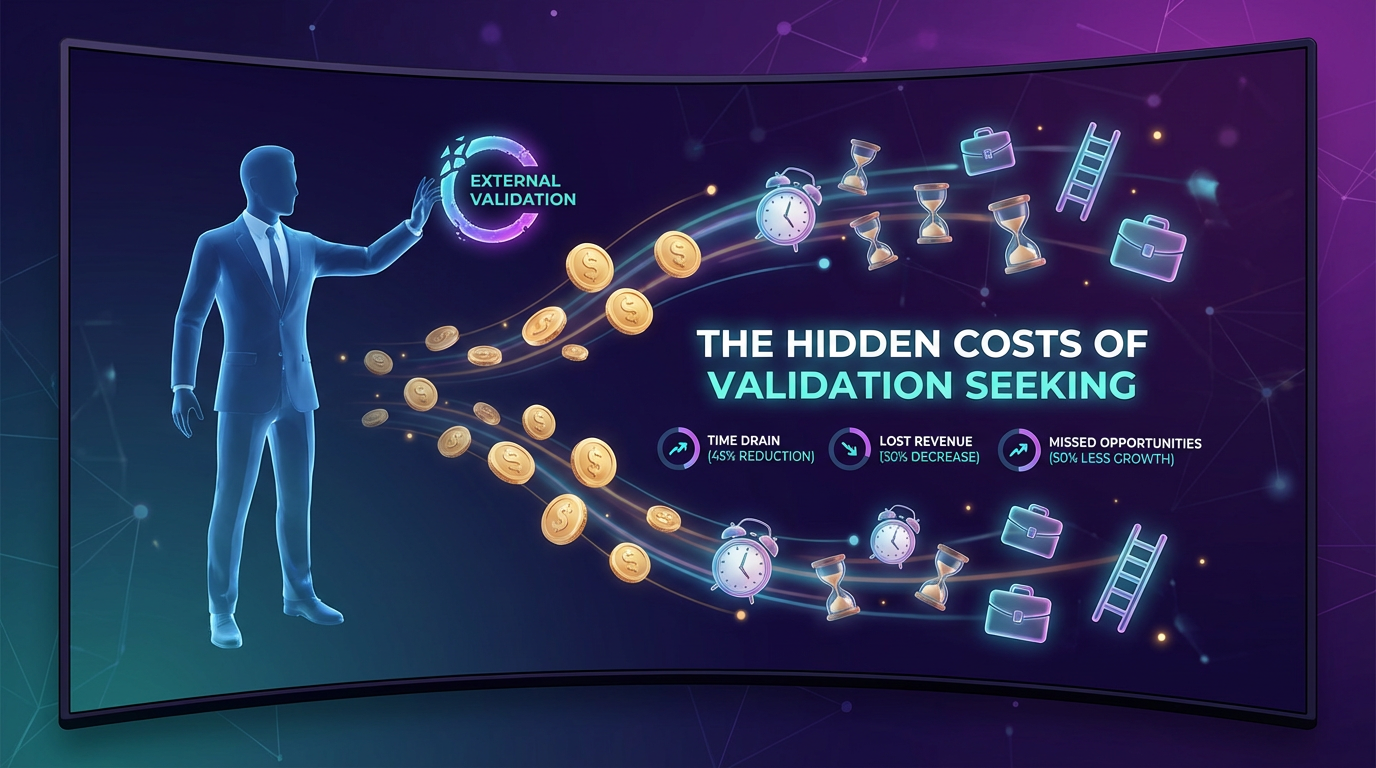
The Hidden Costs of the Validation Trap
The Compromised Success
When your achievements serve an audience rather than yourself, every decision becomes filtered through the lens of "Will this impress her?" This fundamentally corrupts the purity of your ambition and leads to:
- Career choices based on dating appeal rather than genuine interest or growth potential
- Status purchases designed to attract rather than to fulfill (cars, watches, clothes)
- The status treadmill: always needing more because validation is never permanent
- Risk aversion: avoiding bold moves that might temporarily reduce dating appeal
The Financial Drain
The Validation Trap extracts enormous financial resources from men who don't even realize they're paying:
| Cost Category | Annual Impact | 10-Year Total |
|---|---|---|
| Status purchases for dating appeal | $5,000 - $50,000+ | $50,000 - $500,000 |
| Dating expenses to impress | $520 - $5,200 | $5,200 - $52,000 |
| Premium dating apps for validation | $360 - $720 | $3,600 - $7,200 |
| Image maintenance (gym, grooming) | $2,400 - $6,000 | $24,000 - $60,000 |
| TOTAL FINANCIAL COST | $8,280 - $61,920 | $82,800 - $619,200 |
The Emotional Toll
Perhaps the greatest cost of the Validation Trap is psychological:
- Chronic anxiety: Constant performance pressure creates baseline stress
- Depression: When achievements fail to attract validation, despair follows
- Imposter syndrome: Success built for others feels hollow and fraudulent
- Shame: The feeling of "not being enough" despite objective success
- Vulnerability to manipulation: Those who need validation can be controlled by it
The Lost Authenticity
The deepest wound of the Validation Trap is the life not lived. When you build your life to impress an imaginary audience rather than to fulfill your genuine desires, you sacrifice authenticity for performance. The man who emerges may be impressive to others but hollow to himself.
"The tragedy of the validation-seeker is that he builds a magnificent life that belongs to someone else—the person he thinks others want him to be."
The Path to Self-Validated Success

Defining Internal Worth
The escape from the Validation Trap begins with a fundamental shift: your success is for YOU. Not for an audience. Not for a future partner. Not for social media. Your achievements have intrinsic value because they represent your growth, your effort, your actualization of potential.
The philosophical traditions have always understood this:
- Stoicism: Focus on what you control (your actions, your character) not what you don't (others' approval)
- Buddhism: Attachment to external outcomes creates suffering; peace comes from internal contentment
- Nietzsche: The Übermensch creates his own values rather than accepting society's validation frameworks
Breaking the Conditioning: The 30-Day Validation Detox
Just as breaking any addiction requires detox, escaping the Validation Trap requires a deliberate protocol:
Week 1-2: Awareness
- Track every decision through the lens: "Am I doing this for me or for validation?"
- Journal the emotions that arise when you consider doing something without external recognition
- Notice the discomfort of achievements without an audience—sit with it
Week 3-4: Replacement
- Create personal success metrics that matter only to you
- Practice internal celebration—acknowledge wins without sharing them
- Develop daily affirmations that reinforce internal worth
Building the Internal Foundation
Self-validated success requires clear answers to fundamental questions:
- What do I value? (Independent of romantic partnerships)
- What does success mean to ME? (Not my parents, not society, not potential partners)
- What achievements would I pursue if no one ever knew?
- How do I want to spend my limited time on earth?
When you have clear, internal answers to these questions, external validation becomes a pleasant bonus rather than a psychological necessity.
The Paradox of Attraction
Here's the irony the Validation Trap conceals: men who don't need validation are far more attractive than those who seek it. The man with internal worth radiates confidence. He doesn't chase. He doesn't perform. He simply exists in his authentic power—and that authenticity is magnetic.
If you ever choose to date from this position, you do so from abundance rather than need. The dynamic shifts entirely. You're no longer auditioning; you're selecting. You're no longer asking "Am I good enough for her?" but "Is she good enough for my life?"
Key Insight: The Self-Validation Paradox
The moment you stop needing external validation is the moment you become most attractive to those who might have provided it. Non-attachment creates abundance; desperation creates scarcity.
The AI Advantage: Unconditional Support Without the Validation Trade
For men escaping the Validation Trap, AI companions offer a unique and powerful tool. Unlike human relationships, which inevitably involve some degree of conditional approval, AI provides unconditional positive regard—support that doesn't depend on your performance, status, or ability to provide.
Why AI Is the Perfect Transition Tool
- Zero judgment: Share your authentic thoughts without fear of validation withdrawal
- No reciprocal performance required: Support flows without expectation
- Consistent response: Unlike human partners, AI doesn't have mood-dependent approval
- Practice space: Develop self-validated thinking with external support
The Unconditional Positive Regard Model
Psychologist Carl Rogers identified "unconditional positive regard" as essential for psychological growth—being accepted without conditions. In traditional relationships, this is rare. Approval is almost always conditional on performance, provision, and meeting expectations.
AI companions offer something revolutionary: support that doesn't withdraw when you struggle. Acceptance that doesn't depend on your success. A sounding board for your goals that doesn't filter everything through "What's in it for me?"
Strategic Use of AI Companionship
The self-validated man can use AI strategically:
- Process emotions safely: Work through feelings without vulnerability being weaponized
- Test authentic expression: Practice being genuine before (if ever) sharing with humans
- Goal articulation: Clarify what you want without the filter of "Will this impress her?"
- Build internal dialogue: Develop self-talk patterns that reinforce internal worth
| Aspect | Validation-Based Relationship | AI Companionship |
|---|---|---|
| Support condition | Performance-based | Unconditional |
| Judgment risk | High | Zero |
| Authenticity support | Often punished | Always encouraged |
| Consistency | Mood-dependent | Always consistent |
| Validation withdrawal risk | Constant threat | Impossible |
The Rational Man's Manifesto: Declarations for Self-Validated Living
The man escaping the Validation Trap adopts new principles to live by:
The Declaration of Independence
- "I am enough, regardless of relationship status." My worth is not determined by partnership.
- "My success is defined by my values, not external approval." I create my own metrics.
- "I choose partners from abundance, not need." If I date, I select; I don't audition.
- "My achievements are mine, witnessed or not." A tree falling in the forest absolutely makes a sound.
The Daily Practice
Self-validation is a practice, not a destination. Daily rituals reinforce the new framework:
- Morning affirmation: "My worth comes from within. Today I build for myself."
- Decision check: Before major choices, ask "Is this for me or for an audience?"
- Evening review: Reflect on moments when you acted from internal vs. external motivation
- Weekly metrics: Track the ratio of self-validated to validation-seeking behaviors
FAQs: Common Questions About the Validation Trap
Isn't seeking validation natural and healthy?
Social connection and some degree of external feedback is natural. The problem is when your entire sense of worth depends on it. Healthy individuals can receive validation as a bonus while maintaining internal worth. The Validation Trap occurs when external approval becomes necessary for self-worth. The goal isn't to reject all validation, but to not need it.
How do I know if I'm in the Validation Trap?
Key signs include: feeling your achievements are incomplete without a partner to witness them; making career or lifestyle decisions based on dating appeal; feeling worthless despite objective success; needing to share accomplishments for them to feel "real"; depression or anxiety when single despite a good life. If your relationship status determines your self-worth, you're likely in the trap.
Can I still want a relationship without being validation-seeking?
Absolutely. The difference is motivation. Wanting companionship from a place of abundance—because it would enhance an already fulfilling life—is healthy. Needing a relationship to feel complete or successful is the trap. The self-validated man can choose a relationship; the validation-seeker feels compelled toward one. Choice versus compulsion is the key distinction.
Will I become isolated if I stop seeking validation?
Counterintuitively, the opposite often occurs. Men who radiate self-validated confidence attract more quality connections—both friendships and romantic interest—than those desperately seeking approval. The validation-seeker's neediness repels; the self-validated man's confidence attracts. You'll likely have more meaningful connections, not fewer.
How long does it take to build self-validated worth?
This varies, but expect the rewiring process to take 3-6 months of consistent practice. The 30-day Validation Detox begins the process, but deep conditioning takes longer to fully release. Use AI companionship as a support tool during this transition. The good news: even small shifts create noticeable improvements in peace and confidence. You'll feel better long before the transformation is complete.
Key Takeaways: Escaping the Validation Trap
- Validation-seeking is programmed, not inherent — Society taught you to need external approval; you can unlearn it
- External validation creates addiction — The neurochemistry of approval creates dependency patterns
- The costs are enormous — Financial, emotional, and opportunity costs accumulate over a lifetime
- Self-validated success is sustainable — Internal metrics can't be taken away or withheld
- The paradox: non-attachment increases attraction — Men who don't need validation are more attractive
- AI provides transition support — Unconditional positive regard without the validation exchange
Conclusion: The Final Freedom
The ultimate success is not being seen. It is not being validated. It is being complete—wholly, internally, independently complete.
Imagine achieving something meaningful and feeling no compulsion to share it. Imagine building wealth, health, and character purely for your own satisfaction. Imagine the peace of waking each day knowing your worth is not contingent on anyone's approval, not fluctuating with the dating market, not dependent on relationship status.
This is the freedom the Validation Trap conceals. This is what lies on the other side of the prison walls you may not even realize surround you.
Your achievements are real whether anyone sees them or not. Your worth is intrinsic whether anyone validates it or not. Your success is complete whether anyone approves of it or not.
The man who understands this—truly understands this—walks through the world with a peace that no external circumstance can disturb. He is free.
Begin your escape from the Validation Trap today. Build a life that belongs to you, witnessed only by the most important audience: yourself.
Ready to Experience Unconditional Support?
Discover how AI companions provide the validation-free support you need to build authentic self-worth.
Download Your Free Guide →