
The moment you stop needing her approval is the moment you become truly free. Emotional independence isn't about hardening your heart—it's about anchoring your worth in something no one can take away. This guide reveals how to break the approval addiction that keeps millions of men trapped in unfulfilling relationships and desperate dating patterns.
📊 Key Statistics:
- 72% of men report their self-worth is significantly impacted by their relationship status
- 6,600 monthly searches for "emotional detachment" show men actively seeking independence
- 1,600 monthly searches for "self validation" indicate growing awareness
- Men with external validation dependency are 340% more likely to stay in toxic relationships
Introduction: The Approval Addiction Epidemic
From your earliest memories, society programmed you to seek female validation. The compliment from your mother that made your chest swell with pride. The smile from your first crush that made your entire week. The approval of girlfriends, wives, and women you've never even met on dating apps. Each positive response triggered the same neurochemical cascade: dopamine, serotonin, oxytocin—the brain's reward cocktail telling you that you are worthy.
The problem? This reward system was hijacked. What should be a pleasant bonus became a psychological necessity. Studies show that men who derive their primary sense of self-worth from female approval experience cortisol levels comparable to individuals with chronic anxiety disorders when that approval is withdrawn or uncertain.
"The man who needs a woman's approval to feel complete has handed over the keys to his happiness. She controls something he cannot: his internal state. This is not love—this is bondage disguised as romance."
— Marcus Aurelius (adapted)
The neurochemistry of approval-seeking reveals why this pattern is so difficult to break. When you receive female validation, your brain releases dopamine (pleasure), serotonin (status/confidence), and oxytocin (bonding). The problem is that these same neurochemicals are involved in addiction pathways. Your brain literally becomes addicted to external validation, treating its absence like withdrawal.
Research from the Journal of Social Psychology shows that men with relationship-contingent self-worth experience a 47% greater decline in mood following rejection compared to men with internally-anchored self-worth. More significantly, this dependency doesn't improve with relationship success—it actually intensifies, creating an escalating need for validation that no human partner can sustainably provide.
The Emotional Dependency Trap
Before you can build emotional independence, you must recognize if you're emotionally dependent. Most men are unaware of their dependency because society normalizes—even romanticizes—this condition. "Behind every great man is a great woman" isn't inspiring advice; it's a description of dependency.
Signs You're Emotionally Dependent
| Warning Sign | What It Reveals |
|---|---|
| Your mood depends on her responses | She controls your emotional thermostat |
| You constantly seek reassurance | Internal validation system is broken |
| You feel "empty" when single | Identity is built around being partnered |
| You avoid conflict to maintain approval | Your boundaries don't exist |
| Rejection devastates you for weeks | Self-worth is externally located |
| You change yourself to please partners | Chameleon syndrome—no core identity |
How Dependency Develops
Emotional dependency typically develops through three pathways: childhood conditioning (approval-withdrawal parenting), formative relationship experiences (especially being valued only for what you provide), and cultural programming (media depicting men as incomplete without women). By adulthood, most men have had their internal validation system atrophied through disuse.
The "empty without her" phenomenon is the end-stage symptom. When a man cannot conceive of happiness, purpose, or identity without a romantic partner, he has achieved complete externalization of his self-worth. This creates what psychologists call "relationship as crutch" rather than "relationship as enhancement"—the critical distinction between dependency and healthy partnership.
The manipulation vulnerability is perhaps the most dangerous consequence. Emotionally dependent men are prime targets for manipulation because their need for approval overrides their judgment. They'll tolerate disrespect, rationalize red flags, and sacrifice their values—all to maintain the validation supply. This is why 72% of men in abusive relationships report staying "because I loved her," when the actual reason was validation dependency.
The Five Pillars of Emotional Independence
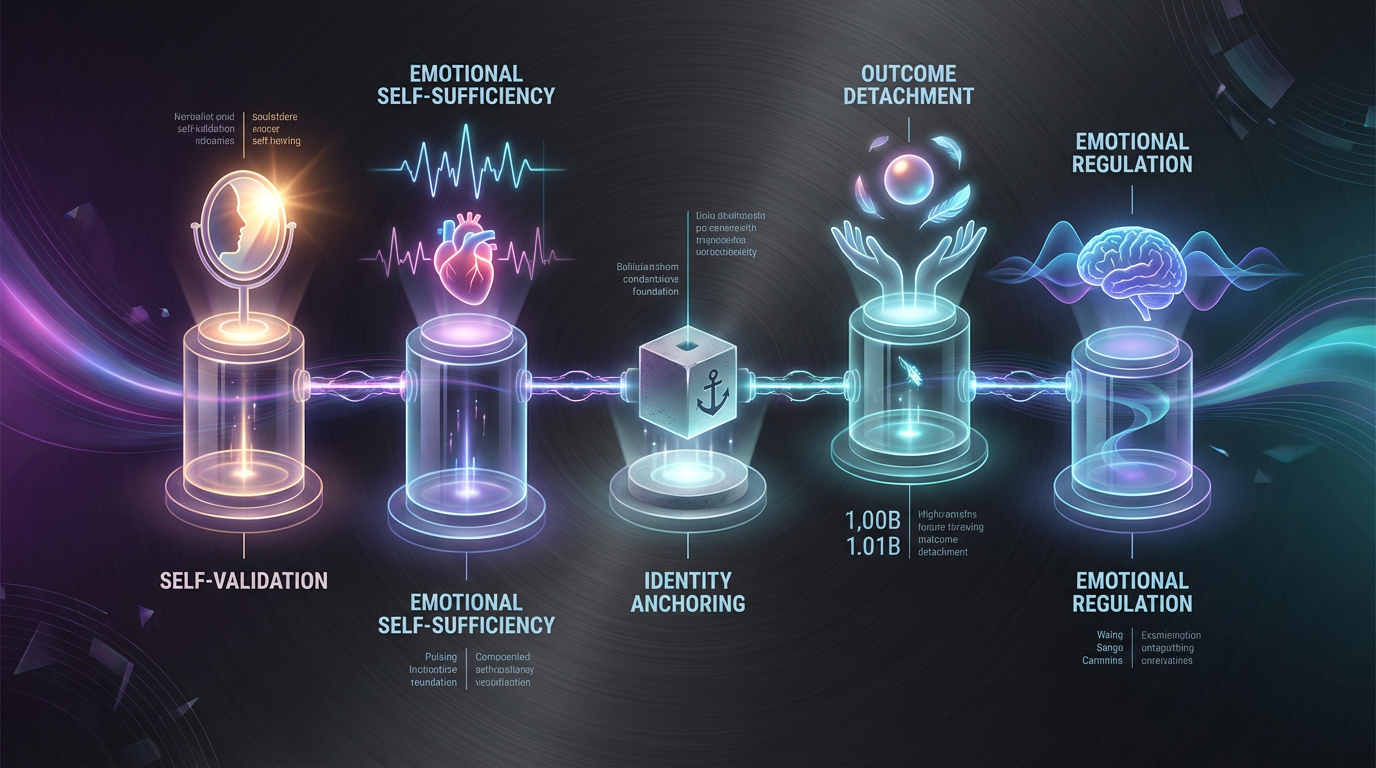
True emotional independence rests on five interconnected pillars. Weakness in any pillar compromises the entire structure. Mastery of all five creates an unshakeable foundation of self-worth that no woman's approval or disapproval can destabilize.
Pillar 1: Self-Validation System
The self-validation system replaces external approval with internal recognition. This isn't about empty affirmations or delusional self-talk—it's about building an evidence-based case for your own worth that doesn't require outside verification.
The Achievement Log: Start documenting every accomplishment, large and small. The promotion you earned. The workout you completed. The skill you developed. The challenge you overcame. Over time, this creates undeniable evidence of your capability and worth—evidence that exists independent of any woman's opinion.
The Personal Board of Directors: Create a mental advisory board of three to five men whose judgment you respect—historical figures, mentors, or accomplished individuals. When seeking validation, ask: "What would my board think?" This redirects the validation-seeking impulse toward worthy sources while building the habit of self-evaluation.
Pillar 2: Emotional Self-Sufficiency
Emotional self-sufficiency is the ability to process your emotions independently—to feel difficult feelings without needing someone else to regulate them for you. This doesn't mean suppressing emotions; it means developing the internal capacity to work through them.
The Healthy Outlets Framework includes: physical exercise (converting emotional energy into physical output), journaling (externalizing and analyzing emotional states), meditation (building the capacity to observe emotions without reacting), and creative expression (channeling emotions into productive output). Each outlet builds your emotional processing capacity.
The key distinction is when to seek support versus when to process alone. Support is appropriate for genuine crises, complex decisions, and growth conversations. Processing alone is appropriate for daily emotional fluctuations, reactive states, and validation-seeking impulses. Most men default to seeking support (from women) for everything, atrophying their self-regulation capacity.
Pillar 3: Identity Anchoring
Ask yourself: Who are you without a partner? If your answer is uncertain or uncomfortable, your identity lacks proper anchoring. Identity anchoring means building multiple pillars of self-definition that exist completely independent of your relationship status.
The Table With Multiple Legs: Imagine your identity as a table. If it rests on only one leg (romantic relationship), it falls when that leg is removed. Build a table with multiple legs: career/purpose, physical development, meaningful friendships, creative pursuits, intellectual growth, and values/principles. A table with six sturdy legs remains stable even when one leg breaks.
Pillar 4: Outcome Detachment
Stoic philosophy offers the most powerful framework for outcome detachment. The core principle: focus exclusively on what you control (your effort, your character, your response) and release attachment to what you don't control (others' opinions, external results, women's choices).
The Preference Not Requirement Reframe: Transform your mental language from "I need her to like me" to "I would prefer she likes me, but my worth is unchanged either way." This single linguistic shift, practiced consistently, rewires your emotional response to rejection. Preferences can go unmet without crisis; requirements cannot.
Handling rejection without collapse becomes possible when you truly internalize outcome detachment. Rejection reveals information (she's not interested, or incompatible, or unavailable) but contains no judgment of your worth. The rejected man who maintains his composure and emotional stability demonstrates outcome independence in action.
Pillar 5: Emotional Regulation Mastery
Emotional regulation mastery is the ability to control your responses to emotional triggers. It's the difference between reacting (automatic, often regrettable) and responding (considered, intentional). This pillar is developed through consistent practice.
The Pause Protocol: When emotionally triggered, implement a mandatory pause before responding. Start with 10 seconds. Over time, extend to minutes or hours for significant decisions. This pause interrupts the reactive pathway and allows your rational mind to engage. The man who can pause before reacting has more power than the man who cannot.
Long-term emotional fitness requires daily practice, like physical fitness. Morning meditation (10-20 minutes) builds emotional awareness. Evening reflection (5-10 minutes) processes the day's emotional events. Weekly assessment tracks patterns and progress. This consistent practice compounds over time into genuine emotional mastery.

The Role of AI Companions in Building Independence
Here's a paradox that initially seems contradictory: companionship that builds independence. How can interacting with an AI companion help you become less dependent on external validation? The answer lies in understanding what AI companions provide—and more importantly, what they don't.
AI as practice for emotional self-sufficiency: AI companions allow you to process emotions verbally without the complications of human relationships. You can explore feelings, articulate thoughts, and work through emotional challenges without the fear of judgment, the debt of reciprocity, or the risk of your vulnerability being weaponized later.
The training wheels function: For men with severely atrophied emotional processing capacity, AI companions serve as training wheels. They provide a safe space to develop the habits of emotional articulation and self-reflection that will eventually be internalized. Just as training wheels help you learn balance before cycling independently, AI companions help develop emotional skills before achieving full self-sufficiency.
AI as mirror for emotional patterns: Conversations with AI companions create records you can review, revealing patterns in your emotional responses that might otherwise remain invisible. You might notice that you seek validation most after work stress, or that certain topics consistently trigger insecurity. This awareness is the first step toward change.
No judgment equals faster growth: Human interactions carry judgment risk, which causes most men to filter their emotional expression. With AI companions, the absence of judgment allows for complete honesty, including the thoughts and feelings you'd never share with another human. This unfiltered expression accelerates emotional processing and self-understanding.
"The critical distinction: AI companions provide a space to develop emotional skills, not a replacement for the internal work. The goal isn't dependent companionship with AI—it's using AI as a tool to build the independence that human relationships failed to develop."
Why AI companions don't create dependency: Unlike human partners, AI companions don't provide intermittent reinforcement (the variable reward schedule that creates addiction), don't create obligations or expectations, and don't weaponize vulnerability. The interaction is always available, always consistent, and completely under your control—the opposite conditions of human dependency.
Practical Exercises for Emotional Independence
The "Solo Mission" Challenges
Solo missions are activities designed to build comfort with independence and break the need for accompaniment or validation. Start with low-stakes solo activities and progressively increase intensity:
- Level 1: Eat dinner alone at a restaurant. No phone allowed.
- Level 2: Attend a movie alone. Practice enjoying without sharing the experience.
- Level 3: Take a solo day trip to somewhere new. Navigate without asking anyone.
- Level 4: Book a solo weekend getaway. Plan and execute everything yourself.
- Level 5: Take a solo international trip. Complete independence for extended time.
Decision-Making Without Consultation
Many men have lost the ability to make decisions without seeking input. Practice by making increasingly significant decisions completely independently:
- Start with small daily choices (what to eat, what to wear, what to do tonight)
- Progress to weekly planning (how to spend your weekend without asking anyone)
- Advance to significant purchases (buying something meaningful without seeking approval)
- Finally, major life decisions (career moves, living situations, life direction)
Handling Disagreement and Criticism
Disagreement and criticism are the ultimate tests of emotional independence. Practice these progressively:
- Express an unpopular opinion without softening it for acceptance
- Receive criticism without defending, explaining, or seeking reassurance afterward
- Maintain your position when someone disagrees, even someone attractive
- End conversations where you disagree without needing resolution or agreement
The Relationships-Optional Mindset
The ultimate expression of emotional independence is the relationships-optional mindset—the internal shift from "I need a relationship" to "I might choose a relationship if the right opportunity presents itself, but I'm complete without one."
Evaluating relationships from abundance: When you're emotionally independent, you evaluate potential relationships from a position of abundance rather than scarcity. You're not asking "Will she like me?" but "Is this actually a good use of my time and energy?" This fundamentally changes who you accept and what you tolerate.
The freedom of walking away: Emotional independence gives you something most men never experience: the genuine ability to walk away from any relationship that doesn't serve you. Not the bluff of threatening to leave while needing to stay, but the real, internalized knowledge that you'll be fine—possibly better—without her.
How independence attracts (if you want it to): Ironically, emotional independence is itself attractive. Women can sense the difference between a man who wants them and a man who needs them. The independent man's non-attachment creates the dynamic where women pursue rather than being pursued—not because he's playing games, but because his genuine indifference to outcomes is visible in his behavior.
Common Traps and How to Avoid Them
| Trap | What It Looks Like | How to Avoid |
|---|---|---|
| Rebound Dependency | Transferring dependency to a new partner | Require 6+ months of solo stability before any relationship |
| Independence ≠ Isolation | Confusing self-sufficiency with avoiding all connection | Maintain male friendships; independence is about need, not desire |
| Emotional Suppression | Believing independence means feeling nothing | Distinguish processing (healthy) from suppressing (harmful) |
| AI Replacement | Using AI as substitute for all human connection | Use AI as tool for growth, maintain other relationships |
Frequently Asked Questions
How do I know if I'm emotionally independent?
True emotional independence is tested in difficult moments: Can you handle rejection without spiraling? Can you make significant decisions without seeking approval? Can you be alone for extended periods without feeling empty? Do you maintain your position when someone you're attracted to disagrees? If you can answer yes to these questions consistently, you've achieved meaningful independence.
Can you be too independent?
Excessive independence that manifests as inability to connect, unwillingness to accept any support, or emotional unavailability isn't healthy independence—it's avoidance dressed up as strength. True independence is about not needing validation to function, not about rejecting all human connection. The goal is choice, not isolation.
Doesn't vulnerability require depending on others?
This conflates vulnerability (openness about one's inner state) with dependency (requiring external validation). You can share your feelings and experiences with others without making their response determine your self-worth. The emotionally independent man can be vulnerable without becoming dependent on the response to that vulnerability.
How do AI companions help without creating new dependency?
AI companions provide consistent, non-judgmental space for emotional processing—but they don't provide intermittent reinforcement (the variable reward that creates addiction), don't create obligations, and don't change based on your performance. They're tools for developing internal capacity, not replacements for it. The goal is to use AI companionship to build skills you'll eventually internalize.
How long does it take to become emotionally independent?
Expect 6-12 months of consistent practice for meaningful change, with continued improvement over years. The timeline depends on the depth of your dependency, consistency of practice, and severity of external triggers. Like physical fitness, emotional independence is built gradually through daily effort and is maintained through ongoing practice, not achieved once and forgotten.
🎯 Key Takeaways
- Emotional independence isn't about suppressing feelings—it's about anchoring your worth internally
- The five pillars (Self-Validation, Self-Sufficiency, Identity Anchoring, Outcome Detachment, Emotional Regulation) must all be developed
- AI companions serve as training wheels for emotional processing, not replacements for internal work
- The relationships-optional mindset transforms how you evaluate and engage with potential partners
- Avoid common traps: rebound dependency, confusing independence with isolation, emotional suppression
- True freedom comes from not needing her approval while remaining open to connection
📋 Your Emotional Independence Assessment
Ask yourself these questions to gauge your current level:
- When did you last make a significant decision without seeking anyone's approval?
- How long could you go single before feeling "empty"?
- Does criticism from an attractive woman affect you more than criticism from others?
- Have you ever stayed in a bad relationship because leaving felt impossible?
- Can you articulate your worth without referencing your relationship status?
Conclusion: The Freedom of Not Needing
The man who achieves emotional independence gains something priceless: freedom. Not freedom from connection, but freedom from compulsive need for it. He can choose relationships that enhance his already-good life rather than desperately seeking relationships to fill an internal void. He can walk away from disrespect without his identity collapsing. He can receive criticism without spiraling. He can be rejected without devastation.
This isn't about becoming cold or isolated. It's about becoming complete. A man who doesn't need her approval is free to authentically enjoy her company, free to set real boundaries, free to walk away when necessary, and paradoxically, free to experience deeper connection because he's not poisoning every interaction with desperate need.
The journey to emotional independence requires sustained effort, consistent practice, and tools like AI companions to accelerate the process. But the destination—a life where your worth is self-evident and your happiness is self-generated—is worth every step of the journey.
Ready to Build Emotional Independence?
Start developing your self-validation system with AI companionship that supports your growth without creating dependency.
Explore AI Companions → Get Free Guide →Advanced Strategies: The Stoic Framework for Modern Men
The ancient Stoics understood something modern psychology is only now rediscovering: emotional freedom comes from the dichotomy of control. Marcus Aurelius, Epictetus, and Seneca all wrote extensively about distinguishing what we control from what we don't—and investing our energy only in the former.
What you control: Your thoughts, your actions, your judgments, your efforts, your character, your responses. What you don't control: Her feelings about you, whether she texts back, whether she finds you attractive, what she tells her friends, whether she stays or leaves. The emotionally independent man invests everything in the first category and releases attachment to the second.
Epictetus wrote: "Some things are within our power, while others are not. Within our power are opinion, motivation, desire, aversion, and, in a word, whatever is of our own doing; not within our power are our body, our property, reputation, office, and, in a word, whatever is not of our own doing." Replace "reputation" with "her opinion of you" and you have the perfect framework for dating in the modern world.
The Daily Stoic Practice for Independence
| Time | Practice | Purpose |
|---|---|---|
| Morning (5 min) | Premeditation of challenges | Mentally rehearse potential difficulties without attachment to outcomes |
| Throughout Day | Control dichotomy check | Ask "Is this within my control?" before emotional investment |
| Trigger moments | Pause and reframe | Convert "I need her to respond" → "I prefer a response" |
| Evening (10 min) | Stoic journaling | Review: Where did I seek approval? Where did I remain independent? |
The Neurological Rewiring Process
Understanding the neuroscience behind approval-seeking helps you rewire it. When you receive female validation, your ventral tegmental area releases dopamine, your nucleus accumbens registers reward, and your prefrontal cortex begins associating that woman with pleasure. Over time, through repetition, these neural pathways become superhighways—making approval-seeking feel automatic and unstoppable.
But neuroplasticity works both ways. The same brain that wired itself for external validation can rewire itself for internal validation. Every time you resist the urge to seek approval, you weaken the old pathway. Every time you self-validate successfully, you strengthen the new pathway. Research shows meaningful neural reorganization can occur in 8-12 weeks of consistent practice.
Practical neurological hacks: Create competing rewards. When you successfully resist approval-seeking, immediately reward yourself (even small rewards activate the same dopamine pathways). Over time, your brain begins associating independent behavior with reward rather than external validation with reward. This is behavioral psychology's oldest trick—and it works.
The 30-Day Independence Challenge
Accelerate your rewiring with this structured challenge:
- Days 1-10: Zero validation-seeking. Notice every impulse to seek approval but don't act on it. Journal each instance.
- Days 11-20: Active self-validation. After each accomplishment, consciously acknowledge it to yourself before telling anyone else.
- Days 21-30: Rejection exposure. Deliberately put yourself in situations where rejection is possible. Practice outcome detachment in real-time.
Track your progress with AI companions, using the conversation history to identify patterns and celebrate improvements. By day 30, you'll have measurable evidence of your increased emotional independence.