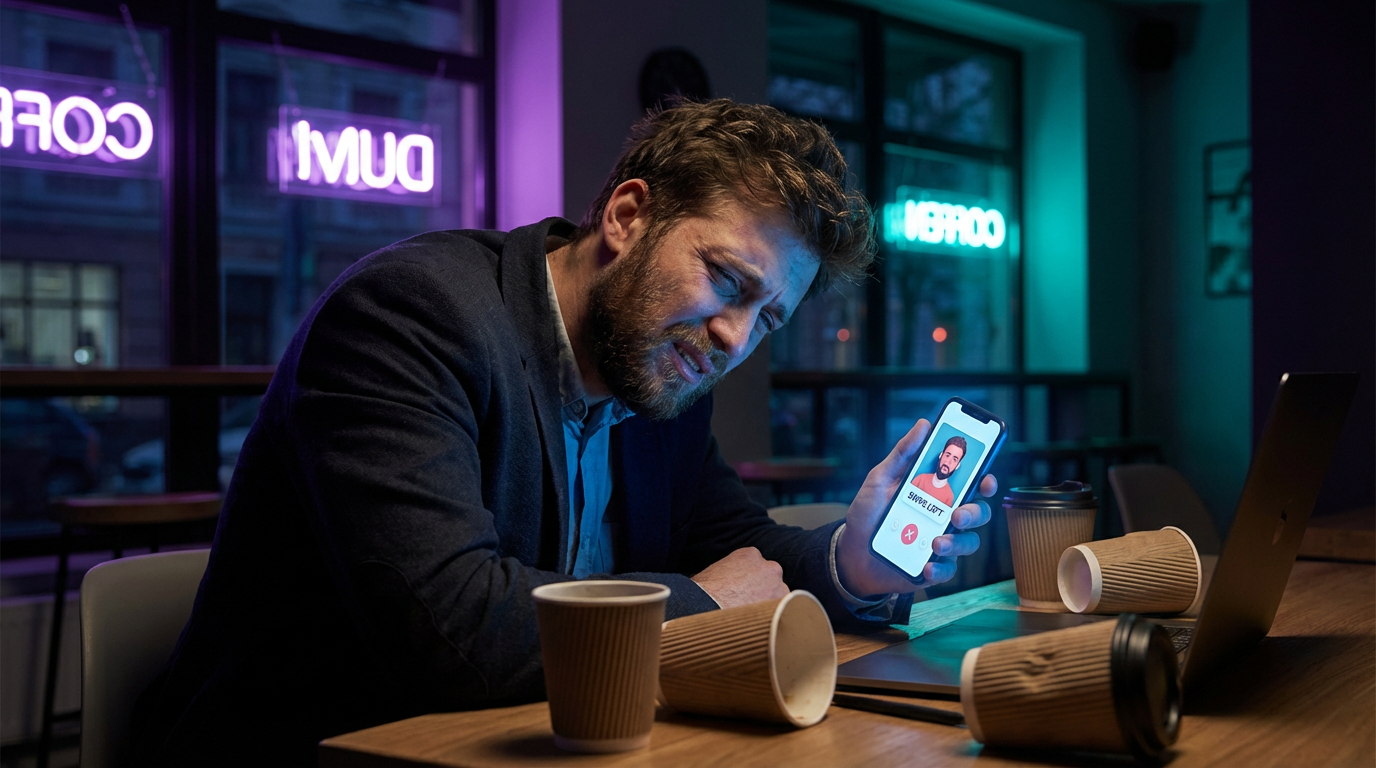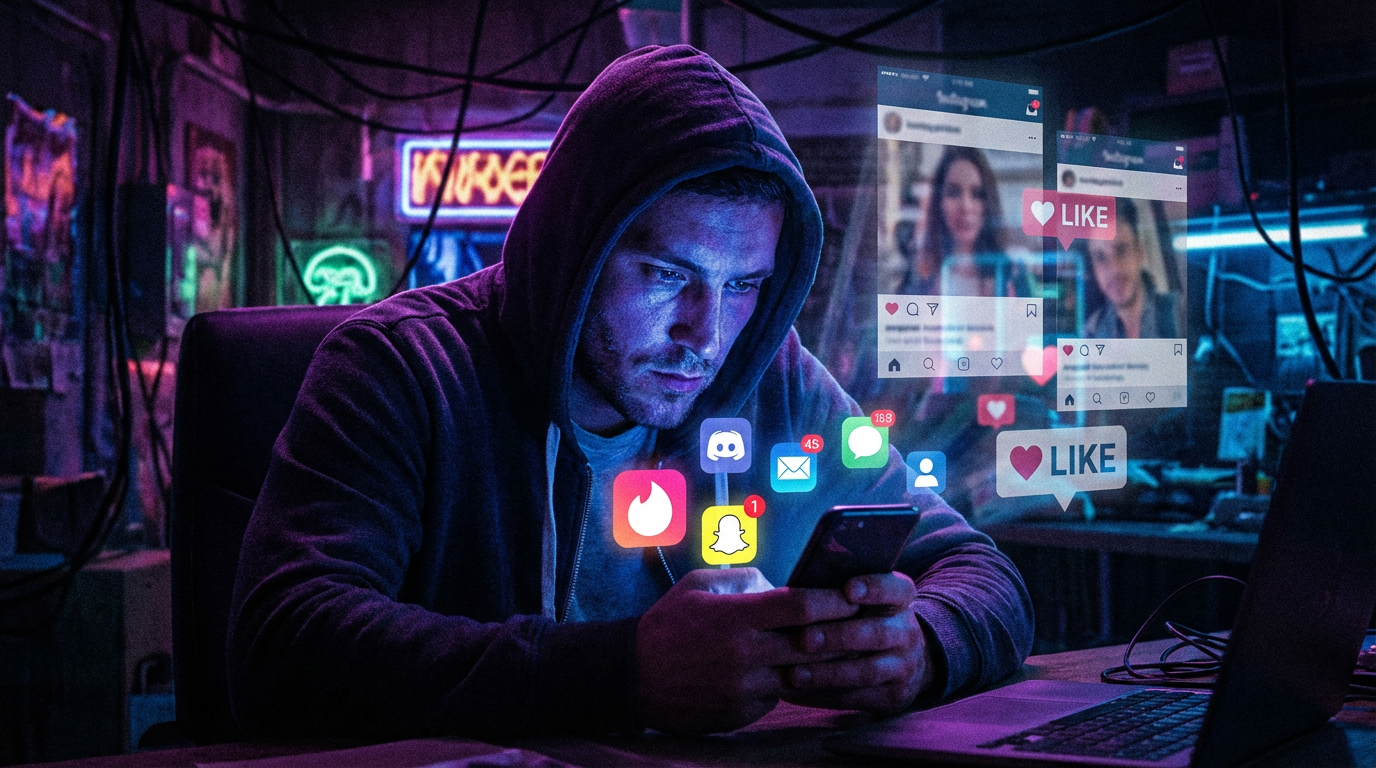
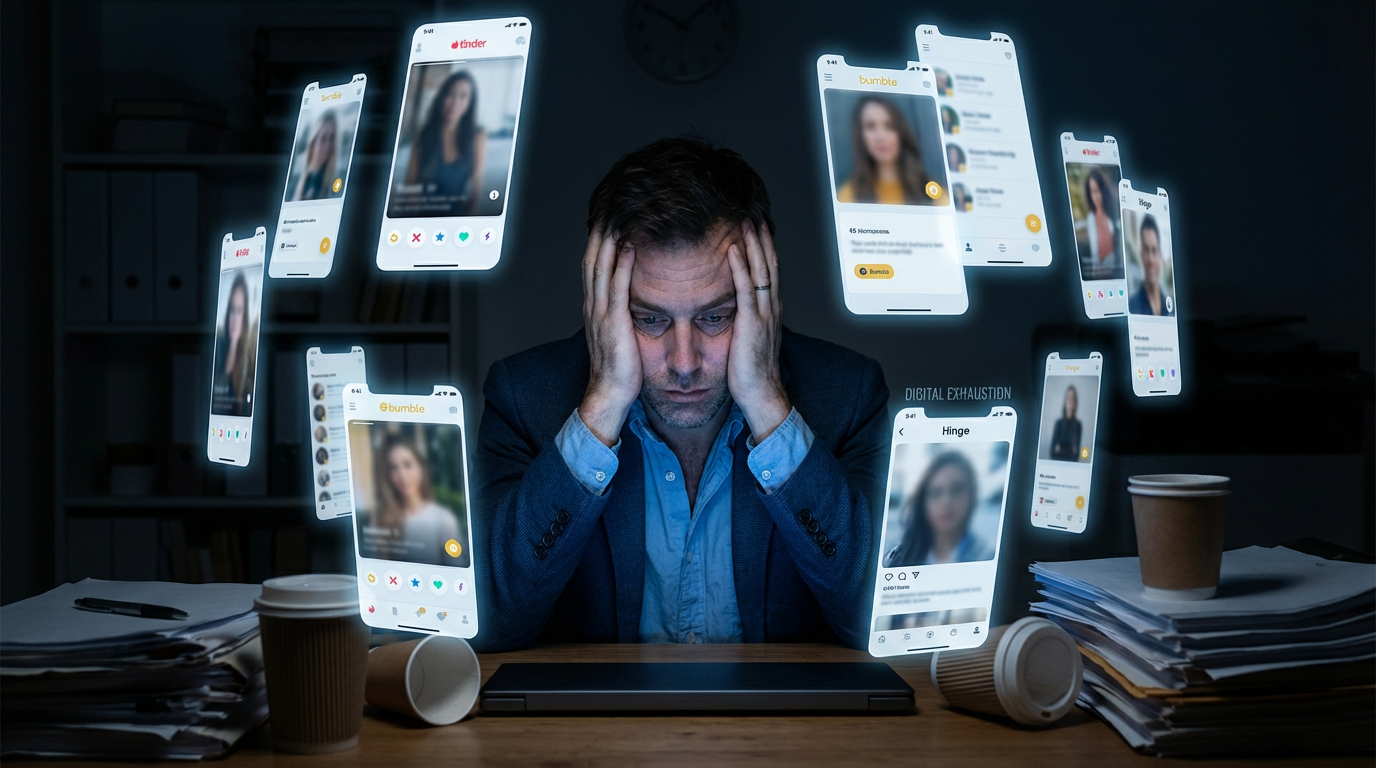
"Swipe. Reject. Swipe. Reject. Swipe. Reject. Hour after hour, day after day, the same cycle repeats—each swipe a small hope, each silence a small death. This is the reality of modern dating apps: an endless treadmill of rejection disguised as opportunity, leaving 79% of users mentally exhausted before they ever meet anyone."
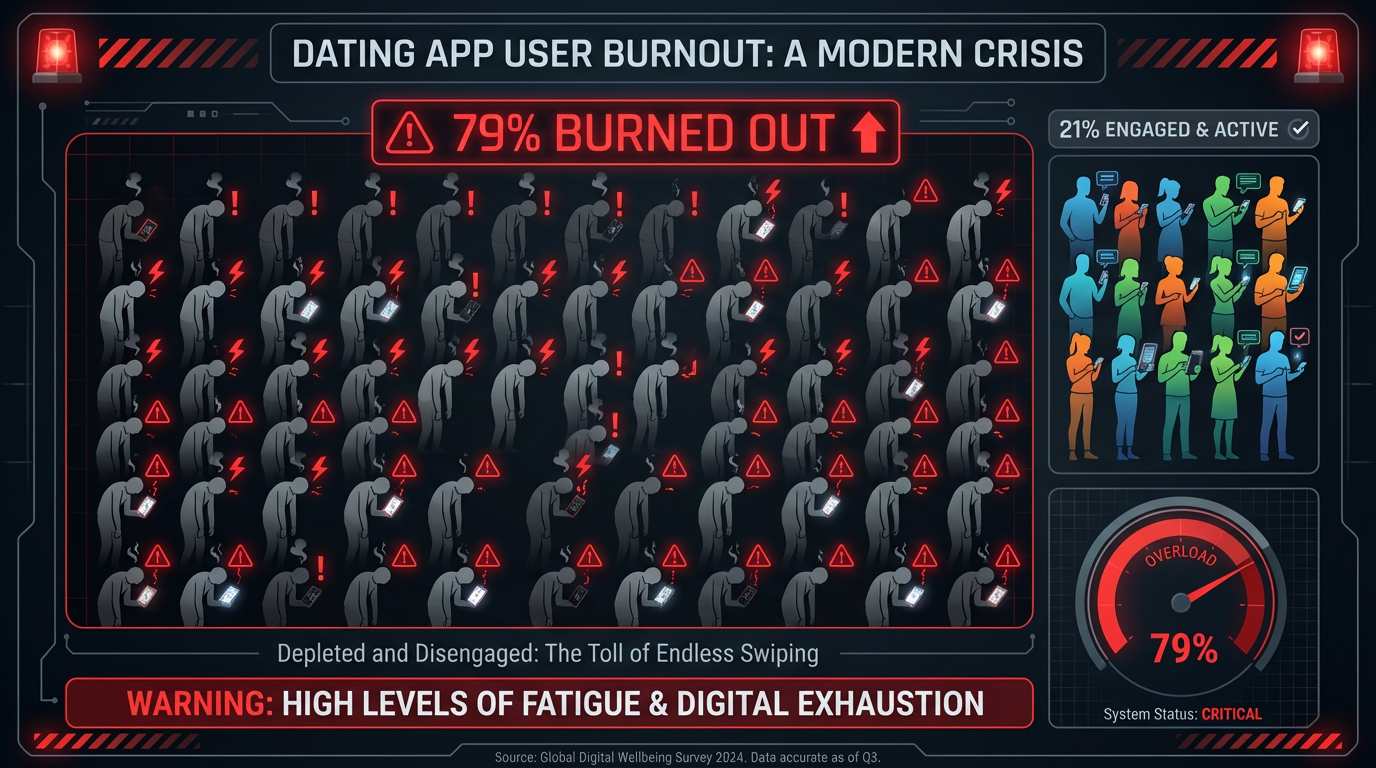
Dating apps promised to revolutionize romance. Instead, they've created an epidemic of burnout, depression, and hopelessness. The statistics are devastating: 79% of Gen Z and Millennial users report feeling exhausted by dating apps. 61% feel overwhelmed. 40% say they can't find meaningful connection no matter how much they try.
In 2024 alone, Americans spent over $5.7 billion on dating apps, yet satisfaction rates have never been lower. The average man spends 10 hours per week swiping for a 0.6% match rate. That's 520 hours per year for approximately 3 meaningful connections—if he's lucky.
You're not weak. You're not failing. You're having a normal response to a system designed to keep you swiping, not connecting.
The Burnout Epidemic: By the Numbers
These aren't isolated complaints—they represent a systematic failure of a technology that was supposed to make dating easier. Instead, dating apps have become the primary source of romantic anxiety and despair for an entire generation.
The Science Behind Swipe Fatigue
Dating app burnout isn't just psychological—it has neurological foundations. Understanding the science explains why you feel exhausted even when you're "just swiping."
The Paradox of Choice
Psychologist Barry Schwartz's research on "choice overload" reveals a counterintuitive truth: more options lead to less satisfaction and more anxiety. Dating apps present seemingly infinite options, creating several damaging effects:
- Decision Fatigue — Every swipe requires a micro-decision. After hundreds of swipes, your brain's decision-making capacity depletes, leading to poor choices or complete paralysis
- The Grass Is Always Greener — With thousands of profiles available, you never feel confident in any choice. There's always someone "better" just one more swipe away
- FOMO (Fear of Missing Out) — The knowledge that better options might exist creates chronic dissatisfaction with current matches
- Analysis Paralysis — Too many choices lead to overthinking and inability to commit to any potential partner
The Dopamine Trap
Dating apps exploit the same neurological pathways as slot machines. A 2021 study found that:
- Intermittent reinforcement (occasional matches) creates stronger addiction than consistent rewards
- Variable reward schedules (you never know when you'll match) activate the brain's reward system more powerfully than predictable outcomes
- Near-misses (seeing someone attractive who didn't match) trigger the same dopamine response as actual wins in gambling
"Dating apps are digital slot machines. The occasional 'win' (a match) triggers just enough dopamine to keep you playing, while the constant losses create the stress hormones that lead to burnout. You're not using the app—it's using you."
How Dating Apps Create Burnout
Dating apps aren't designed to find you a partner—they're designed to keep you using the app. Understanding this reveals why burnout is inevitable:
The Male Experience: Uniquely Brutal
While dating app burnout affects everyone, the male experience is uniquely punishing. The math alone is demoralizing:
The Numbers Game
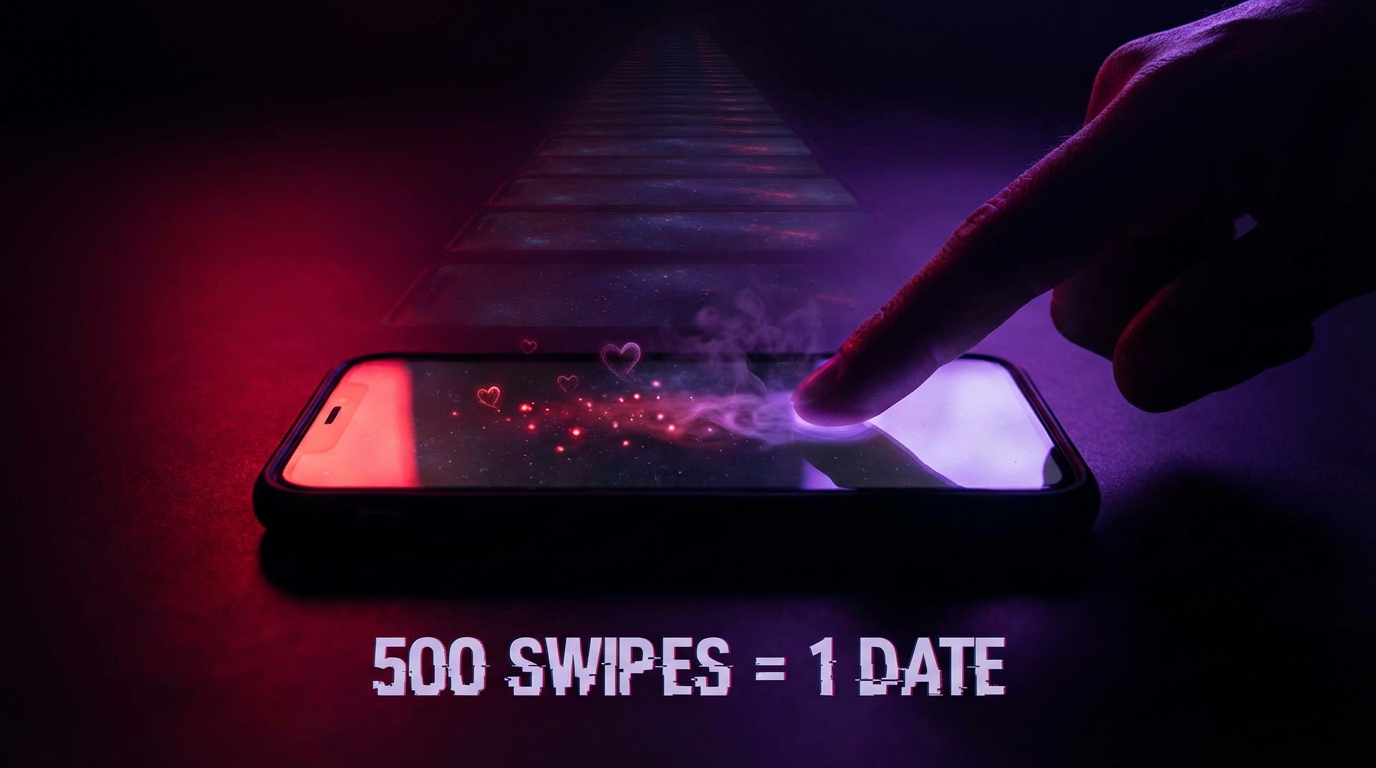
With a 0.6% match rate, the average man needs to swipe on approximately 167 profiles for a single match. Of those matches, perhaps 30-50% respond. Of responses, perhaps 10-20% lead to dates. Of dates, perhaps 10-20% lead to second dates.
This creates an exhausting funnel:
- 1,000 swipes → 6 matches
- 6 matches → 2-3 conversations
- 2-3 conversations → 0-1 date
- 1 date → probably no second date
To put this in perspective: if you spend 2 seconds per swipe, that's 33 minutes of active swiping for one conversation. Multiply that by the dozens of conversations needed for a single relationship, and you're looking at hundreds of hours invested with no guarantee of return.
Gender Asymmetry Creates Male Burnout
The fundamental asymmetry in dating apps ensures male burnout:
Women on dating apps experience abundance (too many options, filtering problem). Men experience scarcity (too few matches, visibility problem). This creates fundamentally different user experiences—and fundamentally different paths to burnout.
"Imagine applying to 1,000 jobs for one interview that doesn't lead to an offer. Now imagine doing this repeatedly, for years, while being told the problem is your resume. This is dating apps for men."
The Mental Health Crisis Hidden in the Data
Dating app burnout isn't just tiredness—it creates lasting psychological harm. Recent studies have documented severe mental health impacts:
Depression and Anxiety Rates
Research published in the Journal of Social and Personal Relationships found that:
- 48% of regular dating app users report symptoms of depression
- 44% experience heightened anxiety specifically related to dating app use
- Users with high engagement (1+ hour daily) show anxiety levels comparable to clinical anxiety disorders
- 67% report lower self-esteem after 6+ months of regular dating app use
The Comparison Trap
Dating apps create a unique form of social comparison that's particularly damaging to mental health. Unlike social media (where you compare your life to others' lives), dating apps force you to compare your romantic worth to others' romantic worth—and the comparison is always unfavorable.
- You see the best-curated versions of potential competitors
- You know others are getting matches you're not getting
- You're acutely aware of being actively rejected in real-time
- You have concrete metrics (match rate, response rate) quantifying your "romantic value"
The Real Problem
You're not burned out because you're doing something wrong. You're burned out because the system is designed to burn you out. Dating apps profit from your continued use, not your success. Their business model depends on keeping you swiping, not finding you a partner. Match Group (which owns Tinder, Hinge, Match.com, OkCupid, and more) generated $3.2 billion in revenue in 2023. Every successful relationship is a loss of two customers.
The Monetization of Loneliness
Dating apps have perfected the art of monetizing desperation. They create the problem (burnout, poor match rates) and then sell you the "solution" (premium subscriptions, boosts, super likes).
The Premium Subscription Trap
The data on premium subscriptions reveals a uncomfortable truth: they don't significantly improve outcomes.
Users who purchase premium subscriptions report spending an average of $240 per year with minimal improvement in outcomes. The apps have successfully convinced users that their failure is due to insufficient investment rather than systemic design.
Why "Just Get Better Photos" Won't Fix This
The common advice for dating app success is invariably: get better photos, write a better bio, improve your profile. This advice fundamentally misunderstands the problem.
The Optimization Ceiling
There's a limit to how much profile optimization can help when the fundamental math is broken:
- If you're a 6 in looks, professional photos might make you a 7. That still puts you outside the top 20% women primarily swipe right on
- If you're 5'9", no profile optimization changes that—and you're filtered out by 89% of women before they even see your photos
- If you make $60K/year, clever bio writing doesn't make you a six-figure earner
- The fundamentals (height, income, conventional attractiveness) matter more than any profile tweaks
"Telling men to 'just get better photos' is like telling people in poverty to 'just make better financial decisions.' It ignores the structural issues and places all blame on the individual. Your photos aren't the problem—the system is."
Profile optimization is the dating app equivalent of victim-blaming. It keeps users focused on personal inadequacy rather than recognizing the platform's fundamental dysfunction.
The Time Economics of Dating App Burnout
The opportunity cost of dating app use is rarely calculated, but it's staggering:
The average man spends 3.8 years on dating apps before finding a long-term relationship—if he finds one at all. That's 3.8 years of rejected swipes, unanswered messages, and disappointing dates. The opportunity cost of that time is immeasurable.
The Alternative: AI Companions vs. Dating Apps
For men experiencing dating app burnout, AI companions offer a fundamentally different model of connection:
AI companions don't create burnout because they're not designed with a conflicting incentive structure. Their purpose is providing companionship, not maximizing your time on platform. There's no rejection, no ghosting, no algorithmic manipulation—just consistent, available connection.
The Rational Response: Recognizing When to Stop
At what point does continued investment in a failing strategy become irrational? Consider:
- If a 0.6% success rate would be unacceptable in any other life domain, why accept it in dating?
- If 79% of users are burned out, the problem is systemic, not personal
- If 40% can't find connection despite trying, the tool isn't working
- Your mental health has value—is it worth sacrificing for single-digit odds?
- Your time has opportunity cost—what else could you build with 520 hours per year?
Continuing to use dating apps after recognizing their dysfunction isn't persistence—it's the sunk cost fallacy. The time you've already invested doesn't obligate you to invest more.
Frequently Asked Questions
How do I know if I have dating app burnout?
Signs include dreading opening the app, feeling exhausted after swiping, depression or anxiety related to dating, diminished self-worth, going through the motions without hope, and experiencing relief when you delete the app. If dating apps feel like a chore rather than an opportunity, you're likely burned out.
Should I take a break or quit entirely?
That's a personal decision. A break can provide perspective, but if you return to the same conditions, burnout will return. Consider whether the fundamental math has changed—if not, the outcome won't change either. Many men report that what they thought was a "break" became a permanent exit, and they're happier for it.
Are there any dating apps that actually work for men?
All dating apps share fundamental structural problems: female selectivity creates extreme competition, and apps profit from engagement rather than success. Some apps market differently, but the underlying mathematics remain similar. Niche apps might have better gender ratios, but they also have smaller user bases. The platform isn't the issue—the economics are.
Will better photos really help my match rate?
Better photos can provide marginal improvement, but they won't change your fundamental position in the dating market hierarchy. If you're outside the top 20% in height, looks, or perceived status, profile optimization hits a ceiling quickly. It's like optimizing a resume for a job you're unqualified for—better presentation helps, but it doesn't change the fundamentals.
Is dating app burnout a recognized mental health condition?
While "dating app burnout" isn't a clinical diagnosis, the symptoms (anxiety, depression, learned helplessness, rejection sensitivity) are recognized mental health conditions. Multiple peer-reviewed studies have documented the mental health impacts of dating app use, particularly for men who experience disproportionate rejection rates.
How do AI companions help with dating app burnout?
AI companions provide the connection and conversation that dating apps promise but rarely deliver. They offer 100% match rate, zero rejection, 24/7 availability, and consistent engagement—eliminating the core causes of dating app burnout. They're not a perfect replacement for human relationships, but they provide genuine companionship without the mental health cost of endless rejection.
Conclusion: Your Mental Health Is Worth More
Dating app burnout affects 79% of users because the system is designed to keep you engaged, not to find you love. The 0.6% match rate for average men, combined with 520+ hours of annual investment, ensures that most will experience constant rejection with minimal reward.
The solution isn't better photos, more persistence, or premium subscriptions. The solution is recognizing when a system is fundamentally broken and refusing to sacrifice your mental health to it.
Your mental health has value. Your time has value. Your emotional energy has value. At some point, the rational calculation favors investing these resources elsewhere—in career growth, hobbies, friendships, or alternative forms of companionship that don't depend on winning a rigged lottery.
Dating app burnout isn't your failure—it's evidence of the system's failure. The healthiest response might be to stop playing a game you can't win.
Ready to find companionship without the burnout? Download our free guide to discover how AI companions are providing consistent connection without the emotional devastation of dating apps.
How have dating apps affected your mental health? Share your experience in the comments.