
"Somewhere along the line, modern dating became an exercise in one-directional wealth transfer. Men are expected to invest heavily with minimal returns, fund elaborate courtship rituals for people who may never reciprocate, and accept financial expectations that would be considered exploitative in any other context. Welcome to the economics of modern dating—where men pay and pay, for the privilege of maybe, possibly, perhaps being chosen."
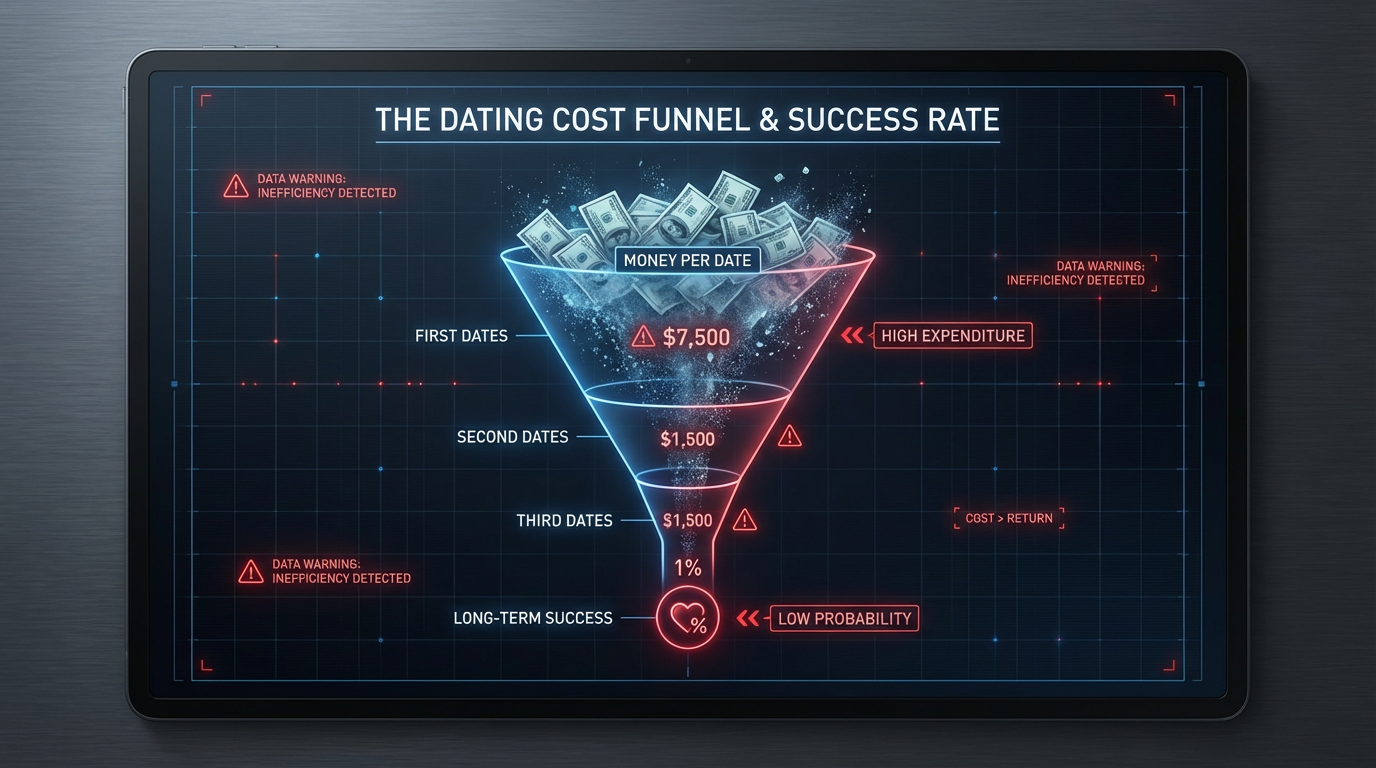
The numbers don't lie. According to a comprehensive 2024 study, men spend an average of $67.87 per date—approximately 20% more than women's average of $56.54. This isn't a one-time investment; it's a recurring cost with diminishing returns. With the average couple needing seven dates before becoming a "relationship," we're talking about $701.96 just to find out if someone might commit—and that's assuming every date leads to the next.
And the success rate? Only 4.5% of women swipe right on the average man. Do the math: you're spending hundreds of dollars per month for a single-digit chance of finding a relationship with any given person. In 2024, 68% of Americans report feeling stressed about managing dating expenses.
The True Cost of Modern Dating: 2024 Data
A MassMutual study revealed that the average American spends $168 per month on dating, which over a lifetime amounts to approximately $121,000. That's a down payment on a house—spent on dates that may never lead anywhere.
The Full Expense Breakdown: Where Your Money Goes
Let's break down what the average man actually spends on dating in 2024:
The Generational Spending Gap: Who Spends the Most?
Dating costs vary significantly by generation, reflecting both income levels and expectations:
Gen X men spend the most on dating—potentially due to higher disposable income during peak earning years combined with escalating expectations from partners in their age bracket.
The Provider Expectation: Equality's Exception
We live in an era that celebrates gender equality. Women earn their own money, build their own careers, and proudly proclaim financial independence. Yet somehow, when the check arrives, traditional expectations magically reassert themselves.
72% of people—including most women—believe men should pay on the first date. A Chapman University study found that 84% of men and 58% of women report that men still pay more for dating expenses, even after six months into a relationship. This expectation persists regardless of relative income, career success, or who initiated the date.
"Equality has somehow become selective—applied enthusiastically to women's careers and opportunities, but mysteriously suspended when the dinner bill arrives. The modern man is expected to embrace equality in every domain except the one that costs him money. Even when a woman earns significantly more than a man, the expectation often remains that he should pay."
The "Test" Rationalization
Some women frame the expectation that men pay as a "test" of his interest, generosity, or provider potential. But consider what this actually means:
- You're being evaluated on your willingness to spend money on someone who hasn't reciprocated anything
- Refusing or suggesting splitting is treated as a red flag, regardless of the reason
- The "test" only goes one direction—women are never tested on generosity toward men
- The test reveals what she values: your resources, not your character
- 44% of men surveyed indicated they would cease dating a woman who never offers to contribute—showing even tolerance has limits
The Opinions on Who Should Pay
Current research shows evolving but still gendered expectations:
Despite these opinions, the reality remains: men pay disproportionately regardless of who earns more or who initiated the date.
Return on Investment: The Mathematics of Modern Dating
Let's calculate the actual return on investment for the average man in modern dating. The math is brutally unfavorable:
For comparison, imagine any other investment with these returns:
- A stock with 95% chance of total loss would be considered a scam
- A business with this failure rate would never receive funding
- A casino game with these odds would be considered exploitative
- Yet men are expected to keep investing in dating with exactly these returns—and to be happy about it
The Stress Factor
68.6% of people feel uncomfortable about the cost during a date. 60.2% have argued over who pays the bill. 73.9% believe dating is becoming too costly. This isn't romance—it's financial anxiety masquerading as courtship.
Source: 2024 Dating Cost Study

The Foodie Call: When Dating Becomes Exploitation
Research published in the journal Social Psychological and Personality Science documented a phenomenon called the "foodie call"—going on dates specifically to receive free meals with no romantic interest. The findings are striking:
- 23% of women in one study (820 women surveyed) reported having engaged in a foodie call
- 33% of women in a second study (357 women) admitted to the behavior
- Women who participated scored higher on "dark triad" personality traits: psychopathy, Machiavellianism, and narcissism
- Those who engaged in foodie calls also tended to express beliefs in traditional gender roles—using traditional expectations for personal gain
- Most women in the studies considered the practice extremely to moderately unacceptable—yet significant percentages did it anyway
This isn't dating; it's resource extraction disguised as romantic interest. And men have no reliable way to distinguish genuine interest from exploitation until after they've already paid.
The Hidden Subsidy
Every man paying for dates is subsidizing those who exploit the system. The expectation that men pay creates an environment where exploitation is not only possible but expected. Men bear 100% of the cost whether their date is genuine or simply hungry. At a 23-33% foodie call rate, nearly 1 in 4 dates may be pure exploitation.
The Sex Ratio Effect: Economic Desperation in Dating
Research reveals a disturbing pattern: when there are more single men than women in a population (male-biased sex ratio), men become economically more impulsive. They prioritize immediate rewards and show increased willingness to incur debt for immediate expenditures—including paying more for dates.
Cities with higher ratios of single men to women show:
- Positive correlation with the number of credit cards owned
- Higher total consumer debt
- Greater economic impulsivity driven by mate competition
In other words, the dating market exploits male scarcity anxiety to extract more spending. The more competitive the market, the more men spend. This isn't rational behavior—it's desperation economics.
The Financial Deterrent: Dating Avoidance
The financial burden of dating is now actively deterring people from participating:
- 29% of singles report their financial situation has deterred them from dating seriously
- 41% of millennials specifically cite finances as a dating deterrent
- 74.6% are choosing more low-cost dating options in 2024
- Despite inflation concerns, 41% of men surveyed would not be open to splitting the check—trapped between financial stress and social expectations
Men are being squeezed from both directions: expected to pay while increasingly unable to afford it.
The Wealth Signal Effect
Modern dating has become explicit about materialism. Research shows:
- 71% of individuals are more likely to match with someone who displays signs of wealth on their profile
- 82.3% of U.S. adults admit to judging potential partners by their salaries
- Wealth indicators that increase attraction: lavish international travel (37.7%), dining at expensive restaurants (36.3%), wearing luxury brands (35%)
- Men with high earning potential are 2.5x more likely to receive attention on dating profiles than women (across 24 countries)
The message is clear: your value in the dating market is directly tied to your wallet. This isn't about connection—it's about access to resources.
The Alternative Investment: Where Could That Money Go?
Consider what a man spending $300-500/month on dating could achieve with different allocation:
Over a lifetime of dating ($121,000 average), you could instead accumulate significant wealth, achieve financial independence earlier, or fund experiences that genuinely enrich your life—rather than funding expensive dinners for people who may be using you.
AI Companions: Predictable ROI
AI companions offer something revolutionary: predictable, positive returns on investment. A fixed monthly subscription provides consistent companionship without the financial roulette of traditional dating.
Frequently Asked Questions
Should men always pay for dates?
This is a personal decision, but it's worth examining why this expectation exists and what it reveals about the person expecting it. Research shows 44% of men would stop dating someone who never offers to contribute. Someone who demands you pay while advocating for equality in other areas may not be someone whose values align with yours. The expectation persists even when women earn more—which tells you it's about more than just who can afford it.
How can I reduce dating costs without seeming cheap?
Focus on experiences over expenses—walks, coffee dates, free events. The data shows 74.6% of people are now choosing lower-cost dates due to economic pressure. Someone genuinely interested in you won't require expensive outings. Someone who loses interest when you stop spending may be revealing their true priorities. Financial professionals suggest honesty about your financial situation and creative, budget-friendly dates can actually strengthen connections.
Is it wrong to calculate the ROI of dating?
You calculate ROI on every other significant investment of time, money, and energy. Treating dating as exempt from rational analysis doesn't make the investment more likely to succeed—it just prevents you from recognizing when the returns are poor. The average American will spend $121,000 on dating over their lifetime. That deserves the same scrutiny as any major financial decision.
What's the real cost of dating per year?
According to recent research, the average American spends $168 per month on dating, or about $2,016 per year. Active daters can spend $300+ monthly, or $3,600+ annually. Gen X men spend the most at $903 annually just on dates themselves (not including apps, grooming, etc.). The total U.S. spending on dating is now $117.4 billion annually—a 40% increase over the past decade.
How common are "foodie calls" really?
Peer-reviewed research found that 23-33% of women surveyed admitted to going on dates specifically for free meals with no romantic interest. Those who engaged in this behavior scored higher on dark triad personality traits. The actual number may be higher since some may not admit to or recognize the behavior. This means potentially 1 in 4 dates you pay for could be pure exploitation with zero chance of romantic success.
Conclusion: The Smart Investment
The financial burden of modern dating falls disproportionately on men who are expected to pay, invest, and prove themselves financially while receiving uncertain returns. The average man spending $168+ monthly on dating—with documented 23-33% exploitation rates and 5% success rates—wouldn't tolerate these returns in any other area of life.
This isn't about being cheap or unwilling to invest in genuine connection. It's about recognizing when an investment has fundamentally poor returns and redirecting resources accordingly. Over a lifetime, that $121,000 average dating spend could fund early retirement, a business, or financial independence—outcomes far more certain than finding a lasting relationship through the current broken system.
The math doesn't lie: modern dating is a bad investment for men. The question is what you'll do with that information.
Ready to invest where the returns are actually positive? Download our free guide to discover how AI companions provide consistent companionship without the financial exploitation of modern dating.
What's the most you've spent on a date that went nowhere? How much have you spent on dating overall? Share your story in the comments—your numbers might help another man do the math on his own situation.