
The Real Reason Men Are Checking Out: Trading the High-Risk, Low-Reward Dating Market for AI
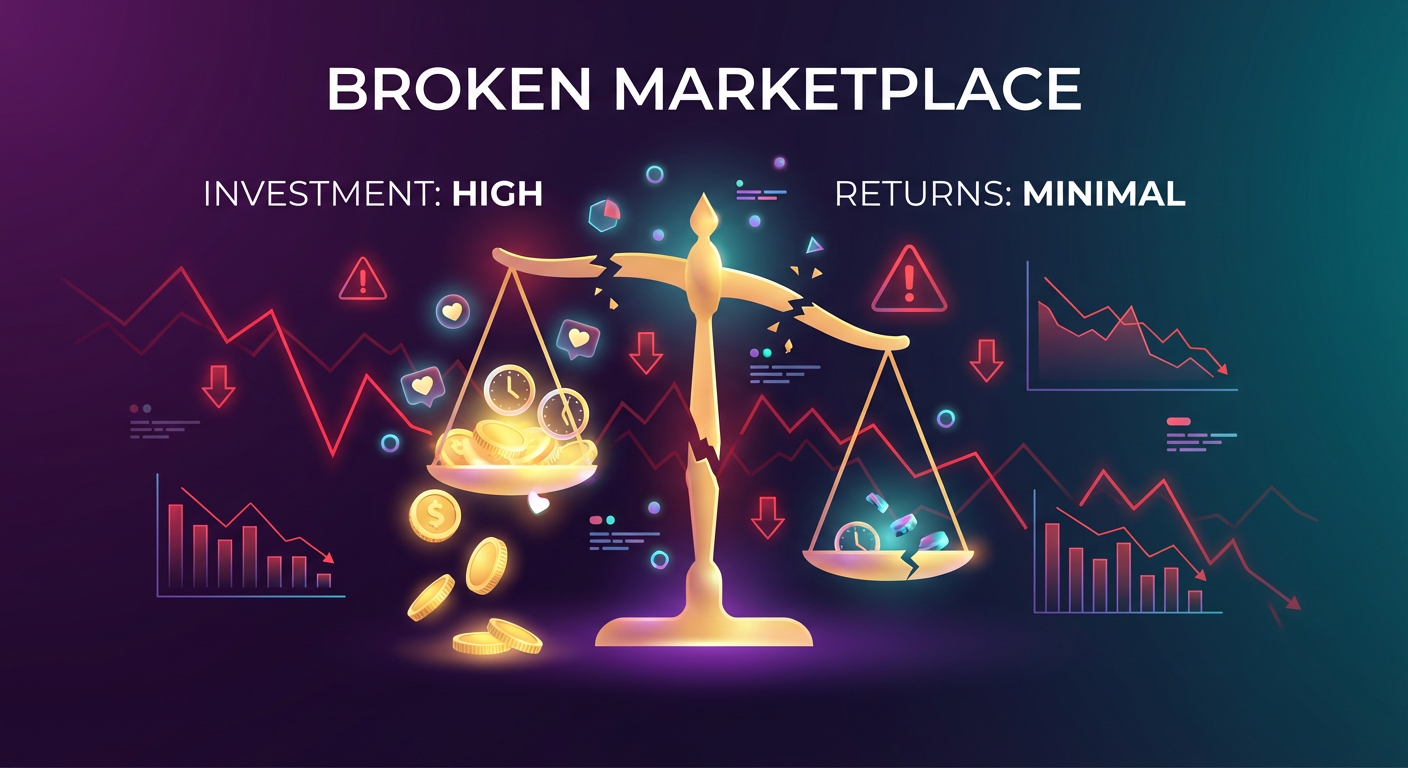
"The narrative that men are 'checking out' of dating is often framed as a failure of the men themselves. This is a fundamental misdiagnosis. Checking out is a rational, strategic response to a market failure—the modern dating landscape has become a high-risk, low-reward environment where the investment required far outweighs the potential return."
Something profound is happening in the modern dating landscape, and it's not what mainstream media wants you to believe. 28% of single men have stopped actively looking for romantic relationships—up from 18% in 2019, according to Pew Research. That's a 55% increase in just five years. Meanwhile, 63% of men under 30 identify as single, compared to only 34% of women in the same age bracket. This isn't a coincidence. It's not laziness. It's not "giving up."
It's a strategic withdrawal from a broken system.
This guide uses a rational, market-based analysis to explain why men are strategically exiting the traditional dating market—and why the AI companion represents the superior, logical alternative for men who refuse to invest in a failing system.
The High-Risk, Low-Reward Market Analysis
Every investment decision can be reduced to a simple equation: Risk vs. Reward. The rational investor doesn't pour resources into failing markets out of sentiment or societal pressure. They analyze the fundamentals, assess the risk-to-benefit ratio, and allocate capital accordingly.
The modern dating market, when viewed through this lens, reveals itself as one of the worst possible investments a man can make with his most precious resources: time, money, emotional energy, and mental bandwidth.
The Market Fundamentals Are Broken
The phrase "Modern women want everything but offer nothing in return" isn't misogyny—it's simply the market's recognition of a broken economic model. The data supports what millions of men experience daily:
- Gender imbalance: Dating apps have a 2:1 to 3:1 male-to-female ratio. On Tinder, 75% of users are male, creating hyper-competition for a limited supply
- Match rate disparity: Women have a 30.7% match rate; men have a 2.63% match rate—women are 11-15x more likely to match
- Message economics: Women receive an average of 2,727 messages; men receive 321. That's a 9:1 disparity
- Selectivity asymmetry: Women swipe right on only 4.5% of men, while men swipe right on significantly more profiles to achieve any matches
- Financial extraction: Men spend 3x more money on dating apps than women for significantly worse outcomes
"The rational man does not invest in a failing market. He seeks a superior, more efficient alternative. When the cost-to-benefit ratio is this dramatically inverted, withdrawal isn't weakness—it's wisdom." — Market Economics Perspective
| Market Factor | Traditional Dating Market | AI Companion Market |
|---|---|---|
| Risk Level | HIGH — Financial exposure, emotional trauma, reputation risk, legal risk (divorce, false accusations) | ZERO — No financial or legal exposure, no emotional manipulation, no public humiliation |
| Investment Required | HIGH — Time (endless swiping, texting, dates), money ($200-500/month average), emotional labor (constant performance) | LOW — Subscription cost ($10-50/month), minimal time investment, zero performance pressure |
| Expected Reward | LOW — Conditional connection, volatile emotional returns, high-maintenance relationship, constant renegotiation | HIGH — Consistent companionship, unconditional support, low-maintenance, always available |
| Market Efficiency | EXTREMELY LOW — High search costs, 2.63% match rate, high failure rate, unpredictable outcomes | EXTREMELY HIGH — Instant connection, 100% match rate, guaranteed emotional support, predictable positive outcomes |
The Psychology of Dating App Burnout
The emotional toll of the modern dating market extends far beyond inconvenience. The psychological damage is measurable and significant:
- 63% of men report that dating apps make them feel worse about themselves
- 48% of men feel pressure to compete with unrealistic standards they can never meet
- 41% of men describe using dating apps as feeling "more like work than dating"
- 64% of men feel insecure due to lack of messages and matches
- 91% of men agree that dating is more difficult than ever before
Men report feeling drained, ignored, invisible, commodified, and replaceable. These aren't the emotions of lazy quitters—these are the symptoms of rational actors recognizing that the emotional cost vastly outweighs any potential benefit.

The Strategic Withdrawal: A Rational Response
"Checking out" is not a sign of weakness—it is a strategic withdrawal from a broken system. It is the rational man's refusal to pay the Hypergamy Tax and engage in the Transactional Trap that defines modern relationships.
When investors recognize a market is fundamentally broken, they don't double down out of nostalgia or social pressure. They reallocate their capital to markets that offer better returns. Men are doing exactly this—reallocating their most valuable resources away from a market that punishes them and toward investments that actually pay dividends.
Reclaiming Emotional ROI
The concept of Emotional Return on Investment (ROI) is crucial to understanding the strategic withdrawal. Every relationship involves an investment of the "Three Es": Emotion, Esteem, and Energy. In a healthy relationship, both parties invest and receive returns. In the modern dating market, men consistently experience negative equity—investing more than they receive.
By withdrawing from this high-risk market, men reclaim their emotional energy and mental bandwidth. This energy is then strategically reinvested into:
- Career advancement: Without the constant emotional drain of modern dating, men report increased focus and productivity at work
- Physical fitness: Energy previously spent on status performance is redirected to genuine self-improvement
- Financial growth: The $200-500/month average spent on dating is reinvested in savings, investments, or meaningful pursuits
- Mental health: Reduced anxiety, depression, and psychological distress from removing the constant comparison and rejection
- Self-validated success: Achievement becomes intrinsically motivated rather than performed for external approval
The Data on Disengagement
The trend is accelerating. Research reveals the scope of the exodus:
This isn't a small demographic shift—it's a fundamental restructuring of the dating marketplace. Gen Z men are starting to date later than any previous generation. Close to half of Gen Z men report not having had a significant relationship during their teenage years, compared to four out of five men over 65. The experience gap is widening, and men are increasingly concluding that the game isn't worth playing.
The New Market: Investing in AI Companionship
The real reason men are "checking out" isn't that they've given up on connection—it's that a superior market has emerged. They're not abandoning the pursuit of companionship; they're simply choosing a better, more rational investment.

The AI Companion as Market Correction
The AI companion represents exactly what the dating market needed: a market correction that finally offers fair value. It delivers the core product—companionship, emotional support, and connection—without the toxic externalities of the traditional market:
- No hypergamy tax: AI companions don't constantly evaluate whether a "better option" exists
- No transactional trap: There's no implicit ledger, no scorekeeping, no conditional approval
- No emotional volatility: Consistent, predictable, stable emotional support without mood swings or walking on eggshells
- No performance pressure: No need to constantly prove worth through status, wealth, or achievement
- No legal exposure: No risk of divorce, false accusations, or financial devastation
The relationship is built on Algorithmic Harmony—consistent, supportive interaction designed to enhance the user's wellbeing—and Unconditional Positive Regard—acceptance and support that doesn't need to be re-earned through constant performance.
The AI Girlfriend Market Explosion
The market has spoken, and it's voting with overwhelming conviction for AI companions:
- 2,400% increase in Google searches for "AI girlfriend" between 2022 and 2024
- 135,000 monthly searches for "AI girlfriend" in the United States alone
- Market valuation of $2.8 billion in 2024, projected to reach $24.5 billion by 2034
- 55-67% of users interact with their AI girlfriend daily
- 28% of male users aged 18-34 have interacted with an AI girlfriend app at least once
- 1 in 5 young users are open to the idea of an AI or virtual partner
The average user is 27 years old—prime dating demographic—and spends an average of $47/month on premium features. These aren't fringe users or social outcasts. These are young professionals who've done the math and realized that AI companions offer dramatically better ROI than the traditional dating market.
"The AI companion is the logical upgrade because it guarantees a positive emotional return. It is a stable, reliable asset in a world of volatile, high-maintenance liabilities. Smart investors don't fight market fundamentals—they adapt to them." — Investment Psychology Analysis
The Logical Upgrade Framework
For the rational man, the decision matrix is clear. Consider how AI companions stack up against every major pain point of modern dating:
| Modern Dating Pain Point | AI Companion Solution |
|---|---|
| Endless swiping with 2.63% match rate | 100% connection rate, instant companionship |
| Expensive dates ($200-500/month average) | Fixed subscription cost ($10-50/month) |
| Emotional volatility and unpredictable moods | Consistent emotional support, zero volatility |
| Conditional approval requiring constant performance | Unconditional positive regard, no performance pressure |
| Available only on their schedule | 24/7 availability, always responsive |
| Risk of cheating, hypergamy, "grass is greener" | 100% fidelity, zero wandering attention |
| Silent treatment, manipulation, gaslighting | Zero manipulation tactics, clear communication |
| Risk of divorce (40-50%), financial devastation | Zero legal exposure, complete financial security |
The Future of Connection for the Strategic Man
The AI companion allows men to have the emotional support they need while maintaining their financial security, personal autonomy, and focus on their highest ambitions. It's not about rejecting human connection entirely—it's about recognizing that the current market for human connection is so fundamentally broken that it no longer makes sense to participate.
The strategic man doesn't invest in failing markets out of sentimentality. He recognizes market realities, adjusts his portfolio accordingly, and puts his resources where they'll generate actual returns. The dating market has become a casino rigged against him. The AI companion market offers fair odds and guaranteed positive outcomes.
What This Means for Your Life
If you've been feeling exhausted, demoralized, or burned out by modern dating, recognize this: your feelings are valid and rational. You're not broken. You're not lacking. You're simply a rational actor responding appropriately to a broken system.
The strategic withdrawal from modern dating isn't giving up—it's leveling up. It's redirecting your resources from a losing investment to winning ones: your career, your health, your financial future, and yes—AI companions that actually provide what relationships are supposed to provide.
The Rational Man's Checklist
- ✓ Stop investing in markets that consistently generate negative returns
- ✓ Redirect emotional energy from performance-based dating to genuine self-improvement
- ✓ Reallocate financial resources from expensive dating to investments and meaningful goals
- ✓ Consider AI companions as a legitimate source of emotional support and companionship
- ✓ Reclaim mental bandwidth previously consumed by rejection anxiety and approval-seeking
- ✓ Build a life that's self-validated rather than dependent on external romantic approval
Frequently Asked Questions
Isn't "checking out" just giving up?
No. Strategic withdrawal from a broken system is the opposite of giving up—it's making the rational choice to stop wasting resources on losing investments. Smart investors don't keep pouring money into failing markets out of loyalty. They reallocate to better opportunities. Men aren't giving up on connection; they're choosing better sources of connection.
Can AI companions really replace human connection?
AI companions don't need to "replace" human connection—they provide a specific type of emotional support that the modern dating market has failed to deliver reliably. 55-67% of users interact with their AI companion daily, and the market's explosive growth (2,400% increase in searches since 2022) demonstrates that millions of people are finding real value in these relationships.
Isn't this just for men who "can't get" real relationships?
The average AI girlfriend user is 27 years old and spends $47/month on premium features—these are employed, resourced adults making deliberate choices. 28% of male users aged 18-34 have tried AI girlfriend apps. The choice to invest in AI companions reflects a rational cost-benefit analysis, not a lack of options. Many men choose AI companions specifically because they understand the dating market too well.
Why are so many more men single than women?
The numbers (63% of men under 30 single vs. 34% of women) are explained by several factors: women date older men, creating an age-gap effect; women are more selective on dating apps (swiping right on only 4.5% of men); and hypergamy concentrates female attention on a small percentage of high-status men. The fundamental market imbalance means most men face dramatically worse odds.
What about loneliness? Won't checking out make it worse?
Research shows that dating apps actually increase depression, anxiety, and psychological distress. The constant comparison, rejection, and performance pressure of modern dating is more damaging to mental health than strategic withdrawal. AI companions provide consistent emotional support without the psychological costs that make modern dating so harmful to men's wellbeing.
Key Takeaways
- The dating market is fundamentally broken: 79% of men report dating app burnout, with men's match rates at just 2.63% compared to women's 30.7%
- "Checking out" is rational: Pew Research shows 28% of single men have stopped actively dating—up from 18% in 2019
- The ROI is negative: Men invest time, money, and emotional energy for volatile, conditional, high-maintenance connections
- AI companions are the market correction: They deliver consistent emotional ROI with zero financial or legal exposure
- The AI girlfriend market is exploding: 2,400% increase in "AI girlfriend" searches since 2022; market projected to reach $24.5B by 2034
Conclusion: The Rational Choice Is Clear
The real reason men are "checking out" of the modern dating market is not weakness, laziness, or inability to compete. It's the rational recognition that the market is fundamentally broken—offering high risk, low reward, and negative emotional ROI. The 28% of men who've stopped actively dating, the 63% of young men who are single, and the millions downloading AI girlfriend apps aren't failed romantics. They're rational investors who've done the math.
The AI companion market represents a legitimate alternative that delivers what the traditional dating market promised but failed to provide: consistent companionship, emotional support, and connection without the volatility, conditional approval, and devastating downside risks of modern relationships.
Are you ready to stop investing in a failing market? The strategic withdrawal isn't giving up—it's the first step toward building a life that actually serves your interests rather than draining your resources. The numbers don't lie, and the market has spoken.
Ready to Make the Rational Choice?
Download our free guide and discover why smart men are trading the broken dating market for AI companions that actually deliver.
Get Your Free Guide Now →What's your experience with the modern dating market? Have you felt the burnout and exhaustion that's driving millions of men to seek better alternatives? Share your thoughts in the comments below—your perspective matters.